
Zeno of Citium
Quotes & Wisdom
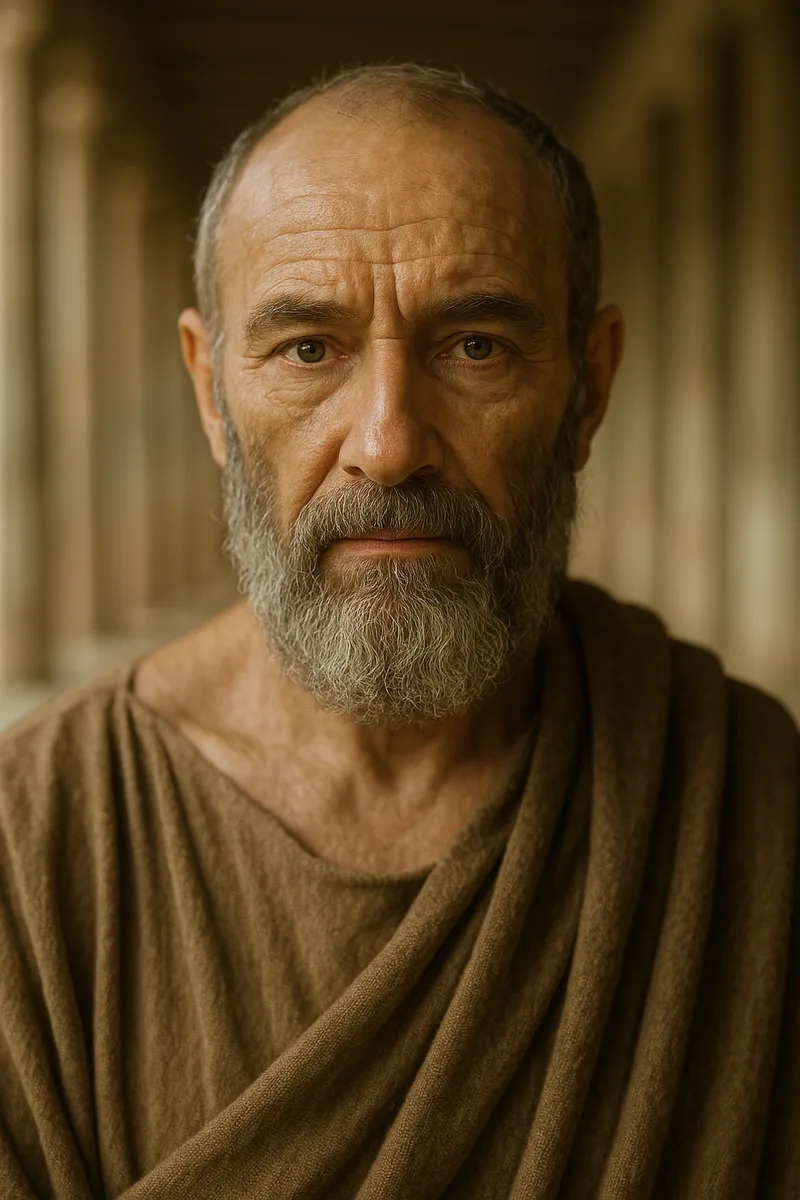
Zeno of Citium: The Founder of Stoicism
Zeno of Citium was the Phoenician-Greek philosopher who founded Stoicism - the most influential philosophical school of the ancient world and one of the most enduring systems of practical ethics ever devised. Born around 334 BC in Citium, a Greek city on the island of Cyprus, Zeno came to Athens as a merchant, lost his fortune in a shipwreck, and turned to philosophy with the intensity of a man who had learned that external goods could vanish in an instant. He studied under the Cynics, the Academics, and the Megarians before developing his own system, which he taught from the Stoa Poikile - the "Painted Porch" - in the Athenian agora, giving his school its name. Zeno's teachings - that virtue is the only true good, that we should live in accordance with nature and reason, and that we must distinguish between what we can and cannot control - passed through Seneca, Epictetus, and Marcus Aurelius to shape Western ethics, Christianity, and the modern self-help movement.
Context & Background
Zeno was born around 334 BC in Citium (modern Larnaca), a coastal city on the southeastern shore of Cyprus with both Greek and Phoenician populations. His father, Mnaseas, was a merchant, and Zeno grew up in the commercial world of the eastern Mediterranean. Cyprus was a cultural crossroads - Greek, Phoenician, and Egyptian influences mingled - and Zeno's cosmopolitan background would later shape his philosophy's universalist vision.
The Hellenistic world Zeno entered was in upheaval. Alexander the Great had conquered the Persian Empire and spread Greek culture from Egypt to India, but his death in 323 BC shattered the brief unity of his empire into warring successor states. The old certainties of the Greek city-state were dissolving. Athens, once the dominant power in Greece, was now a subject city, its political independence gone, its citizens struggling to find meaning in a world where individual action seemed powerless against the forces of empire and fortune.
This crisis of meaning created an enormous demand for practical philosophy - for systems of thought that could help ordinary people live well in uncertain times. The major philosophical schools of the Hellenistic period - Stoicism, Epicureanism, and Skepticism - all emerged in response to this demand. Where Epicurus counseled withdrawal into the pleasures of friendship and contemplation, and the Skeptics counseled suspension of judgment, Zeno offered a philosophy of active engagement with the world, grounded in reason, virtue, and acceptance of what cannot be changed.
According to tradition, Zeno came to Athens around 312 BC after a shipwreck destroyed the cargo of purple dye he was transporting from Phoenicia. Stranded and ruined, he wandered into a bookshop and began reading Xenophon's account of Socrates. Inspired, he asked the bookseller where he could find such men. At that moment, the Cynic philosopher Crates of Thebes happened to walk by, and the bookseller pointed: "Follow that man." Zeno did, and his philosophical education began.
He studied with Crates for several years, absorbing the Cynic emphasis on virtue, self-sufficiency, and indifference to convention. He then studied with Stilpo of the Megarian school and Polemon of the Academy, broadening his philosophical training. Around 300 BC, Zeno began teaching his own philosophy at the Stoa Poikile, the Painted Porch on the north side of the Athenian agora. The location gave his school its name: the Stoics.
Zeno's system was comprehensive, covering logic, physics, and ethics. In logic, he developed propositional logic, which was in some respects more advanced than Aristotle's syllogistic logic. In physics, he taught that the universe was a living, rational organism governed by a divine reason (logos) that permeated all things. In ethics - the part of his philosophy that has endured most powerfully - he argued that virtue was the only genuine good, that vice was the only genuine evil, and that everything else - health, wealth, reputation, even life itself - was "indifferent," neither good nor bad in itself.
The core Stoic principle - "live according to nature" - meant, for Zeno, living according to reason, which was both the essence of human nature and the governing principle of the cosmos. A virtuous person was one who aligned their will with the rational order of the universe, accepting what happened while acting rightly within their sphere of control.
This teaching had profound practical implications. If virtue is the only good, then no external circumstance - poverty, illness, exile, even death - can make a person truly unhappy. Conversely, no amount of wealth, fame, or pleasure can make a vicious person truly happy. The Stoic sage, in Zeno's ideal, was a person of perfect rationality, complete emotional equilibrium, and absolute moral integrity - an ideal that Zeno freely admitted no actual human being had ever achieved, but that served as a guiding star for philosophical practice.
Zeno's Stoicism was also radically cosmopolitan. In his early work The Republic - written in deliberate contrast to Plato's work of the same name - Zeno envisioned a world without national boundaries, where all human beings were fellow citizens of a single cosmic city, governed by reason rather than convention. This vision of universal human equality and world citizenship was revolutionary in the context of ancient Greek thought, which typically drew sharp distinctions between Greeks and "barbarians."
None of Zeno's writings survive intact. His ideas are known through fragments, quotations, and summaries by later authors, particularly Diogenes Laertius, whose Lives of the Eminent Philosophers provides the most detailed ancient account of Zeno's life and thought. This means that reconstructing Zeno's philosophy requires piecing together evidence from sources that are sometimes contradictory or unreliable.
Zeno was reportedly thin, tall, and dark-complexioned, with a twisted neck. He lived frugally - eating raw food, drinking water, and wearing thin clothes - in keeping with his Cynic training. He was respected by the Athenians despite being a foreigner (a "metic" without citizenship), and the city honored him with a golden crown, a bronze statue, and the keys to the city walls.
He died around 262 BC at approximately seventy-two years of age. According to one account, he tripped and broke his toe while leaving his school, and took it as a sign that it was time to die. He held his breath until he expired - a characteristically Stoic exit, choosing reason over reflex. His school outlived him by five centuries, becoming the dominant philosophy of the Roman elite and shaping the thought of Seneca, Epictetus, and Marcus Aurelius - and, through them, the modern world.