Aristotle
Quotes & Wisdom
Aristotle: The Philosopher Who Mapped All Knowledge
Aristotle was the most influential thinker in the history of Western civilization. A student of Plato, tutor to Alexander the Great, and founder of the Lyceum in Athens, he created or systematized nearly every field of intellectual inquiry - logic, biology, physics, ethics, politics, rhetoric, aesthetics, and metaphysics. His method of careful observation, classification, and reasoned argument became the foundation of scientific thinking. For nearly two thousand years, his works were treated as the final authority on everything from the motion of planets to the structure of drama. Even after the scientific revolution overturned much of his physics, his contributions to logic, ethics, and political thought remain alive in every university classroom.
Context & Background
Aristotle was born in 384 BC in Stagira, a small Greek colony on the northern coast of the Aegean Sea, near the border of the Kingdom of Macedon. His father, Nicomachus, was personal physician to King Amyntas III of Macedon, grandfather of Alexander the Great. This connection to the Macedonian court would prove decisive in Aristotle's life. Growing up in a physician's household also gave him an early familiarity with biological observation and empirical inquiry that distinguished his philosophy from Plato's more abstract idealism.
At seventeen, Aristotle traveled to Athens to study at Plato's Academy, where he remained for twenty years - first as student, then as teacher and researcher. The Academy was the intellectual center of the Greek world, devoted to mathematics, dialectic, and the pursuit of abstract truths. Aristotle absorbed Plato's thought deeply but increasingly diverged from his teacher's emphasis on a separate realm of ideal Forms. Where Plato looked upward to transcendent abstractions, Aristotle looked around at the concrete, particular, observable world.
After Plato's death in 347 BC, Aristotle left Athens - possibly because the Academy's leadership passed to Plato's nephew rather than to him, or possibly because anti-Macedonian sentiment in Athens made his position uncomfortable. He spent several years in Asia Minor and Lesbos, conducting biological research that resulted in his remarkable zoological works. In 343 BC, King Philip II of Macedon invited him to tutor the thirteen-year-old Alexander. The details of their relationship are scarce, but Aristotle reportedly instilled in Alexander a love of Homer and a respect for Greek culture. He returned to Athens in 335 BC and founded his own school, the Lyceum.
Aristotle's Nicomachean Ethics - named for his son Nicomachus - is arguably the most influential work of moral philosophy ever written. Its central question is deceptively simple: what is the good life for a human being? Aristotle's answer is eudaimonia - usually translated as "happiness" but better understood as "flourishing" or "living well." Eudaimonia is not a feeling but an activity - the activity of living in accordance with virtue over a complete life.
Virtue, for Aristotle, is a character trait developed through practice and habit. Courage is not an innate gift but a disposition built through repeatedly choosing the courageous action in situations that call for it. Each virtue is a mean between two extremes: courage lies between cowardice and recklessness; generosity lies between stinginess and profligacy. This doctrine of the mean requires practical wisdom (phronesis) - the ability to perceive what the right action is in each particular situation. Ethics, for Aristotle, is not about following rules but about becoming the kind of person who naturally acts well.
Aristotle invented formal logic. His system of syllogisms - structured arguments in which a conclusion follows necessarily from two premises - remained the standard logic for over two thousand years, until Frege and Russell developed modern mathematical logic in the nineteenth and twentieth centuries. Beyond logic, Aristotle's scientific works are staggering in their scope. His biological writings describe over 500 animal species with an accuracy that impressed Charles Darwin, who called him the greatest observer in the history of natural history. His Physics and Metaphysics established frameworks for understanding causation, substance, and change that dominated Western and Islamic thought for centuries.
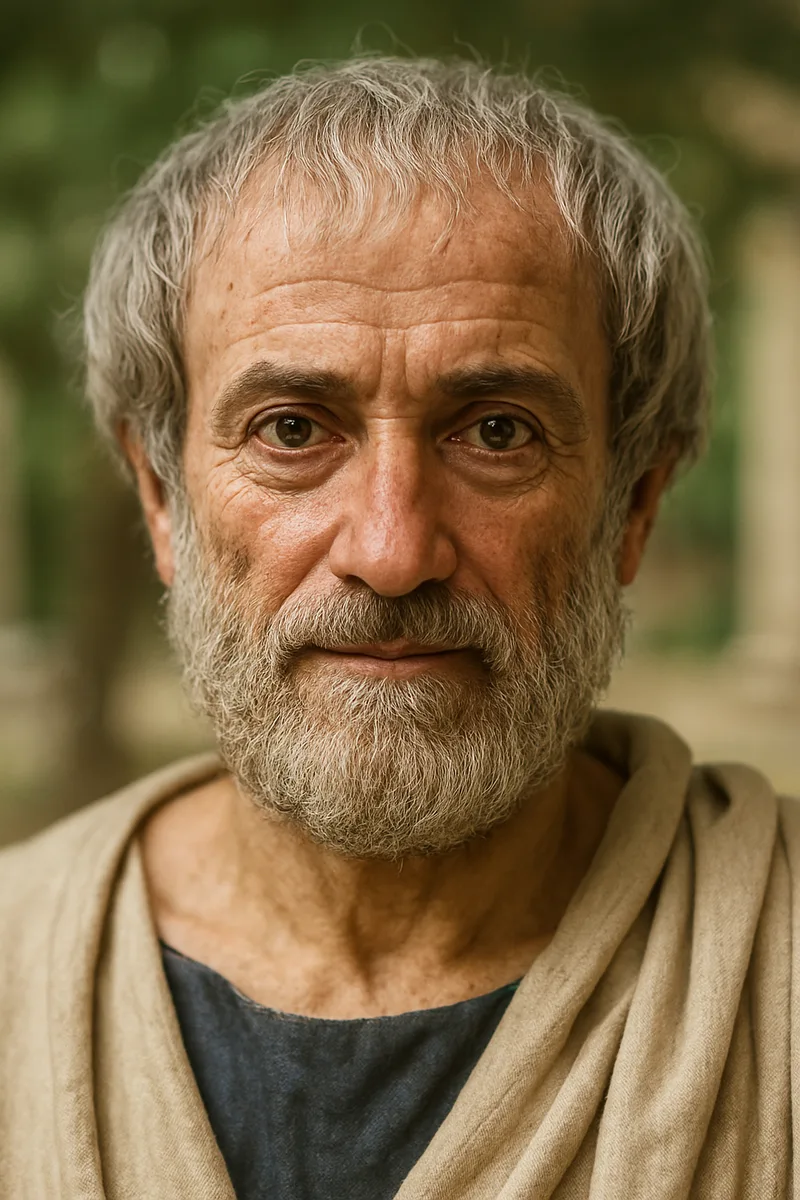
Aristotle was reportedly thin-legged, small-eyed, and a sharp dresser who wore rings and cut his hair fashionably - details that ancient gossips found amusing for a philosopher. He was known as "the reader" among Plato's students, reflecting his voracious appetite for texts at a time when most philosophy was conducted orally. His surviving works are mostly lecture notes rather than polished publications, which is why they can be dense and difficult - his published dialogues, praised in antiquity for their literary grace, are almost entirely lost. He collected the constitutions of 158 Greek city-states, of which only the Constitution of Athens survives. He fled Athens in 323 BC after Alexander's death, when anti-Macedonian sentiment surged, reportedly saying he would not allow Athens "to sin twice against philosophy" - a reference to Socrates' execution. He died the following year in Chalcis, on the island of Euboea.