
Socrates
Quotes & Wisdom
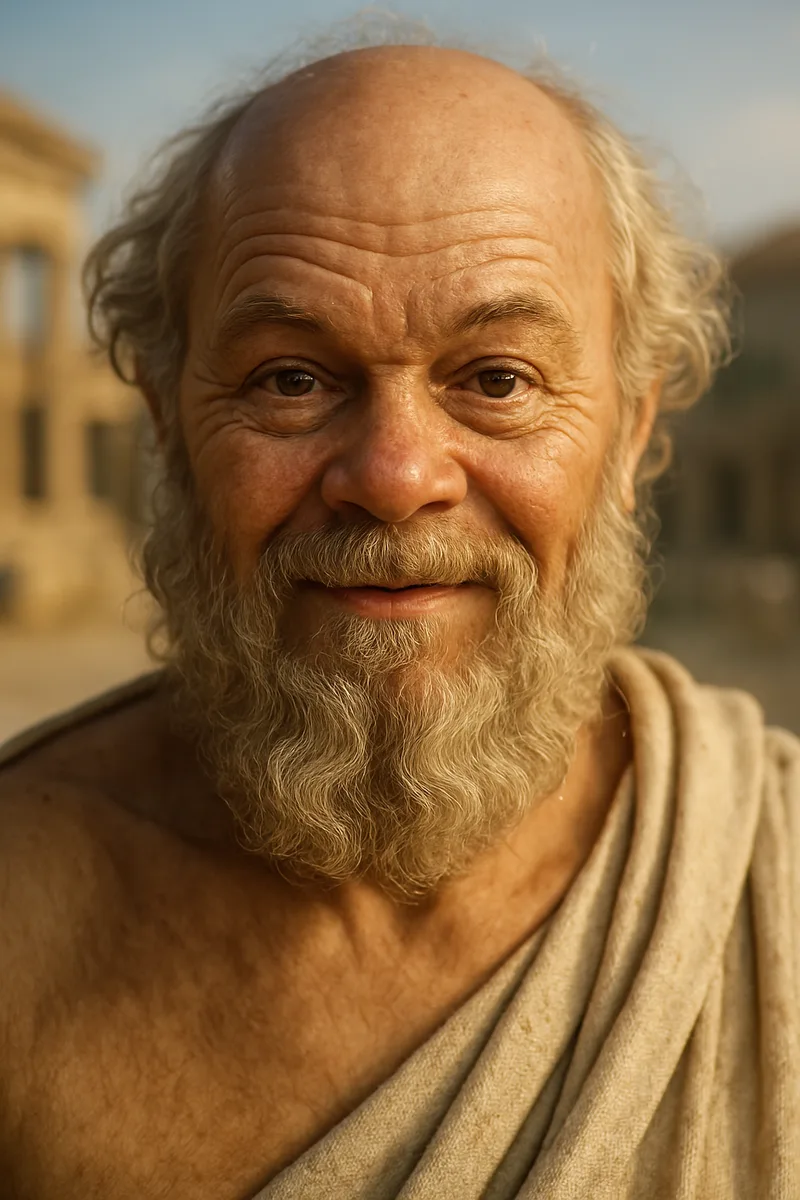
Socrates: The Philosopher Who Knew He Knew Nothing
Socrates is the founding figure of Western philosophy - a man who wrote nothing, founded no school, and left no system, yet transformed the way human beings think about morality, knowledge, and the meaning of a good life. Born in Athens around 470 BC, he spent his days in the marketplaces and gymnasia of the city, engaging anyone who would listen in relentless philosophical conversation. His method - the Socratic method - consisted of asking probing questions that exposed the contradictions in his interlocutors' beliefs, leading them toward the unsettling realization that they knew far less than they assumed. Condemned to death by an Athenian jury in 399 BC for impiety and corrupting the youth, Socrates drank the hemlock with a composure that has haunted the Western imagination ever since. His life and thought survive principally through the writings of his students Plato and Xenophon.
Context & Background
Socrates was born around 470 BC in Athens, the son of Sophroniscus, a stonemason, and Phaenarete, a midwife. He liked to compare his own philosophical method to his mother's profession: as she helped women give birth to children, he helped minds give birth to ideas. This was not false modesty; it reflected his genuine conviction that wisdom could not be transmitted from teacher to student like a commodity but had to be drawn out through questioning.
The Athens of Socrates' prime was the most remarkable city in the ancient world. Under the leadership of Pericles, it had become the center of Greek democracy, art, architecture, drama, and intellectual life. The Parthenon was built during Socrates' youth. Aeschylus, Sophocles, and Euripides were producing their tragedies. Herodotus and Thucydides were inventing the discipline of history. It was an environment of extraordinary intellectual vitality, but also of political instability and imperial ambition.
Socrates served as a hoplite in the Peloponnesian War, fighting at Potidaea, Delium, and Amphipolis, and earning a reputation for exceptional physical endurance and courage. He was also active in Athenian civic life, serving on the Boule (council) and, on at least one occasion, risking his life by refusing to participate in an illegal act ordered by the Thirty Tyrants - the oligarchic regime that briefly governed Athens after its defeat by Sparta in 404 BC.
But Socrates' real battlefield was the agora. He spent his days in conversation, interrogating politicians, poets, craftsmen, and sophists about the nature of justice, virtue, piety, and knowledge. He was a familiar and often irritating presence in Athenian public life - Aristophanes lampooned him in the comedy The Clouds as a cloud-dwelling eccentric who taught young men to make weak arguments strong.
Socrates' philosophical method was deceptively simple: he asked questions. He would approach someone who claimed to have knowledge - about courage, or justice, or beauty - and through a series of carefully directed questions, reveal that the person's beliefs were contradictory, confused, or groundless. This process, known as the elenchus (refutation), typically ended with the interlocutor in a state of aporia - bewilderment, the recognition of one's own ignorance.
This was not cruelty or intellectual gamesmanship, though it often felt that way to those on the receiving end. Socrates believed that the first step toward wisdom was the recognition of ignorance. "I know that I know nothing," he declared - or rather, he knew that his wisdom consisted precisely in recognizing the limits of his knowledge, while others mistakenly believed they understood things they did not.
The Socratic method has had an incalculable influence on Western education, law, and intellectual life. It is the foundation of the case method in law schools, the tutorial system in universities, and the general principle that learning proceeds through questioning rather than lecturing. It is also the foundation of the scientific method, insofar as science begins with the recognition that established beliefs may be wrong and must be tested.
In 399 BC, Socrates was brought to trial before an Athenian jury of 501 citizens on charges of impiety (failing to recognize the gods of the city) and corrupting the youth. The political context was crucial: Athens had recently been through a devastating war, a brutal oligarchy, and a fragile democratic restoration. Socrates' associations with several members of the oligarchic regime, and his habit of publicly questioning democratic values, made him a target.
Plato's Apology - his account of Socrates' defense speech - is one of the great documents of Western literature. Socrates refused to beg for mercy, refused to propose a reasonable alternative penalty, and essentially told the jury that far from deserving punishment, he deserved to be maintained at public expense as a benefactor of the city. The jury convicted him by a relatively narrow margin and sentenced him to death by drinking hemlock.
Socrates spent his final days in prison, conversing with friends about the immortality of the soul. Plato's Phaedo describes the death scene: Socrates drank the poison calmly, walked around until his legs grew heavy, lay down, and died. His last words, as reported by Plato, were: "Crito, we owe a cock to Asclepius. Pay it and do not neglect it." The meaning of this enigmatic statement has been debated for two and a half millennia.
Socrates was, by all accounts, physically ugly - snub-nosed, thick-lipped, bug-eyed, and pot-bellied. He embraced his appearance with cheerful self-deprecation and turned it into a philosophical point: if the pursuit of beauty was the path to truth, as some argued, then Socrates' success as a philosopher proved that inner beauty mattered more than outer form.
He was married to Xanthippe, who had a reputation for being difficult (her name has become a byword for a shrewish wife). Socrates reportedly bore her temper with good humor, saying that living with Xanthippe was good training for dealing with the rest of humanity.
Socrates claimed to be guided by a "daimonion" - a divine inner voice that warned him when he was about to make a mistake. This was not a voice that told him what to do, but one that told him what not to do - a spiritual veto power that he took with absolute seriousness.
He never accepted payment for his teaching, never held political office (beyond the required civic duties), and lived in poverty. His influence on Western thought is perhaps the most remarkable case in history of a man who changed the world without writing a single word.