
Steve Jobs
Quotes & Wisdom
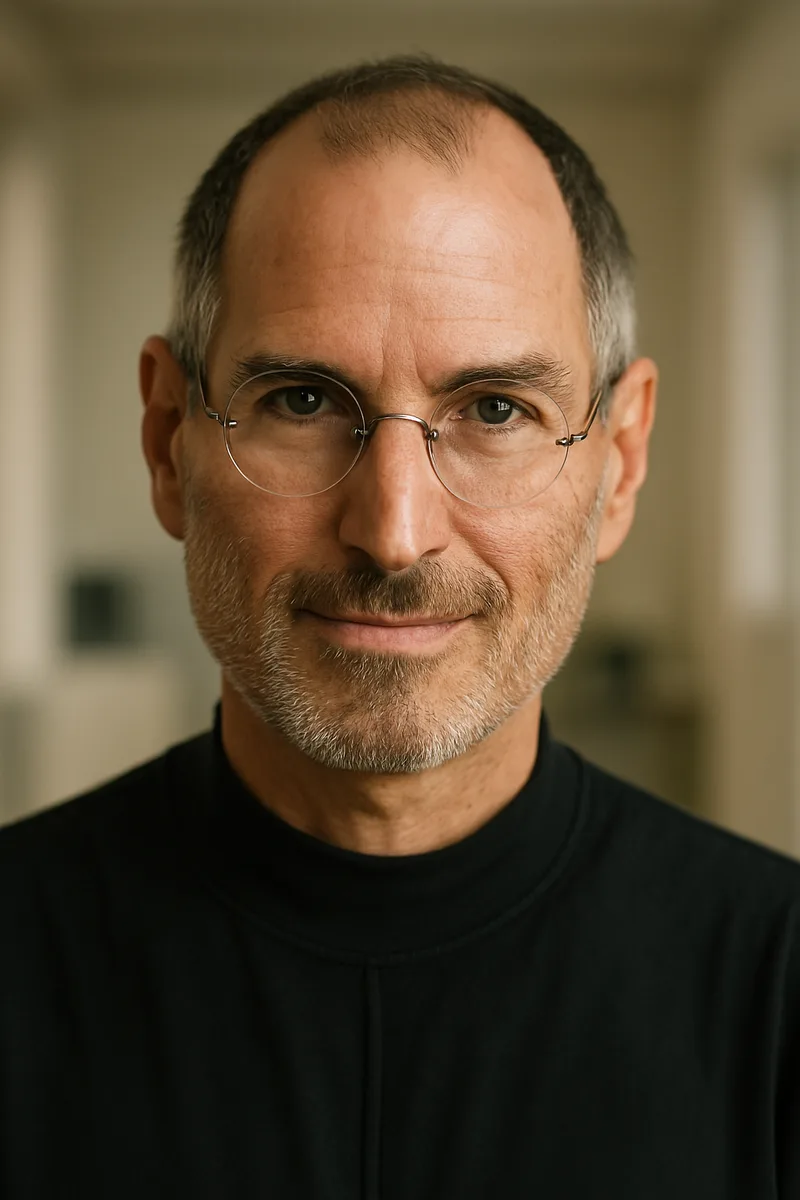
Steve Jobs: The Man Who Thought Different
Steve Jobs was the co-founder of Apple and one of the most transformative figures in the history of technology - a visionary who believed that great products lay at the intersection of technology and the liberal arts. Born in San Francisco in 1955 and adopted by a working-class couple in Mountain View, California, Jobs co-founded Apple in a garage at twenty-one, was ousted from his own company at thirty, and returned twelve years later to rescue it from near-bankruptcy and build it into the most valuable company in the world. Under his leadership, Apple created the Macintosh, the iPod, the iPhone, and the iPad - products that did not merely enter existing markets but created entirely new ones. Jobs was mercurial, demanding, and sometimes cruel, but his obsessive focus on design, simplicity, and the user experience changed how billions of people interact with technology.
Context & Background
Steven Paul Jobs was born on February 24, 1955, in San Francisco, California, to Abdulfattah Jandali, a Syrian graduate student, and Joanne Schieble, an American graduate student. He was adopted shortly after birth by Paul and Clara Jobs, a working-class couple in Mountain View, in what would soon be known as Silicon Valley. Paul Jobs was a machinist and car mechanic who instilled in his son a love of craftsmanship and an attention to detail - he insisted on finishing the back of a cabinet as carefully as the front, even though no one would see it. This principle became central to Jobs' design philosophy.
The Silicon Valley of the 1960s and 1970s was a unique environment - a place where the counterculture and the technology industry were deeply intertwined. Jobs absorbed both influences: he dropped out of Reed College after one semester, traveled to India in search of spiritual enlightenment, practiced Zen Buddhism, experimented with LSD (which he described as "one of the two or three most important things" he had done in his life), and simultaneously became fascinated with electronics through his friendship with Steve Wozniak, a brilliant engineer five years his senior.
In 1976, Jobs and Wozniak co-founded Apple Computer in the Jobs family garage. The Apple II, released in 1977, became one of the first commercially successful personal computers. The Macintosh, launched in 1984 with a famous Super Bowl advertisement, introduced the graphical user interface and the mouse to a mass audience. But internal conflicts at Apple led to Jobs' ouster in 1985 - a devastating blow that he later described as the best thing that ever happened to him.
Jobs' twelve years away from Apple (1985-1997) were extraordinarily productive. He founded NeXT, a computer company whose technology would eventually become the foundation of Apple's operating system. More consequentially, he acquired a small computer graphics division from Lucasfilm and turned it into Pixar Animation Studios. Under Jobs' leadership, Pixar produced Toy Story (1995), the first fully computer-animated feature film, and went on to become the most consistently successful film studio of its era.
When Jobs returned to Apple in 1997, the company was ninety days from bankruptcy. He streamlined the product line, forged a partnership with Microsoft, and began the design-driven revolution that would transform Apple from a struggling computer company into the world's most valuable corporation. The iMac (1998) reintroduced Apple as a design leader. The iPod (2001) and iTunes Store (2003) reinvented the music industry. The iPhone (2007) reinvented the phone. The iPad (2010) created the tablet market. Each product reflected Jobs' core conviction that technology should be beautiful, intuitive, and invisible - that the best interface was the one you did not notice.
Jobs was not an engineer; he was, in his own description, a "product person." His genius lay not in writing code or designing circuits but in understanding what people wanted before they knew they wanted it, and in creating products that were so elegantly designed and effortlessly functional that they felt inevitable.
His design philosophy was rooted in simplicity. "Simple can be harder than complex," he said. "You have to work hard to get your thinking clean to make it simple." He was influenced by the Bauhaus tradition, by the industrial designer Dieter Rams, and by the Zen Buddhist principle that less is more. He drove his teams relentlessly toward the elimination of unnecessary features, buttons, ports, and complexity.
Jobs was also the greatest product presenter of his generation. His keynote addresses - delivered in his trademark black turtleneck, jeans, and sneakers - were theatrical events that set the standard for technology marketing. His ability to build narrative tension, to reveal products with perfect timing, and to articulate the human significance of a technical achievement was unmatched.
Jobs was a pescatarian for much of his life and had an intense, sometimes eccentric relationship with food. He reportedly ate only one or two foods for weeks at a time - carrots, apples, or specific grains - and believed that his diet eliminated body odor, a claim his colleagues disputed.
He was a devoted practitioner of Zen Buddhism, studying under the teacher Kobun Chino Otogawa. His meditation practice and his aesthetic of simplicity were directly connected - both aimed at stripping away the unnecessary to reveal the essential.
Jobs was diagnosed with a rare form of pancreatic cancer in 2003. He initially resisted surgery in favor of alternative treatments - a decision he later regretted - but eventually underwent a Whipple procedure and later a liver transplant. He died on October 5, 2011, at the age of fifty-six. His last words, according to his sister Mona Simpson, were: "Oh wow. Oh wow. Oh wow."