
Warren Buffett
Quotes & Wisdom
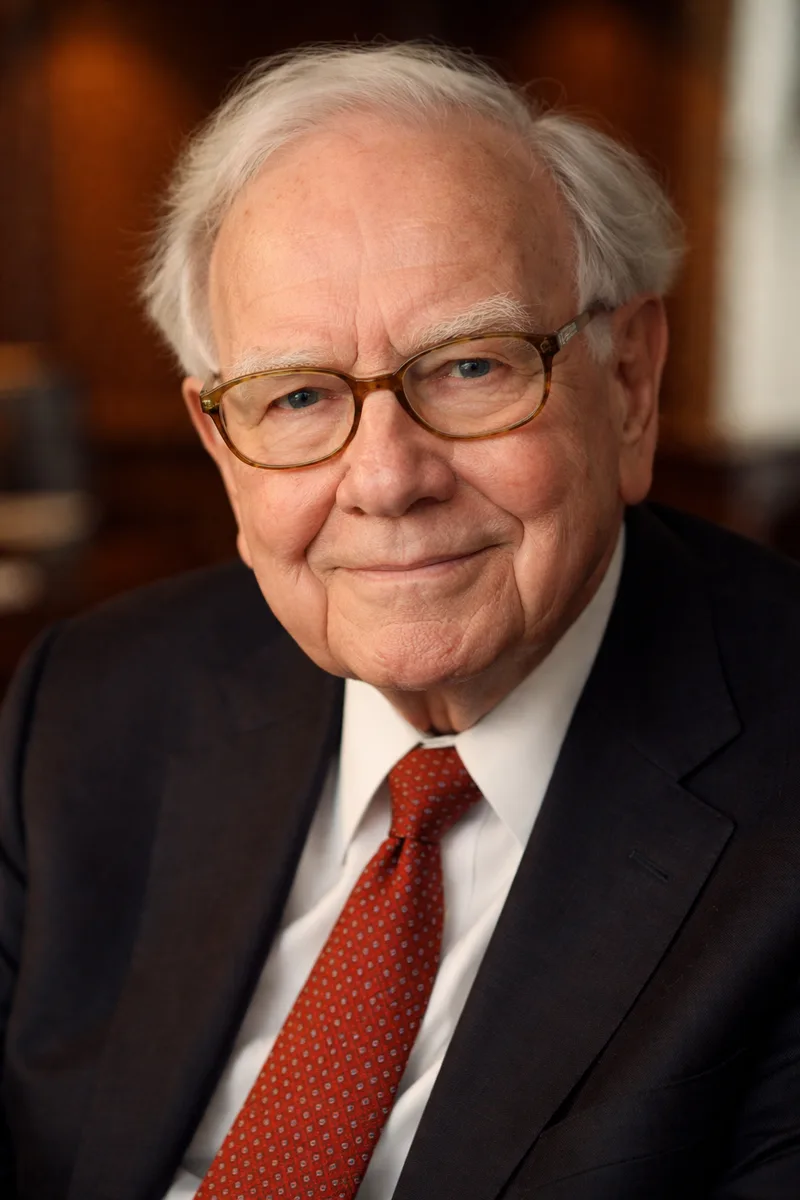
Warren Buffett: The Oracle of Omaha
Warren Buffett turned a $100 investment into one of the largest fortunes in human history - not through speculation or leverage, but through patience, discipline, and an uncanny ability to see value where others saw nothing special. Born in Omaha, Nebraska in 1930, he bought his first stock at age eleven and filed his first tax return at thirteen. As chairman of Berkshire Hathaway, he built a conglomerate spanning insurance, railroads, energy, and consumer brands that became a monument to rational capital allocation. His annual shareholder letters, written with folksy wit and rigorous clarity, became the most widely read texts in the investing world. Buffett also reshaped philanthropy, pledging the vast majority of his wealth to charitable causes and inspiring other billionaires to do the same through the Giving Pledge.
Context & Background
Warren Edward Buffett was born on August 30, 1930, in Omaha, Nebraska, the second of three children and the only son of Howard Buffett, a stockbroker and four-term United States congressman. His arrival coincided with the early tremors of the Great Depression - an economic catastrophe that would define the caution and frugality of an entire generation. Growing up, young Warren watched his father navigate the volatile markets of the 1930s, absorbing lessons about financial risk that would stay with him for life. His father's brokerage office became a second classroom; Warren would sit on the floor reading stock tickers and financial books while other children played outside.
Omaha in the 1930s and 1940s was a midwestern railroad hub, practical and unpretentious. The Buffett household valued hard work and self-reliance. Warren showed entrepreneurial instincts early, selling chewing gum door-to-door at age six, delivering newspapers across multiple routes as a teenager, and filing his first tax return at thirteen, deducting his bicycle as a business expense. He ran a pinball machine business with a high school friend, studied horse racing odds with mathematical precision, and read every book on investing in the Omaha public library by the time he was twelve. By the time he graduated high school, he had already accumulated savings equivalent to a modest house.
The intellectual world that shaped Buffett most profoundly was not Omaha but Columbia Business School, where he studied under Benjamin Graham in 1950-51. Graham, the father of value investing, taught that stocks are not lottery tickets but fractional ownership of businesses, and that the intelligent investor buys when the market price falls below intrinsic value. This idea - that a stock's worth is determined by the underlying business, not by the crowd's mood - became the bedrock of Buffett's philosophy. Graham's 1949 book The Intelligent Investor was, in Buffett's words, "by far the best book on investing ever written." Buffett was the only student Graham ever gave an A+ to at Columbia. The post-war American economy provided the perfect stage: a growing middle class, expanding consumer markets, and a stock market recovering from decades of skepticism after the 1929 crash.
Buffett began his professional career by founding the Buffett Partnership in 1956, pooling money from family and friends and applying Graham's strict quantitative methods - buying stocks trading below their net asset value, the so-called "cigar butt" approach of finding one last puff of value in discarded companies. The results were extraordinary: over thirteen years, the partnership never had a losing year and compounded at roughly 30 percent annually. By the time he dissolved the partnership in 1969, Buffett had turned initial investments of around ,000 into million.
But Buffett's genius lay in his willingness to evolve. Through his partnership with Charlie Munger, who became vice chairman of Berkshire Hathaway and Buffett's closest intellectual companion for over six decades, he moved beyond Graham's narrow quantitative screens. Munger, a sharp-witted lawyer turned investor with voracious reading habits spanning psychology, biology, physics, and history, introduced Buffett to a multidisciplinary way of thinking. Munger convinced him that it was "far better to buy a wonderful company at a fair price than a fair company at a wonderful price." This shift - from statistical bargains to quality businesses with durable competitive advantages, or "moats" - transformed Buffett from a successful investor into a legendary one.
The acquisition of See's Candies in 1972 crystallized this evolution. See's was not cheap by Graham's standards, but it possessed something Graham's formulas could not measure: a brand so strong that customers would pay more year after year without resistance. The cash flow from See's funded decades of further acquisitions and taught Buffett the power of pricing power, brand loyalty, and what he calls "economic goodwill" - intangible assets that compound in value over time. Without the See's experience, Buffett has acknowledged, the later investments in Coca-Cola, Gillette, and American Express might never have happened.
In 1965, Buffett took control of Berkshire Hathaway, then a struggling New England textile mill. He later called it one of his biggest mistakes - buying the company out of stubbornness rather than sound economics. The textile operations bled money for two decades before he finally closed them in 1985. But he transformed the corporate shell into something unprecedented: a holding company that allocated capital across dozens of industries with no corporate bureaucracy, no quarterly earnings guidance, and no stock splits.
Berkshire's structure reflected Buffett's deepest convictions. He used the cash flow from insurance operations - particularly Geico and General Re - as permanent, low-cost capital to acquire businesses and stocks. The concept of insurance "float" - premiums collected before claims are paid - gave Berkshire billions of dollars in cost-free capital that Buffett could invest for years or decades. He gave subsidiary managers almost complete autonomy, asking only that they send excess cash to Omaha. He never paid a dividend, arguing that he could compound capital more effectively than most shareholders could on their own. The results spoke for themselves: a share of Berkshire that cost in 1965 was worth over ,000 by the 2020s, a compounding record unmatched in the history of public markets.
His annual letters to shareholders, written without a ghostwriter, became legendary documents - part financial report, part investing seminar, part moral philosophy. In them, Buffett explained complex concepts like float, intrinsic value, and margin of safety with the clarity of a great teacher. He admitted mistakes openly, praised managers generously, and laced every letter with self-deprecating humor. Bill Gates, who became one of Buffett's closest friends and a fellow bridge enthusiast, called them "the best thing he reads all year." The letters attracted a cult following: each year, over 40,000 shareholders travel to Omaha for the annual meeting, a weekend Buffett calls "Woodstock for Capitalists."
In 2006, Buffett announced that he would give away approximately 99 percent of his wealth, primarily to the Bill and Melinda Gates Foundation. It was the largest charitable pledge in history and shattered the assumption that great capitalists hoard their gains. Together with Gates, he launched the Giving Pledge in 2010, a public commitment by billionaires to donate the majority of their wealth to philanthropic causes during their lifetimes or in their wills. By the mid-2020s, over 200 billionaires from more than 25 countries had signed the pledge.
Buffett's approach to philanthropy reflected the same rationalism he brought to investing. He reasoned that Gates and his foundation were better equipped to deploy charitable capital effectively than he was, just as he was better equipped to compound investment capital than most foundation managers. Rather than building his own monument, he outsourced distribution to those he trusted most. This decision revealed something fundamental about Buffett's character: a rare combination of supreme confidence in his own domain and genuine humility about its boundaries.
His views on wealth inequality, taxation, and the obligations of the fortunate have made him an unusual voice among the ultra-wealthy. He has publicly stated that his effective tax rate is lower than his secretary's, and he has advocated for higher taxes on the rich. He once proposed the "Buffett Rule" - the principle that no household making over one million dollars per year should pay a lower effective tax rate than middle-class families. These positions, coming from one of the world's wealthiest individuals, carry a moral weight that purely political arguments cannot match.
Despite controlling one of the most valuable companies on earth, Buffett still lives in the same Omaha house he bought in 1958 for ,500. He drinks five cans of Coca-Cola a day, eats at the same local restaurants, and drives himself to work each morning. His office contains no computer - he reads annual reports, newspapers, and books for five to six hours daily, calling this sustained reading habit the foundation of his success. He once told an audience of Columbia students that the best investment they could make was not in stocks but in themselves, holding up an encyclopedia and urging them to read 500 pages a day.
Buffett is an avid bridge player, often partnering with Gates in online games, and has said he would play bridge twelve hours a day if he could find the partners. He plays ukulele at shareholder meetings and once appeared in a television commercial strumming alongside a rock band. His sense of humor is dry, self-aware, and ever-present - he has described his diet as that of a six-year-old and his investment approach as "lethargy bordering on sloth." At shareholder meetings, he and Munger would sit on stage for hours answering unscreened questions, a practice virtually no other Fortune 500 CEO would contemplate.
His relationship with Adam Smith's ideas runs deep, though Buffett applies them with characteristic pragmatism rather than ideological purity. He believes in competitive markets but warns constantly about the dangers of unchecked financial speculation and the tendency of Wall Street to generate fees rather than value for clients. He reveres compounding not just as a financial principle but as a life philosophy - in knowledge, relationships, and reputation. As he often reminds audiences, it takes twenty years to build a reputation and five minutes to ruin it.