Charlie Munger
Quotes & Wisdom
Charlie Munger: The Sage of Multidisciplinary Thinking
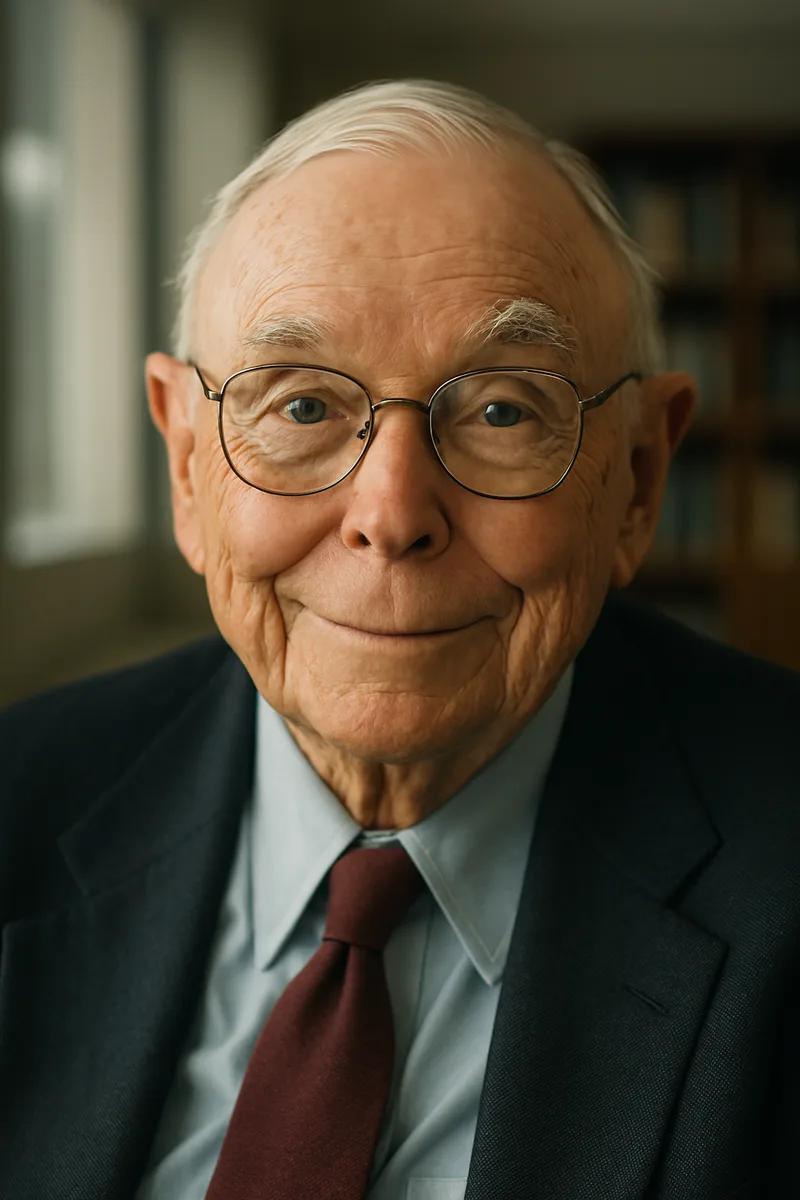
Charlie Munger was Warren Buffett's partner, vice chairman of Berkshire Hathaway, and one of the sharpest minds in American business. Born in Omaha in 1924, he practiced law before transitioning to investment management, where his emphasis on buying wonderful companies at fair prices - rather than mediocre companies at bargain prices - fundamentally changed Buffett's approach. But Munger's influence extends far beyond investing. His concept of a "latticework of mental models" drawn from multiple disciplines - psychology, physics, biology, economics, history - became a framework for clear thinking adopted by executives, investors, and educators worldwide. Blunt, witty, and intellectually voracious, Munger embodied the principle that wisdom comes from reading broadly and thinking independently.
Context & Background
Charles Thomas Munger was born on January 1, 1924, in Omaha, Nebraska - the same city where Warren Buffett grew up, though the two did not meet until decades later. His father was a lawyer, and his grandfather had been a federal judge. The Munger family was intellectually serious and financially comfortable, though the Great Depression shaped Charlie's childhood understanding of economic risk and human folly.
Munger attended the University of Michigan, studying mathematics, before enlisting in the Army Air Corps during World War II. He trained as a meteorologist and served in the military without seeing combat. After the war, he was admitted to Harvard Law School without a bachelor's degree - an unusual accomplishment reflecting both his intellect and the postwar flexibility of admissions standards. He graduated in 1948 and practiced law in Los Angeles for several years before concluding that real estate development and investment offered better returns on his time.
His early adult life was marked by personal tragedy. His first marriage ended in divorce, and his young son Teddy died of leukemia at age nine - an experience that, by his own account, was the worst of his life. He remarried, built a large family, and channeled his grief into relentless intellectual activity and an austere personal philosophy that emphasized endurance, rationality, and the acceptance of life's unfairness.
Munger's most original intellectual contribution is his framework of mental models - the idea that effective thinking requires tools drawn from many disciplines, not just one's professional specialty. He argued that someone who only knows accounting will try to solve every problem with accounting, just as "to the man with only a hammer, every problem looks like a nail."
His recommended models include concepts from psychology (incentive-caused bias, social proof, availability heuristic), mathematics (compound interest, probability, permutations), physics (critical mass, equilibrium), biology (evolution, niche specialization), and economics (comparative advantage, opportunity cost). By building a "latticework" of these models, a thinker can approach problems from multiple angles and avoid the cognitive blind spots that plague specialists.
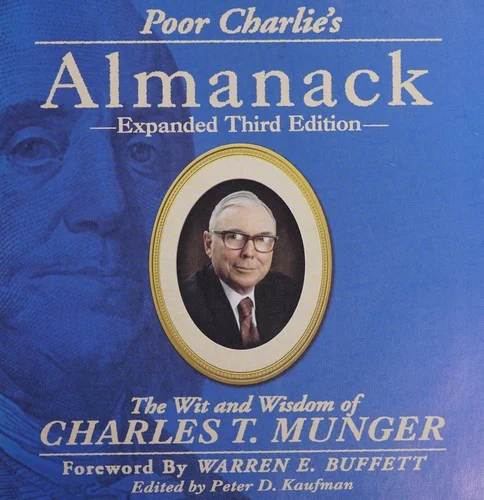
His 1995 speech "The Psychology of Human Misjudgment," later expanded into a chapter in Poor Charlie's Almanack, catalogs twenty-five standard causes of human misjudgment - from incentive-caused bias to the influence of authority to cognitive dissonance. It remains one of the most practical guides to behavioral psychology ever produced.
Munger met Warren Buffett in 1959 at a dinner in Omaha, and the two became intellectual partners almost immediately. While Buffett had been trained by Benjamin Graham to buy statistically cheap stocks - "cigar butts" with one puff left in them - Munger pushed him toward a different approach: buying excellent businesses with durable competitive advantages at reasonable prices, even if they were not statistically cheap. This shift transformed Berkshire Hathaway from a textile company into one of the world's most valuable conglomerates.
As Buffett has said: "Charlie shoved me in the direction of not just buying bargains... He gave me the blueprint for building Berkshire Hathaway."
Munger was an architect by avocation who designed buildings, including dormitories for universities. He was a legendary reader who claimed to read 500 pages a day and was rarely seen without a book. He lost an eye to a surgical complication in the 1970s and bore the disability with characteristic stoicism. He was famous for his blunt, sometimes cutting remarks at Berkshire Hathaway annual meetings - when asked about cryptocurrency, he called it "rat poison." He served on the board of Costco for decades and considered its business model a masterpiece of retailing. He was a generous philanthropist, particularly to educational institutions. He died on November 28, 2023, at age ninety-nine, just weeks short of his hundredth birthday, leaving behind a legacy of intellectual frameworks that continue to shape how people think about investing, decision-making, and the pursuit of wisdom.