
Rosa Parks
Quotes & Wisdom
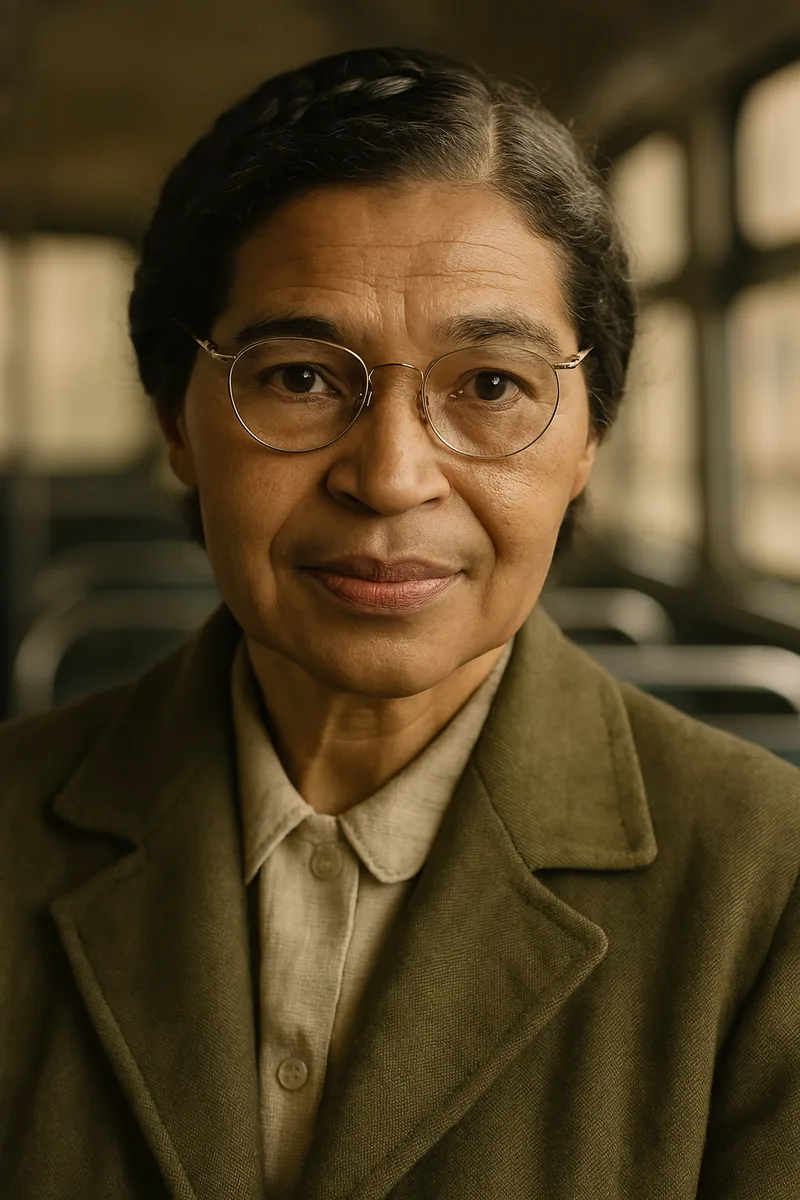
Rosa Parks: The Mother of the Civil Rights Movement
Rosa Parks changed the course of American history with a single act of quiet defiance. On December 1, 1955, in Montgomery, Alabama, she refused to give up her bus seat to a white passenger, sparking the Montgomery Bus Boycott and igniting the modern civil rights movement. But Parks was no accidental heroine. She was a trained activist, a longtime secretary of the Montgomery chapter of the NAACP, and a woman who had spent years fighting for racial justice before that fateful evening. Her courage on that bus was not a spontaneous gesture but the culmination of a lifetime of principled resistance. Parks went on to work alongside Martin Luther King Jr. and other leaders, and her legacy as the "Mother of the Civil Rights Movement" endures as a testament to the power of individual conscience against systemic injustice.
Context & Background
Rosa Louise McCauley was born on February 4, 1913, in Tuskegee, Alabama, into a world defined by racial apartheid. The Jim Crow laws that governed the American South mandated racial segregation in every aspect of public life - schools, restaurants, drinking fountains, hospitals, and public transportation. Black citizens were denied the right to vote through poll taxes, literacy tests, and outright intimidation. Violence against African Americans was endemic, and lynchings were a regular occurrence.
Rosa grew up on a farm near Pine Level, Alabama, with her mother, Leona, a schoolteacher, and her grandparents, both of whom had been enslaved. She attended segregated schools and was acutely aware from childhood of the indignities that the racial caste system imposed on Black Americans. She later recalled being terrified by the Ku Klux Klan riding past her home and her grandfather sitting on the porch with a shotgun.
She married Raymond Parks in 1932, a self-educated barber who was an early member of the Montgomery NAACP. Through Raymond, Rosa became involved in civil rights activism, and in 1943, she became secretary of the Montgomery chapter. In the summer of 1955, she attended a training workshop at the Highlander Folk School in Tennessee, a center for civil rights organizing that taught strategies of nonviolent resistance. She returned to Montgomery with a deepened commitment to action.
On the evening of December 1, 1955, Rosa Parks boarded the Cleveland Avenue bus in downtown Montgomery and sat in the first row of the "colored section." As the bus filled, the driver, James Blake - the same driver who had ejected her from a bus twelve years earlier - ordered Parks and three other Black passengers to give up their seats so a white passenger could sit. The other three complied. Parks did not.
"People always say that I didn't give up my seat because I was tired," she later wrote, "but that isn't true. I was not tired physically, or no more tired than I usually was at the end of a working day. I was not old, although some people have an image of me as being old then. I was forty-two. No, the only tired I was, was tired of giving in."
Parks was arrested, booked, and charged with violating Montgomery's segregation ordinance. That night, Jo Ann Robinson, a professor at Alabama State College and president of the Women's Political Council, mimeographed 35,000 flyers calling for a one-day bus boycott. The boycott, initially planned for a single day, lasted 381 days - from December 5, 1955, to December 20, 1956 - and catapulted a twenty-six-year-old pastor named Martin Luther King Jr. into national prominence.
The Montgomery Bus Boycott was a masterpiece of nonviolent organizing. Some 40,000 Black commuters found alternative transportation - carpools, taxis, walking - rather than ride the segregated buses. The economic pressure on the bus company and the city was enormous, and the legal challenge that accompanied the boycott ultimately reached the Supreme Court, which ruled in Browder v. Gayle (1956) that Montgomery's bus segregation was unconstitutional.
Parks paid a heavy price for her courage. She and her husband both lost their jobs, received death threats, and were effectively driven out of Montgomery. They moved to Detroit in 1957, where Rosa worked as a seamstress and later as a secretary and receptionist for Congressman John Conyers, a position she held from 1965 to 1988.
Parks remained active in the civil rights movement throughout her life, participating in the 1963 March on Washington and the 1965 Selma to Montgomery marches. She was a quiet, steady presence - not a fiery orator like King or Malcolm X, but a person whose moral authority derived from the consistency of her convictions and the dignity of her bearing.
In 1987, she co-founded the Rosa and Raymond Parks Institute for Self Development, which offered educational programs for young people. She received the Presidential Medal of Freedom in 1996 and the Congressional Gold Medal in 1999, making her only the second person in history to lie in honor in the United States Capitol Rotunda after her death.
Parks was not the first Black person to refuse to give up a bus seat in Montgomery. Claudette Colvin, a fifteen-year-old student, had done so nine months earlier, in March 1955. Civil rights leaders decided that Colvin's case was not ideal for a legal challenge, and they waited for a plaintiff whose personal circumstances would be beyond reproach. Parks, a married, employed, church-going woman with a spotless reputation, was the ideal symbol.
This does not diminish Parks' courage - she knew exactly what she was risking when she refused to move, and she accepted the consequences with full awareness. But it does reveal a more complex picture than the simple narrative of a tired seamstress who spontaneously decided she had had enough.
Parks was a lifelong advocate for education, particularly for young African Americans. She was soft-spoken, deeply religious, and unfailingly polite - qualities that made her resistance all the more powerful. She died on October 24, 2005, in Detroit, at the age of ninety-two. Over 60,000 people filed past her casket as she lay in honor at the Capitol.