
Malcolm X
Quotes & Wisdom
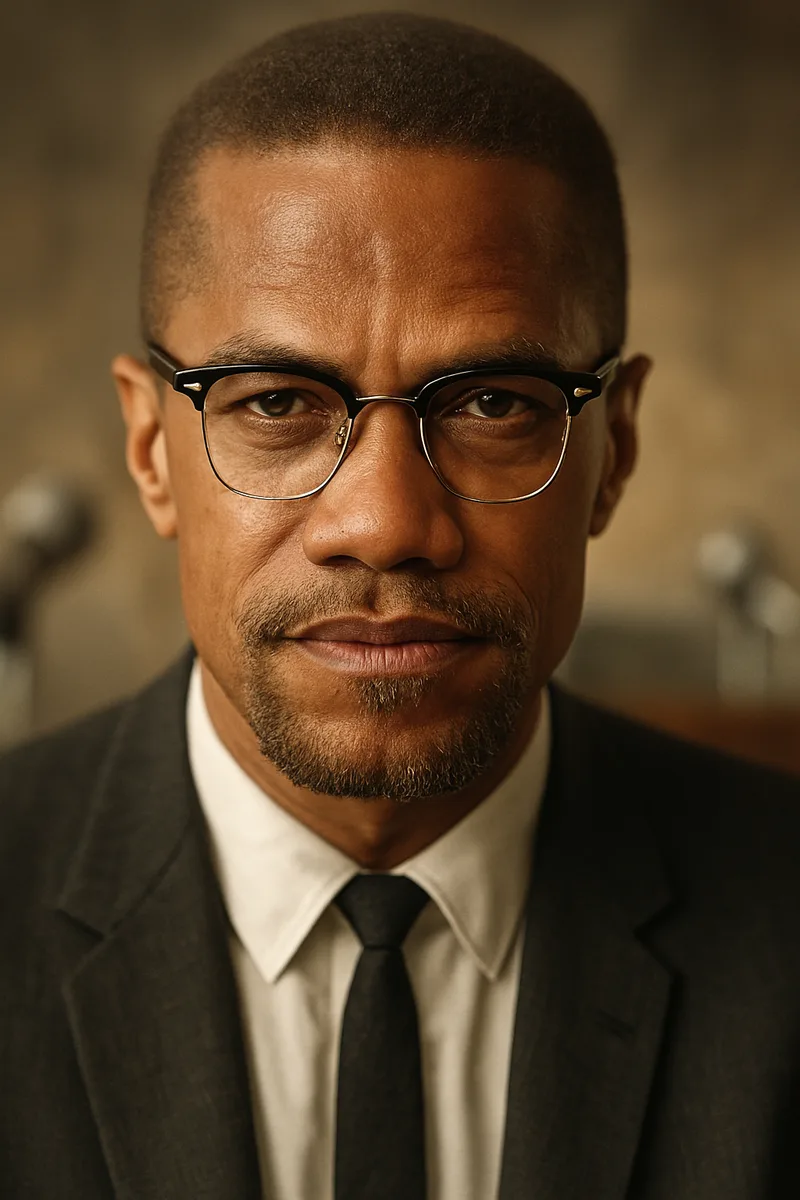
Malcolm X: The Uncompromising Voice for Black Liberation
Malcolm X was one of the most influential and controversial figures of the twentieth-century civil rights struggle, a man whose unflinching articulation of Black anger and pride transformed the national conversation on race in America. Born Malcolm Little in Omaha, Nebraska, he survived a childhood scarred by white supremacist violence, rebuilt himself in prison through voracious reading, and emerged as the chief spokesman for the Nation of Islam before breaking away to forge his own path. His evolution from street hustler to minister to global human rights advocate - all within a single, abbreviated lifetime - remains one of the most remarkable personal transformations in American history.
Context & Background
Malcolm Little was born on May 19, 1925, in Omaha, Nebraska, to Earl and Louise Little. His father was a Baptist minister and organizer for Marcus Garvey's Universal Negro Improvement Association, and the family paid a steep price for this activism. White supremacists burned their home in Lansing, Michigan, when Malcolm was four. Two years later, Earl Little was found dead on the trolley tracks - officially ruled an accident, but the family and community believed he was murdered by a white supremacist group called the Black Legion.
The aftermath devastated the family. Louise Little, a light-skinned woman from Grenada, struggled to feed eight children during the Depression. The strain broke her, and she was committed to a state mental institution, where she remained for twenty-six years. The children were scattered among foster homes and orphanages. Malcolm, despite being a brilliant student - he was elected class president in his predominantly white junior high - was told by a teacher that his ambition to become a lawyer was "no realistic goal for a nigger." The remark, Malcolm later recalled, extinguished his academic motivation entirely.
He drifted to Boston and then Harlem, where he became a street hustler, numbers runner, and burglar under the nickname "Detroit Red." In 1946, at age twenty, he was sentenced to eight to ten years in prison for burglary. It was in prison that his life changed completely. His siblings, who had joined the Nation of Islam, encouraged him to read and study. Malcolm devoured the prison library - dictionaries, encyclopedias, philosophy, history. He later said the experience was like a light being turned on after years of darkness.
Malcolm was released from prison in 1952 and quickly rose through the ranks of the Nation of Islam under the leadership of Elijah Muhammad. He dropped his surname - "the slave name" - and became Malcolm X, the X representing the unknown African name his ancestors had been stripped of. Within a decade, he transformed the Nation of Islam from a small sect into a national movement, increasing membership from roughly 500 to over 30,000.
As the Nation's chief spokesman, Malcolm X articulated a message that electrified Black America and terrified white America. While Martin Luther King Jr. preached nonviolence and integration, Malcolm X advocated self-defense and self-determination. He called the 1963 March on Washington the "Farce on Washington" and argued that asking oppressors for freedom was fundamentally degrading. His rhetoric was sharp, witty, and unsparing - he could dismantle an opponent's argument with a single metaphor.
His famous "Message to the Grassroots" speech in 1963 drew a distinction between the "house Negro" and the "field Negro" that remains one of the most incisive analyses of internalized oppression ever articulated. Malcolm argued that some Black leaders had been co-opted by the white establishment and no longer represented the interests of ordinary Black people. This critique earned him powerful enemies within both the civil rights establishment and the white power structure.
The break with the Nation of Islam in 1964 was both personal and ideological. Malcolm had discovered that Elijah Muhammad, whom he had revered as a prophet, had fathered children with several young secretaries - a devastating betrayal of the movement's moral teachings. But the break also reflected Malcolm's own intellectual evolution beyond the Nation's rigid theology.
In April 1964, Malcolm made the hajj to Mecca, and the experience profoundly altered his worldview. Surrounded by Muslims of every race praying together as equals, he began to reconsider his blanket condemnation of all white people. He wrote in a letter from Mecca: "I have been blessed to visit the Holy City of Mecca. There were tens of thousands of pilgrims, from all over the world. They were of all colors, from blue-eyed blondes to black-skinned Africans. But we were all participating in the same ritual, displaying a spirit of unity and brotherhood."
He returned to America as El-Hajj Malik El-Shabazz, founding the Organization of Afro-American Unity and reframing the struggle for Black rights as a human rights issue with global dimensions. He traveled extensively in Africa and the Middle East, meeting heads of state and building alliances. His vision expanded from American civil rights to Pan-African solidarity and Third World liberation - a shift that made him even more dangerous to those who wanted to contain the movement within safe boundaries.
Malcolm X was a voracious autodidact who copied the entire dictionary by hand in prison to expand his vocabulary. He could quote Shakespeare and the Quran with equal facility, and his debating skills were so formidable that few opponents - including university professors and seasoned journalists - could match him in public exchanges. He was also genuinely funny - his speeches are filled with razor-sharp humor that audiences often miss when reading them on the page rather than hearing them delivered.
He was assassinated on February 21, 1965, at the Audubon Ballroom in Manhattan, at the age of thirty-nine. His autobiography, written with Alex Haley and published posthumously, became one of the most important books of the twentieth century, influencing generations of activists, writers, and thinkers. Malcolm X's legacy lives in the understanding that dignity is not something to be petitioned for but something to be claimed - and that honest confrontation with injustice, however uncomfortable, is the only path to genuine freedom.