
Martin Luther King Jr.
Quotes & Wisdom
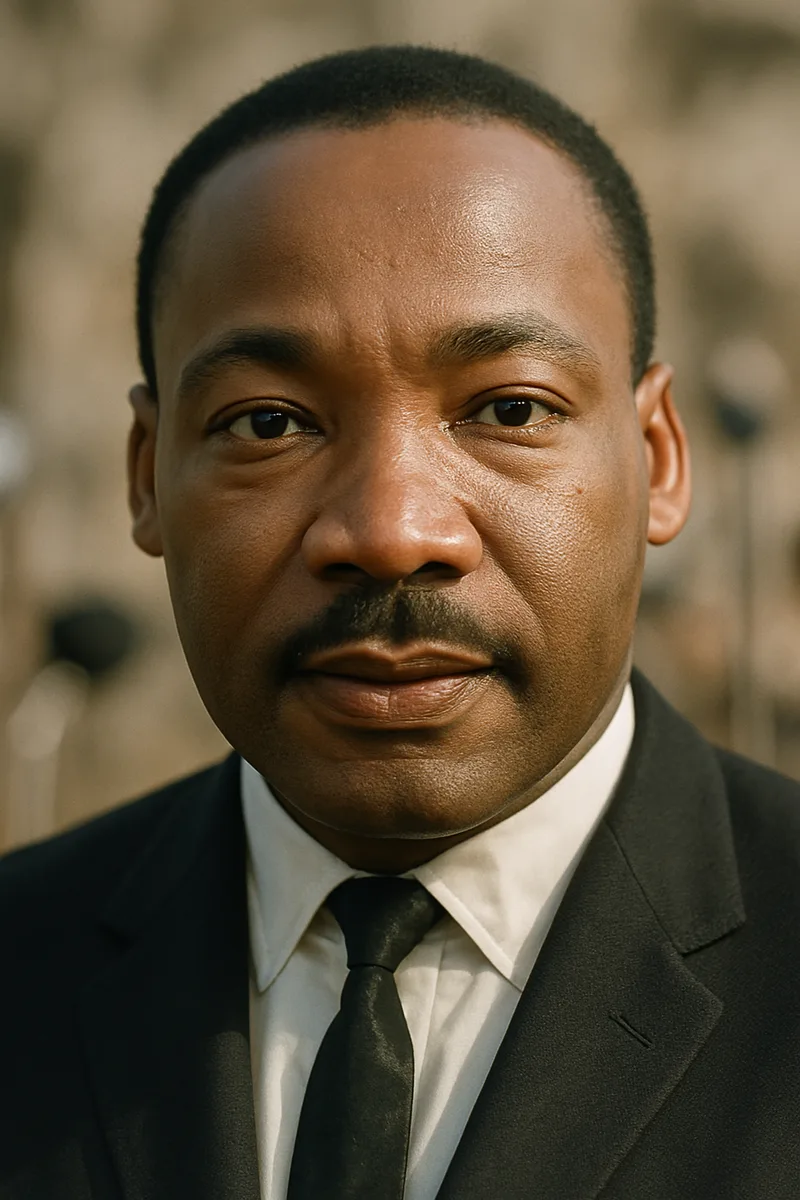
Martin Luther King Jr.: The Moral Conscience of a Nation
Martin Luther King Jr. was the foremost leader of the American civil rights movement, a Baptist minister whose philosophy of nonviolent resistance dismantled the legal architecture of racial segregation and awakened the moral conscience of the nation. Born in Atlanta in 1929 into a family of preachers, he combined the rhetorical power of the Black church with the philosophical rigor of Mahatma Gandhi's nonviolent activism to lead boycotts, marches, and campaigns that changed the law, the culture, and the meaning of American democracy. His "I Have a Dream" speech remains one of the most celebrated pieces of oratory in the English language, and his legacy continues to define the moral vocabulary of social justice worldwide.
Context & Background
Martin Luther King Jr. was born on January 15, 1929, in Atlanta, Georgia, into a family deeply rooted in the Black Baptist tradition. His father, Martin Luther King Sr., was the pastor of Ebenezer Baptist Church, one of the most prominent Black congregations in the South, and his maternal grandfather, A.D. Williams, had held the same pulpit before him. The King household was middle class by the standards of Black Atlanta - comfortable but not wealthy - and the church was the center of their world, providing not only spiritual sustenance but community leadership, education, and a platform for social advocacy.
Young Martin was a precocious child who entered Morehouse College at fifteen, skipping both the ninth and twelfth grades. At Morehouse, he came under the influence of Benjamin Mays, the college president and a theologian who argued that Christianity demanded social action against injustice. King went on to Crozer Theological Seminary in Pennsylvania, where he encountered the writings of Mahatma Gandhi and was struck by the power of nonviolent resistance as a political strategy. He earned his PhD in systematic theology from Boston University in 1955, the same year he accepted the pastorate of Dexter Avenue Baptist Church in Montgomery, Alabama - and the same year Rosa Parks refused to give up her seat on a city bus.
The Montgomery Bus Boycott of 1955-1956 thrust the twenty-six-year-old King into national prominence. For 381 days, Black residents of Montgomery - who comprised seventy-five percent of the bus system's ridership - walked, carpooled, and rode mules rather than submit to segregated seating. King's home was bombed; he was arrested. But the boycott succeeded, and the Supreme Court ruled Montgomery's bus segregation unconstitutional. King had discovered his life's mission.
King's philosophy of nonviolent resistance was not passivity - it was confrontation of the most demanding kind. He asked people to face fire hoses, police dogs, and jail cells without striking back, to absorb violence rather than inflict it, and to love their enemies even as those enemies beat them. This was not a strategy for the faint-hearted. It required extraordinary discipline and courage, and King trained his followers meticulously in its principles before every campaign.
The Birmingham Campaign of 1963 was the movement's crucible. King and the Southern Christian Leadership Conference targeted Birmingham, Alabama - the most segregated city in America, where police commissioner Bull Connor was known for his brutality. When Connor turned fire hoses and attack dogs on peaceful demonstrators, including children, the images shocked the world. King, arrested during the campaign, wrote his famous "Letter from Birmingham Jail" in response to white clergymen who called the protests "unwise and untimely." The letter is a masterpiece of moral philosophy, arguing that injustice anywhere is a threat to justice everywhere and that the real obstacle to freedom is not the violent racist but the white moderate who prefers order to justice.
The March on Washington on August 28, 1963, brought over 250,000 people to the Lincoln Memorial, where King delivered the "I Have a Dream" speech. The speech drew on the Declaration of Independence, the Constitution, and the prophetic tradition of the Bible to articulate a vision of racial harmony that moved the nation. Within a year, the Civil Rights Act of 1964 was signed into law, and King received the Nobel Peace Prize at age thirty-five.
After the victories of 1964 and 1965 - the Civil Rights Act and the Voting Rights Act - King expanded his focus beyond legal segregation to address the deeper economic and structural inequalities that kept millions of Americans trapped in poverty. The shift was controversial, even within the civil rights movement. Some allies worried he was overreaching; others argued that the movement had already won its essential battles.
King saw it differently. He recognized that the right to sit at a lunch counter meant little if you could not afford the meal, and that voting rights were hollow without economic justice. In 1966, he brought the movement north to Chicago, where he confronted housing segregation and encountered a racism that was, if anything, more virulent than what he had faced in the South. He was hit by a rock during a march through the Marquette Park neighborhood and later said he had "never seen - even in Mississippi and Alabama - mobs as hostile and hate-filled" as those in Chicago.
He also spoke out against the Vietnam War, a decision that cost him the support of President Lyndon Johnson and many mainstream allies. His April 1967 speech at Riverside Church in New York - "Beyond Vietnam: A Time to Break Silence" - argued that the war was draining resources from the fight against poverty and that America could not preach democracy abroad while denying it at home. The speech was prophetic but politically costly.
King was assassinated on April 4, 1968, in Memphis, Tennessee, where he had gone to support a sanitation workers' strike. He was thirty-nine years old. In his final speech, delivered the night before his death, he seemed to foresee what was coming: "I've been to the mountaintop. And I've looked over. And I've seen the Promised Land. I may not get there with you. But I want you to know tonight, that we, as a people, will get to the Promised Land."
Beyond the public figure, King was a man of deep intellectual curiosity who read voraciously, a devoted father of four children, and a preacher whose sermons could make congregations weep and laugh within the same sentence. He struggled with doubt, exhaustion, and the weight of leading a movement that put his life in constant danger. He received death threats almost daily and lived with the knowledge that he would likely not survive to old age. That he continued anyway - continued marching, preaching, organizing, and loving - is perhaps the most powerful testimony to the philosophy he preached.