
Ludwig van Beethoven
Quotes & Wisdom
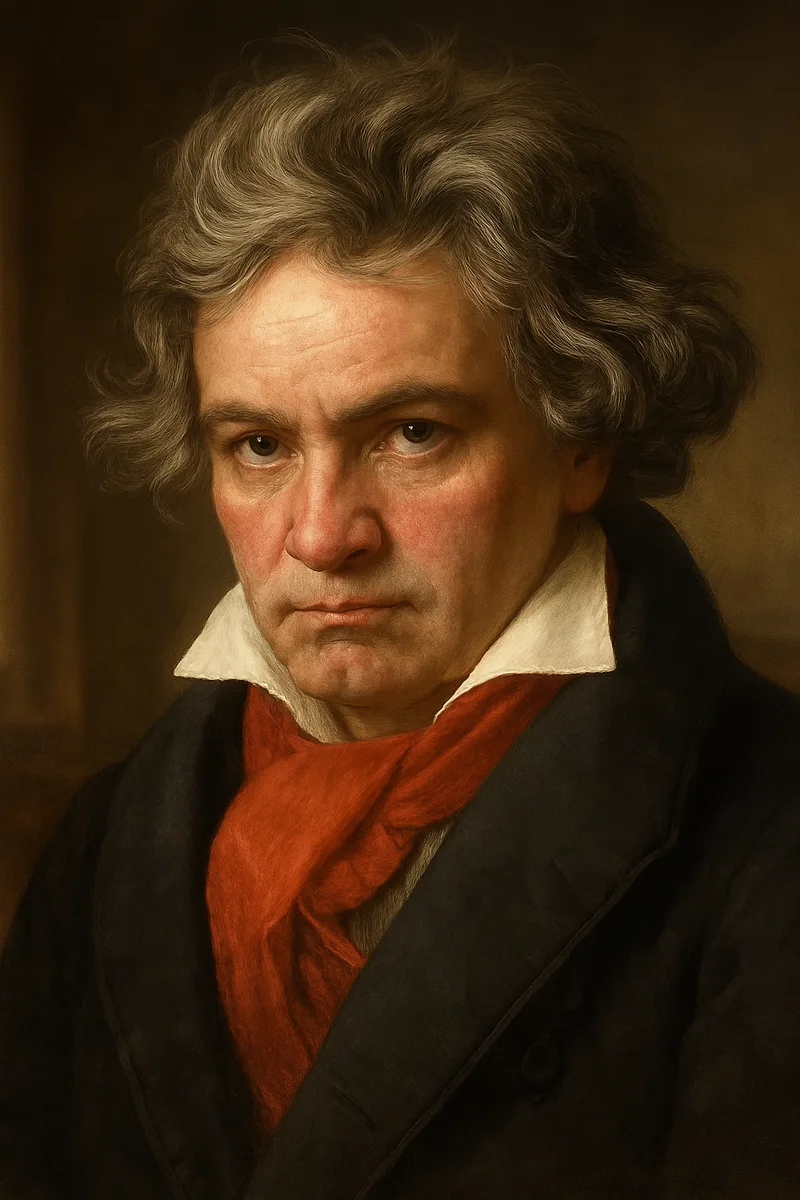
Ludwig van Beethoven: The Composer Who Defied Silence
Ludwig van Beethoven transformed Western music through sheer force of will, composing some of the most celebrated symphonies, sonatas, and concertos in history - many of them after he had gone almost entirely deaf. Born in Bonn in 1770, he moved to Vienna as a young man and never left, bridging the Classical and Romantic eras with works of unprecedented emotional power. His Ninth Symphony, completed when he could not hear a single note of it performed, remains one of humanity's greatest artistic achievements. Beethoven's life was a study in contradictions - tender and volatile, isolated yet profoundly connected to the universal human experience through his art.
Context & Background
Ludwig van Beethoven was born on December 16, 1770, in Bonn, a small Rhineland city that served as the residence of the Elector of Cologne. His grandfather, also named Ludwig, had been the Kapellmeister - the most senior musical position in the court - and the family name carried weight in Bonn's musical circles. His father, Johann, was a court tenor of modest talent and immodest ambition, who recognized his son's gifts early and attempted to mold him into a child prodigy in the mold of Wolfgang Amadeus Mozart. The training was often harsh: young Ludwig was dragged to the keyboard in the middle of the night, sometimes in tears, and forced to practice for hours.
Despite this brutal introduction, Beethoven's talent was undeniable. By the age of twelve he was already working as an assistant court organist, and his first published compositions appeared when he was barely a teenager. Christian Gottlob Neefe, his most important early teacher, introduced him to the works of Johann Sebastian Bach and recognized that his pupil possessed something extraordinary. In 1787, Beethoven traveled briefly to Vienna and may have played for Mozart, who reportedly said, "Keep your eyes on him; someday he will give the world something to talk about."
Beethoven settled permanently in Vienna in 1792, studying with Joseph Haydn and quickly establishing himself as a virtuoso pianist whose improvisations left audiences stunned. Vienna in the 1790s was the undisputed capital of European music, and the young Beethoven navigated its aristocratic patronage system with a mixture of brilliance and bluntness that was entirely new. Unlike Mozart or Haydn, he refused to behave as a servant to his noble patrons, insisting on being treated as an equal - a revolutionary attitude that foreshadowed the Romantic era's elevation of the artist.
The first signs of hearing loss appeared around 1798, when Beethoven was only twenty-seven. By 1802, the condition had become so distressing that he wrote the famous Heiligenstadt Testament, a letter to his brothers that reads like a suicide note - a raw outpouring of despair at the cruelty of a musician losing the one sense essential to his art. "O you men who think or say that I am malevolent, stubborn, or misanthropic, how greatly do you wrong me," he wrote. "For six years now I have been hopelessly afflicted."
But Beethoven did not end his life. Instead, he turned inward. The years following the Heiligenstadt crisis produced what scholars call his "heroic" period - the Third Symphony (Eroica), the Fifth Symphony, the Emperor Concerto, the Waldstein and Appassionata sonatas, and his only opera, Fidelio. These works shattered the elegant conventions of Classical music with their dramatic contrasts, massive structures, and raw emotional force. The Third Symphony alone was nearly twice the length of any symphony that had come before it. When a copyist complained about a passage that violated the rules of harmony, Beethoven reportedly replied, "I make the rules."
His deafness grew progressively worse throughout his middle years. By 1814, he could no longer perform as a pianist. By the early 1820s, visitors communicated with him through conversation books - writing their remarks while he responded aloud. Yet this total isolation from the sonic world coincided with his most profound creative period.
The compositions of Beethoven's final decade stand among the most extraordinary achievements in the history of art. The Ninth Symphony, completed in 1824, was the first major symphony to include vocal soloists and a chorus, setting Friedrich Schiller's "Ode to Joy" as a universal anthem of human brotherhood. At the premiere in Vienna, Beethoven stood on stage attempting to conduct - he was so deaf that one of the soloists had to turn him around to see the audience's thunderous applause.
The late string quartets, composed between 1825 and 1826, are even more radical. Works like the Grosse Fuge and the Quartet in C-sharp minor pushed music into territory that would not be fully understood for a century. These pieces abandon conventional beauty for something deeper - a kind of spiritual intensity that seems to transcend the physical limitations of the instruments themselves. Musicians and scholars have struggled for two hundred years to articulate what makes these late works so powerful, and the most honest answer may be that they resist verbal explanation entirely.
The Piano Sonata No. 32 in C minor, his final sonata, ends with a set of variations that dissolve into something resembling jazz or boogie-woogie - a passage so far ahead of its time that it baffled his contemporaries. Beethoven was no longer writing for his audience. He was writing for posterity, and posterity has confirmed his judgment.
Beethoven was legendarily messy. His apartments in Vienna were chaotic - manuscripts piled on every surface, half-eaten meals abandoned on the piano, wash basins overflowing. He moved more than sixty times during his years in Vienna, often because landlords could no longer tolerate the noise, the mess, or both. He would pour water over his head while composing, which frequently leaked through the floor onto his downstairs neighbors.
He was also a passionate walker. Every afternoon, regardless of weather, Beethoven strode through the streets and parks of Vienna, sketching musical ideas in pocket notebooks. Many of his greatest themes originated not at the keyboard but on these walks, where the rhythm of his footsteps seemed to unlock creative channels. He once told a friend that Johann Wolfgang von Goethe was too deferential to royalty - and proved it by refusing to step aside for the Empress during a walk in the park at Teplitz, while Goethe bowed and scraped.
Beethoven never married, though he fell in love repeatedly and wrote his famous letter to the "Immortal Beloved" - whose identity scholars still debate. He died on March 26, 1827, during a thunderstorm. According to his friend Anselm Huttenbrenner, the dying composer raised his fist at the thunder in a final gesture of defiance. Over twenty thousand people attended his funeral procession through Vienna.