
Galileo Galilei
Quotes & Wisdom
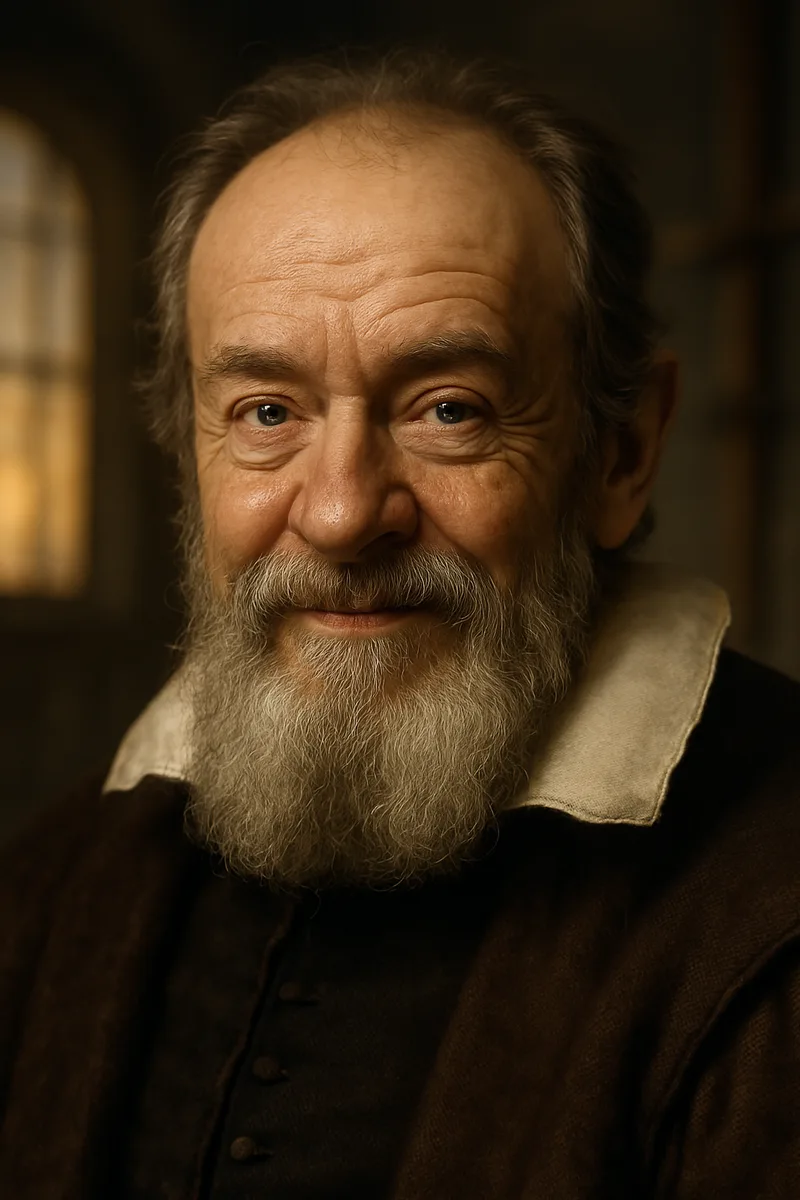
Galileo Galilei: The Father of Modern Science
Galileo Galilei is the founding figure of modern science - the man who turned the telescope toward the heavens, discovered the moons of Jupiter and the phases of Venus, and championed the Copernican model of a sun-centered universe against the opposition of the Catholic Church. Born in Pisa in 1564, he combined mathematical rigor with experimental observation in a way that no one had before, establishing the methods that Isaac Newton and every subsequent scientist would build upon. His conflict with the Church - culminating in his trial and forced recantation in 1633 - became the defining symbol of the tension between scientific inquiry and religious authority. His courage, intellect, and stubbornness changed how humanity understands the universe.
Context & Background
Galileo was born on February 15, 1564, in Pisa, in the Grand Duchy of Tuscany. His father, Vincenzo Galilei, was a musician and music theorist whose experimental approach to acoustics - testing theories through measurement rather than accepting ancient authority - may have influenced Galileo's own scientific temperament. The family was well-born but not wealthy, and Galileo's education required patronage.
The intellectual world of late sixteenth-century Italy was dominated by Aristotelian philosophy, which had been integrated into Catholic theology by Thomas Aquinas. Aristotle's physics taught that the earth was the stationary center of the universe, that heavier objects fall faster than lighter ones, and that celestial bodies are perfect and unchanging. These ideas had the force of religious dogma, and challenging them was both intellectually and socially dangerous.
Yet the foundations were already cracking. Nicolaus Copernicus had published his heliocentric model in 1543, and astronomers like Tycho Brahe were accumulating observational data that did not fit the Aristotelian framework. Galileo studied mathematics at the University of Pisa, held professorships at Pisa and then Padua, and gradually moved from conventional Aristotelianism toward a new physics based on measurement and experiment.
In 1609, Galileo learned of the invention of the telescope in the Netherlands and quickly built improved versions of his own. Turning his telescope toward the night sky, he made discoveries that shattered the Aristotelian cosmos. The moon was not a perfect sphere but had mountains and craters. Jupiter had four moons orbiting it - objects that clearly did not orbit the earth. Venus showed phases like the moon, consistent with the Copernican model. The Milky Way was composed of countless individual stars.
He published these findings in Sidereus Nuncius (Starry Messenger) in 1610, which made him famous across Europe and earned him the patronage of the Medici Grand Duke of Tuscany. But his discoveries also put him on a collision course with the Church. If the earth was not the center of the universe, what did that mean for Scripture, for theology, for the entire structure of Catholic cosmology?
Galileo's advocacy for the Copernican system grew bolder over the following decades. In 1616, the Church declared heliocentrism "formally heretical" and warned Galileo not to teach it as truth. He complied, more or less, until 1632, when he published Dialogue Concerning the Two Chief World Systems - a brilliantly written comparison of the Copernican and Ptolemaic systems that clearly favored Copernicus. The character defending the geocentric view was named "Simplicio" and given arguments resembling those of Pope Urban VIII, who had previously been Galileo's ally.
The Pope was furious. Galileo was summoned before the Inquisition in 1633, found "vehemently suspect of heresy," forced to recant, and sentenced to house arrest for the remainder of his life. The legend that he muttered "And yet it moves" (Eppur si muove) after his recantation is almost certainly apocryphal but captures the spirit of his defiance.
During his house arrest at his villa in Arcetri, Galileo wrote Two New Sciences (1638), which laid the groundwork for modern physics and engineering - arguably his most important scientific work. He went completely blind in 1638 but continued to work with assistants. He never married, though he had three children with Marina Gamba; his eldest daughter, Sister Maria Celeste, was a nun whose letters to her father reveal a relationship of deep tenderness and mutual support. He was an accomplished lutenist, a gifted writer whose Italian prose is among the finest of the period, and a talented artist whose drawings of the moon were scientifically precise. Albert Einstein called him "the father of modern physics - indeed of modern science altogether." He died on January 8, 1642 - the same year Isaac Newton was born.