
Nicolaus Copernicus
Quotes & Wisdom
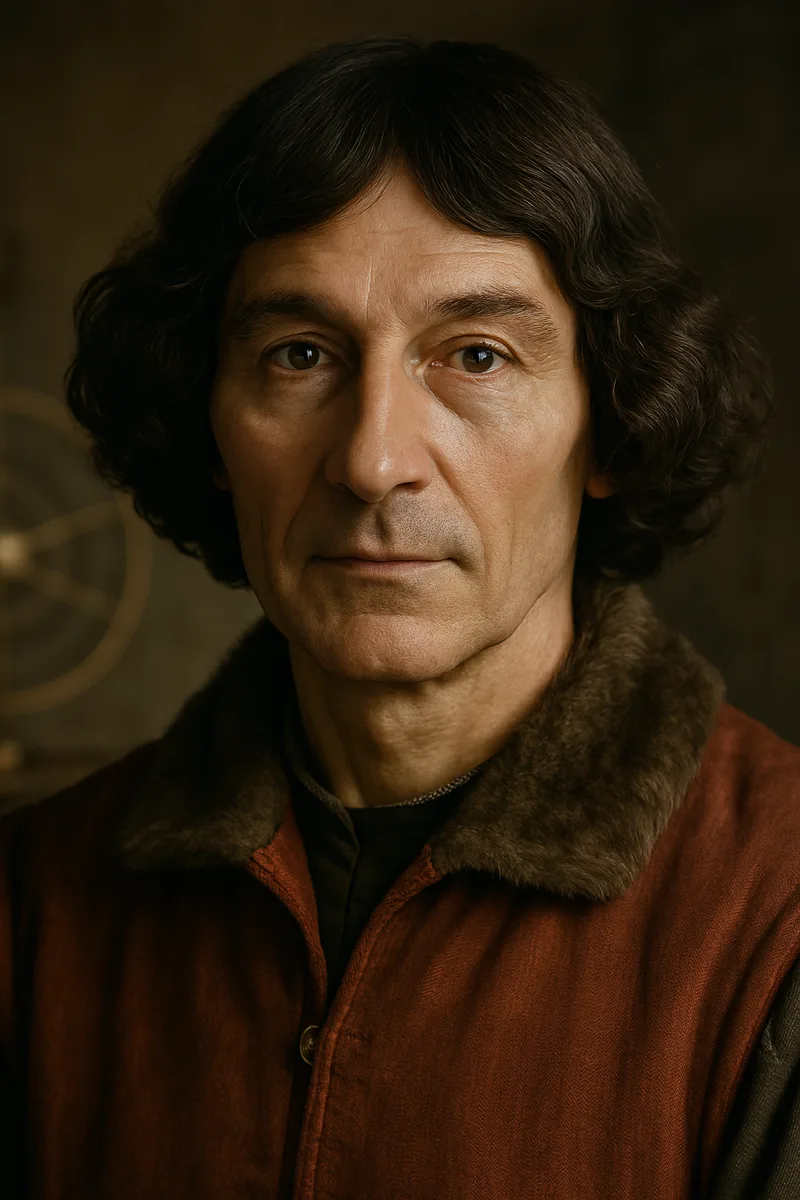
Nicolaus Copernicus: The Man Who Moved the Earth
Nicolaus Copernicus was the Renaissance-era astronomer and polymath whose heliocentric model of the solar system - placing the Sun rather than the Earth at the center - triggered the greatest revolution in the history of science. Born in Royal Prussia in 1473, he was a canon lawyer, physician, diplomat, economist, and classical scholar who pursued astronomy in whatever time remained. His masterwork, De revolutionibus orbium coelestium, published in 1543 as he lay on his deathbed, overturned fifteen centuries of Ptolemaic cosmology and set in motion the scientific revolution that would be carried forward by Galileo Galilei, Johannes Kepler, and Isaac Newton.
Context & Background
Mikolaj Kopernik was born on February 19, 1473, in Torun, a prosperous Hanseatic League trading city on the Vistula River in Royal Prussia, then part of the Kingdom of Poland. His father, also Mikolaj, was a successful copper merchant who died when the boy was about ten. His maternal uncle, Lucas Watzenrode, a powerful cleric who would become Bishop of Warmia, assumed responsibility for the boy's education and career - a stroke of fortune that made everything else possible.
Copernicus entered the University of Krakow in 1491, where he studied mathematics, astronomy, and philosophy. The university was one of the finest in Central Europe, and its astronomy curriculum exposed him to the Ptolemaic system - the geocentric model that had dominated Western astronomy for over a thousand years. Ptolemy's system placed the Earth at the center of the universe, with the Sun, Moon, planets, and stars revolving around it on a complex system of nested spheres and epicycles. The model was elegant in conception but had grown increasingly unwieldy as astronomers added layer upon layer of adjustments to make it match observations.
After Krakow, Copernicus spent nearly a decade in Italy - at the universities of Bologna and Padua - studying canon law, medicine, and astronomy. In Bologna, he lived with the astronomy professor Domenico Maria Novara, who was already skeptical of the Ptolemaic system. Italy exposed Copernicus to the intellectual ferment of the Renaissance, including the revival of ancient Greek texts that suggested alternative cosmologies. Aristarchus of Samos had proposed a heliocentric model in the third century BC, and Copernicus would later cite him as a predecessor.
He returned to Poland around 1503 and spent the rest of his life as a canon of the Warmia Cathedral chapter - an administrative position that provided a steady income and left him time for astronomical observations and calculations. He never held a formal academic position in astronomy.
Copernicus's great insight was deceptively simple: the apparent motions of the celestial bodies could be explained more elegantly if the Earth and the other planets orbited the Sun, and if the Earth rotated on its own axis once per day. This single idea eliminated most of the epicycles and equants that made the Ptolemaic system so cumbersome and produced a model that was, in its fundamentals, correct.
He circulated his ideas privately in a short manuscript called the Commentariolus around 1514, which outlined the heliocentric hypothesis without providing the detailed mathematical proofs. The response from those who read it was mixed - some were intrigued, others skeptical, and many recognized the theological implications of removing the Earth from the center of God's creation.
The full exposition came in De revolutionibus orbium coelestium (On the Revolutions of the Celestial Spheres), a massive work that Copernicus labored over for decades. He was reluctant to publish, partly from perfectionism and partly from fear of controversy. It was only through the persistent encouragement of Georg Joachim Rheticus, a young mathematician from Wittenberg who became his only formal student, that the work was finally sent to a printer in Nuremberg.
The book was published in 1543, and tradition holds that a copy was placed in Copernicus's hands on the day he died, May 24, 1543. Whether he was conscious enough to understand what he held is uncertain, but the timing has given his story a poignant finality.
Copernicus was the opposite of the romantic image of the revolutionary genius. He was cautious, methodical, and deeply uncomfortable with controversy. He spent decades refining his calculations rather than rushing to publish. He was aware that his theory contradicted Scripture - the Bible clearly states that Joshua commanded the Sun to stand still, which implies the Sun moves - and he dedicated De revolutionibus to Pope Paul III in a calculated bid for ecclesiastical protection.
His caution was well-founded. While the Catholic Church did not immediately condemn De revolutionibus - the book was not placed on the Index of Forbidden Books until 1616, seventy-three years after publication - the theological implications of heliocentrism were obvious to everyone. If the Earth was not the center of the universe, then humanity's special place in creation was called into question. Martin Luther reportedly dismissed Copernicus as "the fool who wants to turn the whole art of astronomy upside down."
Yet the Copernican Revolution, once begun, could not be stopped. Galileo Galilei's telescopic observations confirmed the heliocentric model, Johannes Kepler refined it with his laws of planetary motion, and Isaac Newton provided the physical explanation with his theory of universal gravitation. The chain reaction that Copernicus set in motion did not merely change astronomy - it changed humanity's understanding of its own place in the cosmos.
Copernicus was a genuine polymath whose interests extended far beyond astronomy. He served as a physician to his uncle and other clergy members, though he held no formal medical degree. He wrote a treatise on monetary reform that anticipated Gresham's Law - the principle that bad money drives out good - and served as an economic advisor to the Prussian Diet. He was also a skilled administrator who helped organize the defense of Warmia's towns during conflicts with the Teutonic Knights.
He made most of his astronomical observations from a small tower attached to the Warmia Cathedral in Frombork, using instruments he built himself - no telescope existed in his lifetime. His observations were not dramatically more accurate than those of his predecessors; his revolution was conceptual rather than observational. He looked at the same data everyone else had and saw a simpler, more beautiful explanation. He died on May 24, 1543, at the age of seventy, and was buried in an unmarked grave in Frombork Cathedral. His remains were not identified until 2005, when DNA analysis confirmed the bones found beneath the cathedral floor. In 2010, he was reburied with full honors - 467 years after his death - beneath a tombstone bearing a golden model of the solar system he had been the first to correctly describe.