
David Ricardo
Quotes & Wisdom
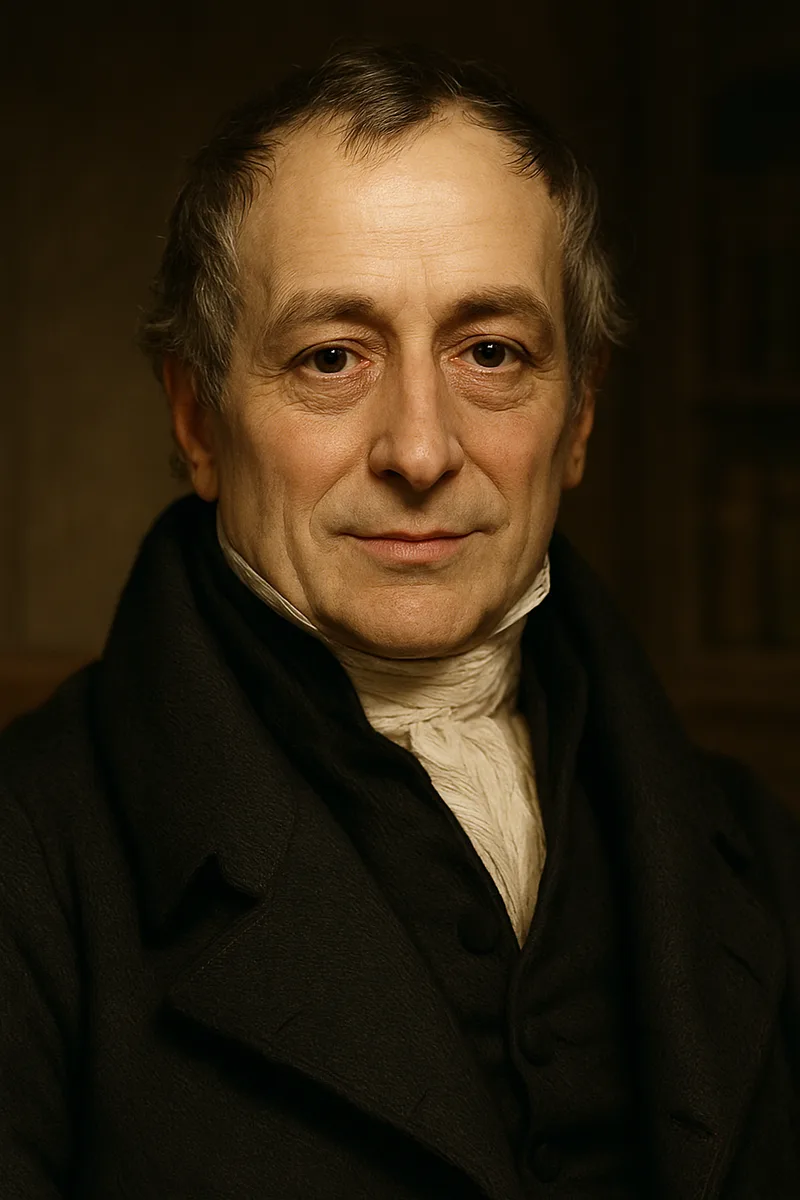
David Ricardo: The Architect of Classical Economics
David Ricardo was the most rigorous economic theorist of the nineteenth century, a man who transformed economics from the discursive essays of Adam Smith into a precise, deductive science. Born in London in 1772 to a Sephardic Jewish family of Dutch origin, he made a fortune on the stock exchange and then devoted himself to economic theory. His principle of comparative advantage - demonstrating that trade benefits all nations, even those less efficient at producing everything - remains the strongest intellectual argument for free trade. His analysis of rent, wages, profits, and taxation shaped economic policy for generations and influenced thinkers from Karl Marx to John Maynard Keynes.
Context & Background
David Ricardo was born on April 18, 1772, in London, the third of seventeen children in a prosperous Sephardic Jewish family. His father, Abraham Israel Ricardo, was a successful stockbroker who had emigrated from the Dutch Republic. David entered his father's business at fourteen, learning the mechanics of finance and trading on the London Stock Exchange. He showed an immediate aptitude for the work.
At twenty-one, Ricardo married Priscilla Anne Wilkinson, a Quaker, and converted to Christianity - a decision that caused a permanent breach with his family and cost him his position in his father's firm. Forced to establish himself independently, he proved spectacularly successful, making a fortune through government bond trading and eventually becoming one of the wealthiest men in England.
The economic world Ricardo analyzed was being transformed by the Industrial Revolution. Britain in the early nineteenth century was the workshop of the world - its factories, mills, and mines were generating unprecedented wealth while also creating new forms of poverty and social dislocation. The Napoleonic Wars (1803-1815) had disrupted trade, inflated food prices, and created fierce debates about monetary policy and trade protection. The Corn Laws - tariffs that protected British landowners by restricting grain imports - became the central economic controversy of the era, and Ricardo's analysis of their effects was decisive in shaping the free-trade movement.
Ricardo's most enduring contribution to economics is the theory of comparative advantage, presented in his Principles of Political Economy and Taxation (1817). Building on Adam Smith's argument for free trade, Ricardo showed that trade is beneficial even when one country is more efficient than another at producing everything.
His famous example involved England and Portugal producing cloth and wine. Even if Portugal could produce both goods more cheaply than England, both countries would benefit by specializing in the good they produced relatively more efficiently and trading for the other. This insight - that it is relative, not absolute, efficiency that determines the gains from trade - is one of the most counterintuitive and powerful ideas in economics. It remains the intellectual foundation of international trade theory and the strongest argument against protectionism.
Ricardo's analysis of income distribution among landowners, capitalists, and workers was equally influential. He developed the theory of differential rent - the idea that rent arises because some land is more productive than others, and as population grows and less productive land is brought into cultivation, the rent on the best land rises. This analysis had direct policy implications: rising rents enriched landowners without any productive effort on their part, while squeezing the profits of capitalists and the wages of workers.
Ricardo argued that the Corn Laws benefited landowners at the expense of everyone else and that free trade in grain would lower food prices, reduce rents, and allow capital to flow to more productive uses. His ideas profoundly influenced the Anti-Corn Law League, led by Richard Cobden and John Bright, which eventually succeeded in repealing the Corn Laws in 1846.
Ricardo became a Member of Parliament in 1819, purchasing the borough seat of Portarlington in Ireland - a common practice in the era of rotten boroughs. Despite his wealth and status, he was known for his personal modesty and intellectual honesty. He was a close friend and intellectual sparring partner of Thomas Malthus - the two disagreed on almost everything in economics but maintained a warm personal relationship conducted through hundreds of letters. Ricardo's writing style was notoriously abstract and difficult, leading one contemporary to complain that reading him was like "eating dry toast." He was an early advocate of a gold standard and the retirement of paper currency. He died on September 11, 1823, at age fifty-one, from an ear infection that became septic - a reminder of the fragility of life before antibiotics. His intellectual influence on economics was immediate and lasting: Karl Marx built his labor theory of value directly on Ricardo's foundations.