
Karl Marx
Quotes & Wisdom
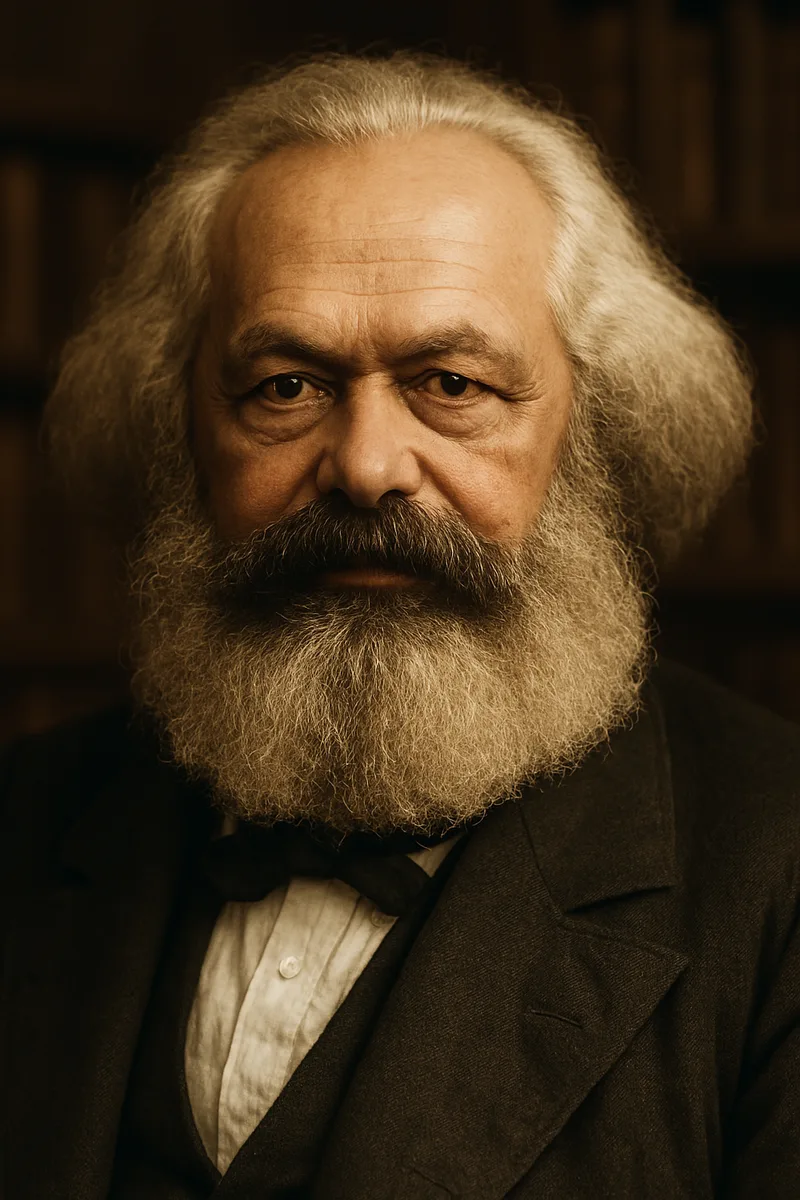
Karl Marx: The Philosopher Who Declared War on the Status Quo
Karl Marx was the most influential and controversial thinker of the modern era. His analysis of capitalism - its internal contradictions, its exploitation of labor, its tendency toward crisis - shaped the political landscape of the twentieth century more than any other body of ideas. Revolutions were fought in his name. Governments were built on his theories. Millions suffered under regimes that claimed his intellectual authority. Whether one sees Marx as a prophet of liberation or an architect of tyranny, his ideas remain unavoidable. His writings combine rigorous economic analysis with philosophical depth and a polemical ferocity that still burns. To read Marx is to encounter a mind that refused to accept that the way things are is the way they must be.
Context & Background
Born on May 5, 1818, in Trier, Prussia (now Germany), Karl Heinrich Marx grew up in a middle-class family navigating the complexities of Jewish identity in Christian Europe. His father Heinrich, a lawyer, converted to Lutheranism to preserve his career under Prussian laws that restricted Jewish participation in public life. This experience of systematic exclusion - where official ideology masked material interests - planted seeds that would flower in Marx's later analysis of ideology and power.
At the universities of Bonn and Berlin, Marx studied law and philosophy, falling under the influence of Hegel's dialectical method. Hegel saw history as the unfolding of ideas through contradiction and resolution. Marx would turn this on its head, arguing that material conditions - economics, technology, class relations - drove historical change, with ideas merely reflecting underlying power structures.
His doctoral thesis on ancient Greek philosophy led not to an academic career but to radical journalism. As editor of the Rheinische Zeitung, Marx confronted the poverty of Rhineland peasants and the censorship of the Prussian state, experiences that pushed him toward increasingly revolutionary positions. When the paper was suppressed in 1843, Marx left for Paris - the center of European radicalism - where he began the intellectual partnership with Friedrich Engels that would change the world.
Marx's central argument was that capitalism, despite its revolutionary productive power, was built on exploitation. Workers created value through their labor but received only a fraction of that value as wages - the rest was extracted as profit by the owners of capital. This 'surplus value' was not a flaw in the system but its fundamental mechanism.
Das Kapital, published in 1867 (with two posthumous volumes), was Marx's attempt to lay bare the 'laws of motion' of capitalist society. It combined economic analysis with historical research, philosophical argument, and vivid descriptions of working conditions in Victorian England that remain harrowing to read. The book argued that capitalism's internal contradictions - the tendency of profits to fall, the cyclical crises of overproduction, the concentration of wealth - would eventually lead to its replacement by a socialist system.
Whether Marx was right about capitalism's ultimate fate remains the great unresolved question of modern economics and politics. His analysis of capitalism's dynamics - its creative destruction, its tendency toward monopoly, its commodification of every aspect of life - has proven remarkably prescient.
The Communist Manifesto, written with Engels in 1848, remains the most widely read political pamphlet in history. Its opening line - 'A specter is haunting Europe, the specter of communism' - announced a new force in world politics. In fewer than fifty pages, Marx and Engels laid out a theory of history as class struggle, an analysis of bourgeois society, and a program for proletarian revolution.
The Manifesto's power lies in its combination of analytical clarity and rhetorical force. Marx was a brilliant polemicist who could compress complex arguments into memorable phrases. 'Workers of the world, unite! You have nothing to lose but your chains' is not just a slogan but a condensation of an entire theory of history and human liberation.
Marx spent most of his adult life in exile, primarily in London, where he lived in grinding poverty sustained by Engels's financial support. Three of his children died young, partly from conditions related to their poverty. He spent decades in the British Museum reading room, researching Das Kapital and writing articles for the New York Tribune to supplement his meager income.
He died on March 14, 1883, and was buried in Highgate Cemetery. Fewer than twenty people attended his funeral. Engels's eulogy predicted that Marx's name would 'endure through the ages.' He was right, though not in the way either man expected.
Marx was a devoted family man whose relationship with his wife Jenny von Westphalen - an aristocrat who gave up social position to share his revolutionary life - was genuinely loving despite its hardships. He drank heavily, suffered from boils and liver disease, and had a famously difficult personality that alienated many potential allies. His feuds with other socialists were legendary in their viciousness.
He was also deeply well-read in literature, admiring William Shakespeare and Balzac above all other writers. He played chess obsessively and badly. His children adored him, calling him 'Moor' for his dark complexion. The contradictions of his personal life - the bourgeois intellectual who preached proletarian revolution, the family man who fathered a child with the family's housekeeper - mirror the contradictions of the movements his ideas inspired.