
Archimedes
Quotes & Wisdom
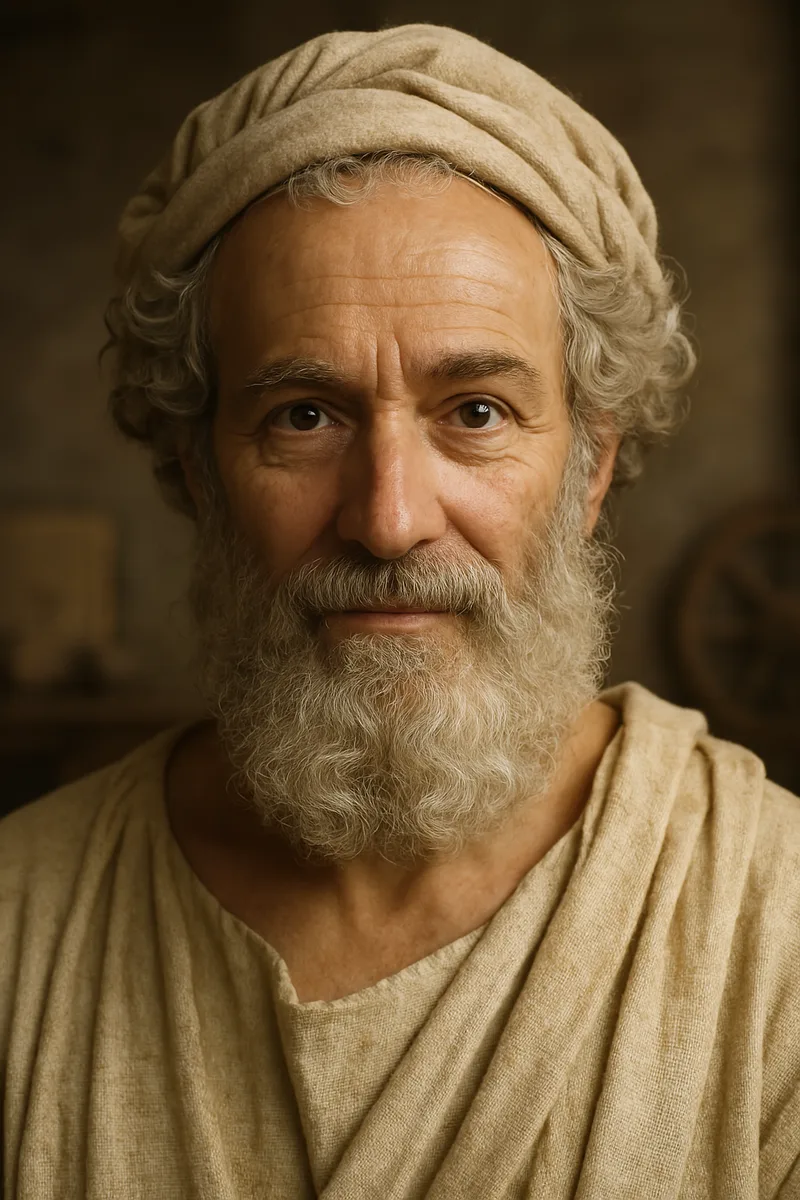
Archimedes: The Greatest Mind of the Ancient World
Archimedes of Syracuse was the ancient world's supreme mathematician, physicist, engineer, and inventor. Working in the Greek colony of Syracuse on the island of Sicily during the third century BC, he discovered the principles of buoyancy and the lever, calculated pi with unprecedented accuracy, and designed war machines that held off the Roman siege of his city for two years. His mathematical works - on spirals, spheres, cylinders, and the method of exhaustion (a precursor to calculus) - remained unsurpassed for nearly two millennia. Ancient and modern scientists alike regard him as one of the greatest intellects in human history, a mind that bridged pure mathematics and practical engineering with equal brilliance.
Context & Background
Archimedes was born around 287 BC in Syracuse, the most powerful Greek city on the island of Sicily. His father, Phidias, was an astronomer, and the family likely belonged to Syracuse's educated elite - some ancient sources suggest a connection to King Hieron II, who became Archimedes' patron and friend. Syracuse in the third century BC was a prosperous, cosmopolitan city caught between two expanding powers: Rome to the north and Carthage to the south. The Punic Wars between these empires would eventually determine Syracuse's fate and cost Archimedes his life.
The intellectual world Archimedes inhabited was the legacy of Aristotle, Plato, and the great geometers Euclid and Eudoxus. He likely studied at the Library of Alexandria in Egypt, the ancient world's greatest center of learning, where he would have encountered the mathematical traditions of both Greece and Babylon. Greek mathematics in this period was primarily geometric - algebra as we know it did not yet exist - and Archimedes pushed geometric methods to their absolute limits, solving problems that would later require calculus.
Syracuse's position as a wealthy trading city also gave Archimedes access to practical engineering challenges: ship design, irrigation, fortification, and warfare. Unlike many Greek intellectuals who disdained practical work, Archimedes moved fluidly between pure mathematics and applied invention, though ancient sources suggest he considered his theoretical work far more important.
Archimedes' most famous discoveries concern the fundamental physics of fluids and mechanics. The story of his "Eureka!" moment - leaping from his bath and running naked through Syracuse after realizing that a submerged body displaces water equal to its volume - may be legend, but the principle is real and transformative. In On Floating Bodies, he established the law of buoyancy that bears his name: a body immersed in fluid experiences an upward force equal to the weight of the fluid it displaces. This principle remains foundational to naval architecture and fluid dynamics.
His work on levers and centers of gravity, described in On the Equilibrium of Planes, established the mathematical theory of the lever. His reported boast - "Give me a place to stand and I will move the earth" - captures the principle's power: with a long enough lever and a fulcrum, any weight can be moved. He demonstrated this to King Hieron by single-handedly moving a fully loaded ship using a compound pulley system.
During the Second Punic War, Rome laid siege to Syracuse in 214 BC. Archimedes designed defensive weapons that terrorized the Roman fleet - catapults that hurled massive stones, cranes that could lift ships out of the water and drop them, and possibly systems of mirrors that focused sunlight to set ships ablaze (though this last claim is debated). The Roman general Marcellus reportedly said that Archimedes was "a geometrical Briareus" - a hundred-armed giant - who used Syracuse's walls to hurl destruction at his fleet.
Syracuse fell in 212 BC after a two-year siege. According to the most common account, Archimedes was killed by a Roman soldier while absorbed in a geometric problem, his last words being "Do not disturb my circles." Marcellus, who had ordered that Archimedes be taken alive, was reportedly grief-stricken.
Archimedes' Method of Mechanical Theorems, lost for centuries and rediscovered on a palimpsest in 1906, revealed that he used physical intuition - imagining shapes balanced on levers - to discover mathematical results before proving them rigorously. This "mechanical method" anticipated integral calculus by nearly two millennia. He designed the Archimedes screw, still used today for pumping water in developing countries. Cicero visited his tomb in Syracuse and found it overgrown and neglected, marked by his requested epitaph: a sphere inscribed in a cylinder, representing his proof that the sphere's volume is two-thirds that of the enclosing cylinder - the discovery he considered his greatest achievement. His works influenced Galileo Galilei, Isaac Newton, and Leibniz as they developed modern physics and calculus.