
Thomas Jefferson
Quotes & Wisdom
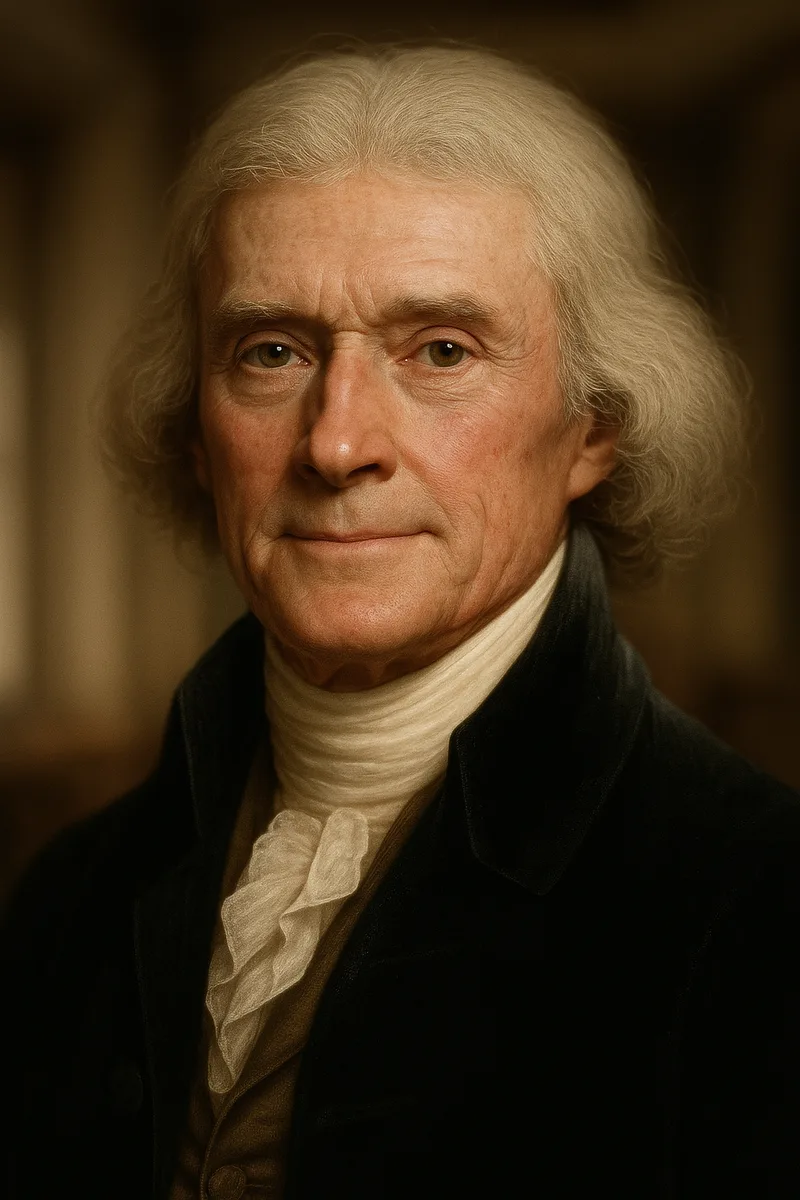
Thomas Jefferson: The Sage of Monticello
Thomas Jefferson was the principal author of the Declaration of Independence, the third President of the United States, and one of the most intellectually versatile figures in American history. Born into the Virginia planter class in 1743, Jefferson was a lawyer, diplomat, architect, scientist, linguist, musician, and philosopher whose range rivaled that of his hero Benjamin Franklin. His declaration that "all men are created equal" became the defining creed of American democracy - and the most consequential sentence in American history. Yet Jefferson's legacy is inextricably bound to the contradiction at its heart: the man who wrote those words enslaved over six hundred human beings in his lifetime. Jefferson's brilliance and his failures, his idealism and his hypocrisy, make him the most complicated of the Founding Fathers - and the one whose legacy Americans continue to debate most intensely.
Context & Background
Thomas Jefferson was born on April 13, 1743, at Shadwell, his family's plantation in Albemarle County, Virginia. His father, Peter Jefferson, was a successful planter, surveyor, and member of the House of Burgesses. His mother, Jane Randolph, came from one of Virginia's most prominent families. Jefferson grew up in the comfortable world of the Virginia gentry - a world built on tobacco, land, and the labor of enslaved people.
Colonial Virginia in the mid-eighteenth century was a society of stark contrasts: a planter aristocracy that read Locke and Cicero, debated natural rights and constitutional government, and maintained its wealth through the enslavement of human beings. Jefferson absorbed both the Enlightenment idealism and the racial hierarchy of this world, and he never resolved the tension between them.
He was educated at the College of William and Mary, where he studied under William Small, who introduced him to the writings of the British empiricists - Locke, Newton, and Bacon, whom Jefferson would later call "the three greatest men that have ever lived." He read law under George Wythe, the foremost legal scholar in Virginia, and was admitted to the bar in 1767. He entered politics almost immediately, winning election to the House of Burgesses in 1769.
The imperial crisis that would lead to American independence was already gathering. British attempts to tax the colonies after the Seven Years' War provoked fierce resistance, and Jefferson quickly emerged as one of the most eloquent voices for colonial rights. His pamphlet A Summary View of the Rights of British America (1774) argued that the colonies owed allegiance to the king but not to Parliament - a radical position that brought him to the attention of the Continental Congress.
In June 1776, the Continental Congress appointed a five-member committee to draft a declaration of independence from Britain. The committee delegated the actual writing to Jefferson, then thirty-three years old. Working in a rented room on Market Street in Philadelphia, he produced one of the most consequential documents in human history.
"We hold these truths to be self-evident," Jefferson wrote, "that all men are created equal, that they are endowed by their Creator with certain unalienable Rights, that among these are Life, Liberty and the pursuit of Happiness." These words, drawn from Locke's political philosophy but transmuted by Jefferson's literary genius, became the founding creed of the American republic and an inspiration for democratic movements around the world.
The contradiction was immediate and obvious. Jefferson, who declared all men equal, enslaved over 600 people during his lifetime. He included a passage in his original draft condemning the slave trade - which Congress deleted - yet he never freed more than a handful of the people he held in bondage. His relationship with Sally Hemings, an enslaved woman who was also the half-sister of his late wife Martha, produced six children and has been confirmed by DNA evidence. The relationship began when Hemings was approximately sixteen and Jefferson was forty-four - a power dynamic that makes the concept of consent deeply problematic.
Jefferson served as Governor of Virginia, Minister to France, Secretary of State under George Washington, Vice President under John Adams, and two-term President (1801-1809). His presidency was marked by the Louisiana Purchase (1803) - which doubled the size of the nation - the Lewis and Clark Expedition, and a commitment to limited government, agrarian democracy, and individual liberty.
He was the founder of the University of Virginia, which he designed architecturally and conceived as a new model for American higher education - secular, rational, and dedicated to intellectual freedom. He was also the architect of Monticello, his mountaintop home near Charlottesville, which he designed and redesigned over decades and which reflects his eclectic intellectual interests in its every detail.
Jefferson's political philosophy emphasized the rights of the individual against the power of government, the importance of an educated citizenry, and the dangers of concentrated wealth and power. He championed religious freedom, authoring the Virginia Statute for Religious Freedom (1786), which became a model for the First Amendment.
Jefferson was a man of staggering intellectual range. He spoke six languages (English, French, Italian, Spanish, Latin, and Greek), played the violin, invented a swivel chair, a revolving bookstand, and an improved plow, and maintained a library of over 6,000 volumes that became the foundation of the Library of Congress after the British burned the original collection in 1814.
He maintained a remarkable correspondence - over 19,000 letters survive - including a late-life exchange with John Adams that is one of the great literary achievements of American political thought. The two men, who had been allies, then bitter enemies, then friends again, wrote to each other about philosophy, politics, religion, and mortality with extraordinary candor and eloquence.
Jefferson died on July 4, 1826 - the fiftieth anniversary of the Declaration of Independence - just hours before Adams, who reportedly died with the words "Thomas Jefferson survives" on his lips. Jefferson had composed his own epitaph, listing the three achievements he wished to be remembered for: the Declaration of Independence, the Virginia Statute for Religious Freedom, and the founding of the University of Virginia. He did not mention his presidency.