
Benjamin Franklin
Quotes & Wisdom
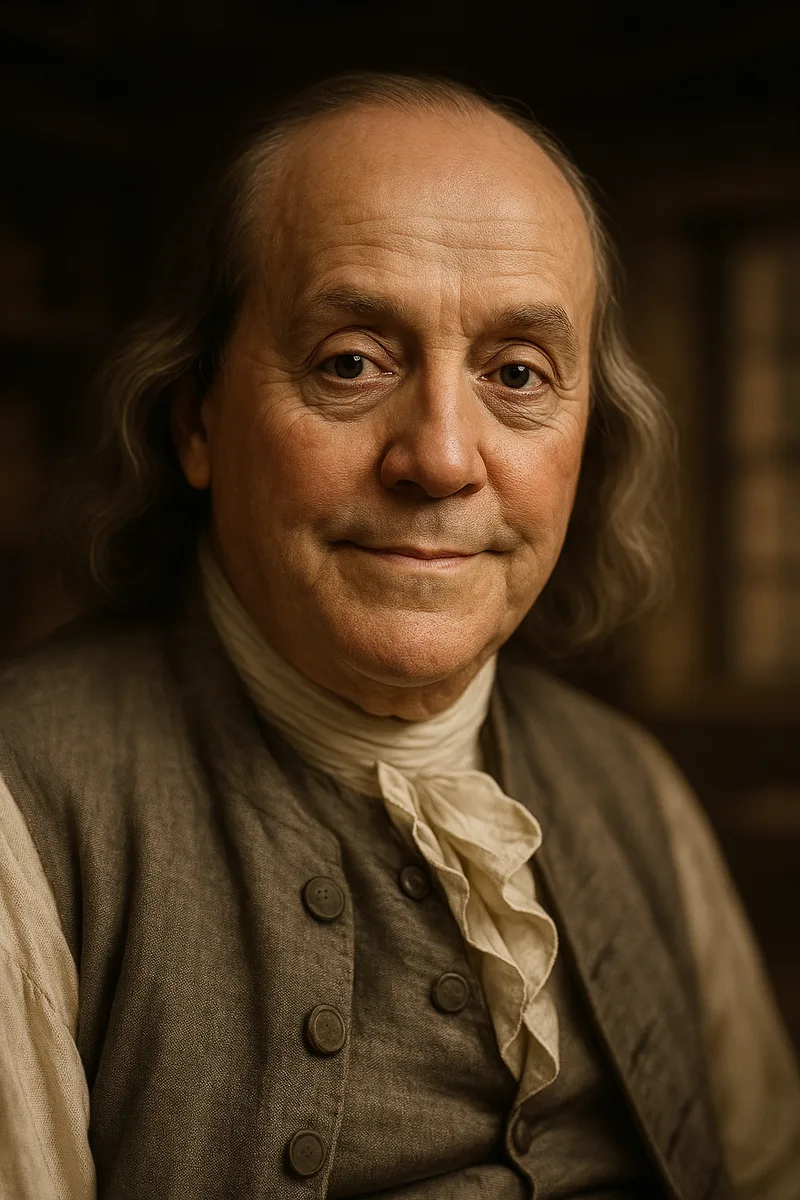
Benjamin Franklin: America's Renaissance Man
Benjamin Franklin was the most versatile genius America has produced. Printer, scientist, inventor, diplomat, writer, and Founding Father - he excelled at everything he attempted with a combination of practical intelligence, relentless curiosity, and disarming wit. His experiments with electricity made him internationally famous; his diplomacy secured the French alliance that won American independence; his inventions, from the lightning rod to bifocal glasses, improved daily life for millions. Through Poor Richard's Almanack and his autobiography, he shaped the American character itself - pragmatic, self-improving, democratic, and optimistic. Born in Boston in 1706, the fifteenth of seventeen children, Franklin proved that talent and industry could overcome any circumstance of birth.
Context & Background
Benjamin Franklin was born on January 17, 1706, in Boston, Massachusetts, into a large Puritan family. His father, Josiah Franklin, was a candle and soap maker who had emigrated from England. With seventeen children to support, Josiah could only afford to send Benjamin to school for two years. At twelve, Benjamin was apprenticed to his older brother James, a printer - a trade that would shape his entire career.
Colonial America in the early eighteenth century was a world of limited social mobility, where birth largely determined destiny. But printing was a gateway to knowledge and influence, and Franklin seized it. He devoured books, taught himself to write by imitating essays in The Spectator, and at seventeen ran away from his brother's print shop to Philadelphia, arriving with barely a dollar to his name. Philadelphia in the 1720s was a rapidly growing city, more tolerant and diverse than Puritan Boston, and it became Franklin's home for the rest of his life.
The intellectual world Franklin inhabited was that of the Enlightenment - the Age of Reason - when thinkers across Europe and America believed that human progress was possible through science, education, and rational inquiry. Franklin became the American Enlightenment's foremost representative, corresponding with scientists and philosophers across the Atlantic while building a practical career as a printer, publisher, and civic leader.
Franklin's scientific achievements would be remarkable for someone who did nothing else. His experiments with electricity in the late 1740s and early 1750s - culminating in the famous (and dangerous) kite experiment of 1752 - demonstrated that lightning was electrical in nature and led to the invention of the lightning rod, which saved countless buildings and lives. He was elected to the Royal Society of London, awarded its Copley Medal, and became the most celebrated scientist in the world.
But Franklin's inventive mind ranged far beyond electricity. He invented the Franklin stove (more efficient than open fireplaces), bifocal glasses, the flexible urinary catheter, and the glass armonica (a musical instrument that Mozart and Beethoven composed for). He mapped the Gulf Stream, studied ocean temperatures, and made observations about weather patterns. He refused to patent any of his inventions, believing they should benefit everyone freely.
Franklin's diplomatic achievement was perhaps his greatest. As American ambassador to France from 1778 to 1785, he secured the military alliance and financial support without which the American Revolution almost certainly would have failed. The French loved him - his fur cap, his homespun wit, his scientific fame - and he played the role of the noble American democrat with consummate skill.
He is the only person to have signed all four of the documents that founded the United States: the Declaration of Independence, the Treaty of Alliance with France, the Treaty of Paris ending the Revolutionary War, and the Constitution. At the Constitutional Convention of 1787, aged eighty-one, he served as a moderating elder statesman, urging compromise when tempers flared between large and small states.
Franklin established America's first lending library, first volunteer fire department, first public hospital, and the University of Pennsylvania. He was a vegetarian in his youth (inspired by Thomas Tryon) but later abandoned the practice when the smell of frying fish proved irresistible - a lapse he justified with characteristic humor. He wrote a famous essay on flatulence ("Fart Proudly") for the Royal Academy of Brussels. He fathered an illegitimate son, William, who became the royal governor of New Jersey and a Loyalist during the Revolution - a breach that never fully healed. He spent his final years advocating for the abolition of slavery, having evolved from a slaveholder in his middle years to an abolitionist in his old age. He died on April 17, 1790, at eighty-four, and 20,000 people attended his funeral in Philadelphia.