
René Descartes
Quotes & Wisdom
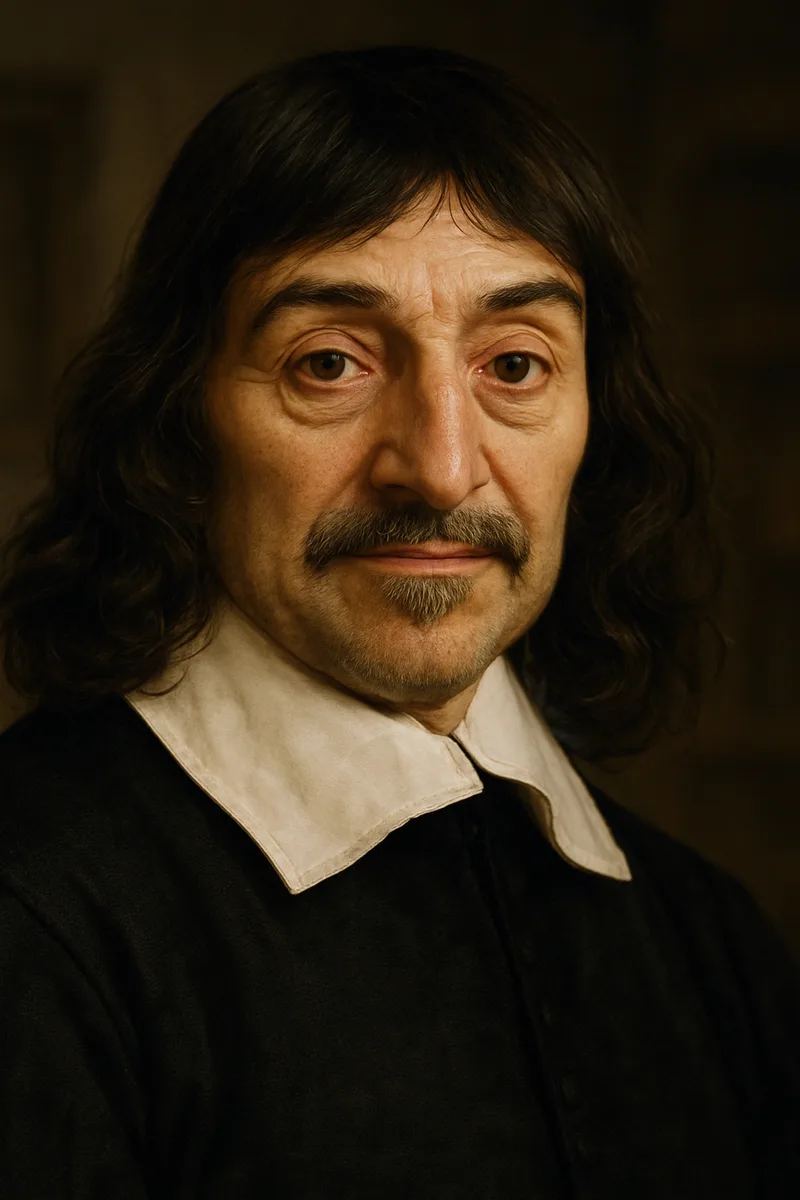
René Descartes: The Father of Modern Philosophy
René Descartes set Western philosophy on a new course with a single, radical question: What can I know for certain? His method of systematic doubt - stripping away every belief that could possibly be false until he arrived at the one thing that could not be denied, his own thinking existence - gave us the most famous sentence in philosophy: "I think, therefore I am." Born in the Loire Valley of France in 1596, Descartes was a mathematician, scientist, and philosopher whose work bridged the medieval and modern worlds. He invented the Cartesian coordinate system, made foundational contributions to optics and geometry, and wrote works that remain required reading in philosophy departments around the world. His insistence that reason, not authority or tradition, was the path to truth helped launch the scientific revolution and the Enlightenment.
Context & Background
René Descartes was born on March 31, 1596, in La Haye en Touraine (now Descartes), a small town in central France. His mother died when he was an infant, and he was raised by his maternal grandmother and a nurse, to whom he was deeply attached. His father, Joachim Descartes, was a councillor in the Parlement of Brittany - a prosperous member of the minor nobility. The family's comfortable means allowed Descartes to receive an excellent education at the Jesuit college of La Flèche, one of the finest schools in Europe.
The early seventeenth century was a period of intellectual upheaval. The medieval worldview, built on Aristotle's philosophy and the authority of the Catholic Church, was under assault from multiple directions. Copernicus had displaced the Earth from the center of the universe. Galileo Galilei was turning his telescope toward the heavens and discovering things that contradicted established doctrine. The Reformation had shattered the unity of Western Christendom. Religious wars - including the devastating Thirty Years' War (1618-1648), in which Descartes briefly served as a soldier - were tearing Europe apart.
In this atmosphere of uncertainty, Descartes sought a new foundation for knowledge - something that could withstand any challenge and provide a secure starting point for science and philosophy. His education at La Flèche had given him a thorough grounding in scholastic philosophy, mathematics, and classical literature, but he came away dissatisfied. "I found myself embarrassed with so many doubts and errors," he later wrote, "that it seemed to me that the effort to instruct myself had no effect other than the increasing discovery of my own ignorance."
On November 10, 1619, while serving in the army and wintering in a small town in Germany, Descartes experienced a series of three vivid dreams that he interpreted as a divine call to devote his life to the pursuit of truth through reason. This night became the mythic origin of his philosophical project.
The method he developed was radical in its simplicity. In his Meditations on First Philosophy (1641), Descartes resolved to doubt everything that could possibly be doubted - the evidence of his senses, the truths of mathematics, even the existence of the external world. He imagined that an evil demon might be systematically deceiving him about everything. But even in the midst of this extreme skepticism, one thing remained certain: the very act of doubting proved that he existed as a thinking being. Cogito, ergo sum - "I think, therefore I am."
From this single certainty, Descartes attempted to rebuild the entire edifice of human knowledge. He argued for the existence of God (as a being whose perfection guaranteed the reliability of human reason), for the reality of the external world, and for a fundamental distinction between mind and body - a dualism that has shaped Western thought ever since.
Descartes was not merely a philosopher; he was one of the most important mathematicians and scientists of his era. His Geometry (1637), published as an appendix to the Discourse on the Method, introduced the Cartesian coordinate system - the framework that allows geometric shapes to be described using algebraic equations. This innovation, which seems obvious in retrospect, was revolutionary: it unified two previously separate branches of mathematics and laid the groundwork for calculus, which Isaac Newton and Leibniz would develop later in the century.
In optics, Descartes formulated the law of refraction (now known as Snell's law, though Descartes discovered it independently) and made significant contributions to the understanding of rainbows. In physics, he proposed a mechanistic view of the universe in which all natural phenomena could be explained by the motion and collision of matter - a view that, while wrong in its details, pointed toward the modern scientific worldview.
His philosophical method - clear and distinct ideas, systematic doubt, the primacy of reason - became the model for scientific inquiry more broadly. The Cartesian aspiration to reduce complex phenomena to simple, self-evident principles lies at the heart of the scientific method as it developed through the Enlightenment.
Descartes spent most of his adult life in the Netherlands, where the relative intellectual freedom and tolerance allowed him to work without fear of persecution. He moved frequently - living in at least eighteen different addresses in twenty years - partly to maintain his privacy and concentration. He was intensely protective of his working time and typically spent his mornings in bed, thinking and writing. This habit may have contributed to his death: when Queen Christina of Sweden invited him to Stockholm in 1649 and insisted on philosophy lessons at five in the morning, Descartes contracted pneumonia and died on February 11, 1650, at the age of fifty-three.
Descartes had a daughter, Francine, born in 1635 to a servant named Helena Jans. Francine died of scarlet fever at the age of five, and Descartes reportedly described her death as the greatest sorrow of his life. He never married.
His remains had a remarkable posthumous journey. Originally buried in Stockholm, his body was exhumed in 1666 and returned to France. His skull was separated from the rest of his remains and passed through several private collections before ending up in the Musée de l'Homme in Paris, where it remains today - a fitting, if macabre, tribute to the man who argued that the mind was the essence of the self.