
Nikola Tesla
Quotes & Wisdom
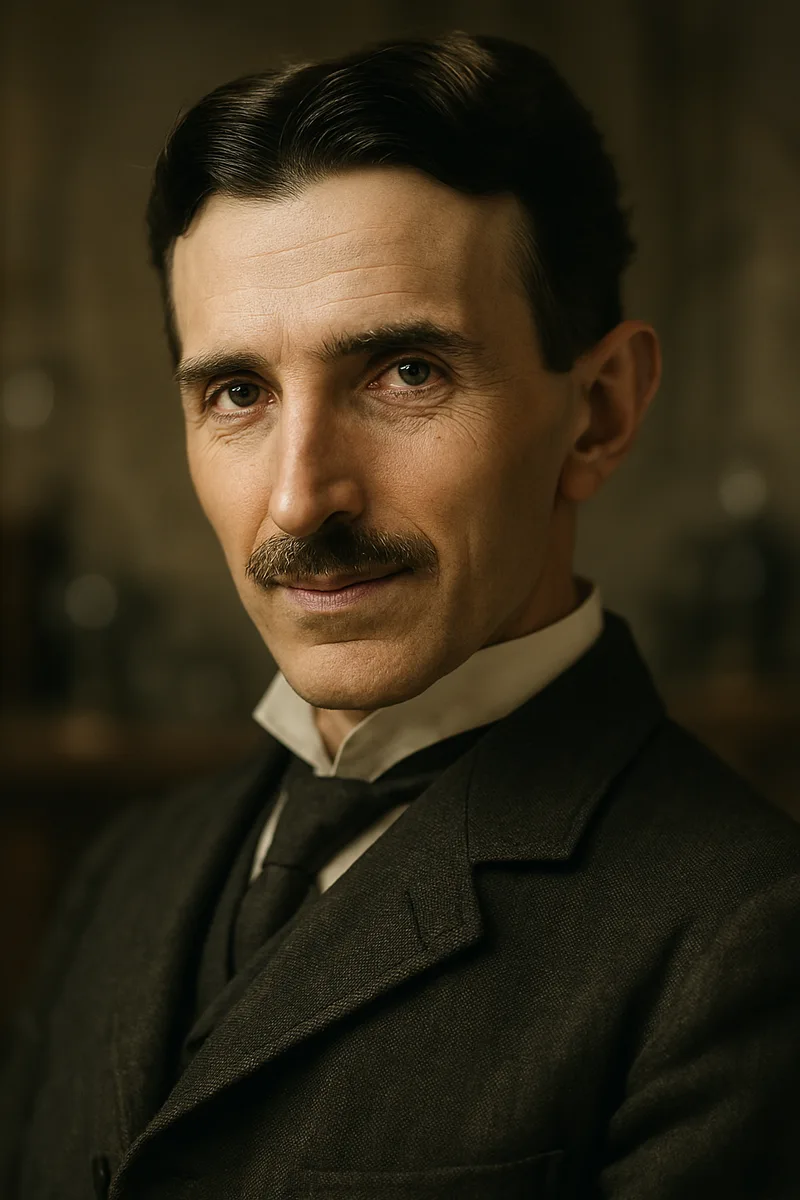
Nikola Tesla: The Wizard of Electricity
Nikola Tesla was one of the most visionary inventors in human history, a man whose work on alternating current, wireless transmission, and rotating magnetic fields helped electrify the modern world. Born in the village of Smiljan in the Austrian Empire - present-day Croatia - Tesla emigrated to the United States in 1884 with little more than a letter of introduction to Thomas Edison. What followed was one of history's great rivalries and one of its great tragedies: Tesla's genius produced some 300 patents and transformed civilization, yet he died in near-poverty in a New York hotel room. His name has become synonymous with inspired, obsessive invention, and his words reveal a mind that saw the future with startling clarity.
Context & Background
Nikola Tesla was born on July 10, 1856, in Smiljan, a small village in the Military Frontier of the Austrian Empire, in what is now Croatia. His father, Milutin Tesla, was a Serbian Orthodox priest and writer; his mother, Djuka Mandic, was an inventive woman who built household tools and had a prodigious memory, though she never received a formal education. Tesla credited his mother as the source of his inventive instinct.
The mid-nineteenth century was a period of rapid industrialization across Europe and North America. The harnessing of electricity was the great technological frontier, and inventors on both sides of the Atlantic were racing to develop practical systems for generating and distributing electrical power. Tesla studied engineering and physics at the Technical University of Graz and the University of Prague, though he did not complete a degree at either institution. While walking in a Budapest park in 1882, he experienced the flash of insight that would define his career: the concept of the rotating magnetic field and the alternating current induction motor.
In 1884, Tesla arrived in New York City to work for Thomas Edison, whose direct current system was the dominant electrical technology of the day. The two men could hardly have been more different - Edison the empirical tinkerer, Tesla the theoretical visionary. Their professional relationship lasted only about six months, but the rivalry between their competing electrical systems - AC versus DC - would define an era. Tesla found a patron in George Westinghouse, who licensed Tesla's AC patents and used them to win the contract to illuminate the 1893 World's Columbian Exposition in Chicago, a triumph that effectively decided the "War of Currents" in favor of alternating current.
Tesla's contributions to electrical engineering are difficult to overstate. His polyphase alternating current system - comprising generators, transformers, transmission lines, and motors - is the foundation of the modern electrical grid. Before Tesla, electricity was a local affair: Edison's direct current power stations could only serve customers within a mile or so of the generating plant. Tesla's AC system allowed power to be transmitted efficiently over hundreds of miles, making large-scale electrification possible for the first time.
The Niagara Falls hydroelectric project, completed in 1896, was the definitive proof of concept. Tesla designed the AC generators that harnessed the power of the falls, and the electricity was transmitted to Buffalo, New York, twenty-six miles away - a feat that would have been impossible with direct current. The success at Niagara Falls established AC as the global standard and laid the groundwork for the electrified world we inhabit today.
But Tesla's ambitions went far beyond power distribution. He was a pioneer of wireless communication, building a radio-controlled boat in 1898 that astonished crowds at Madison Square Garden. He developed the Tesla coil, a resonant transformer circuit still used in radio technology, and he conducted groundbreaking experiments in X-ray imaging, fluorescent lighting, and high-frequency electrical phenomena.
Tesla's imagination was both his greatest asset and his greatest liability. He could visualize machines in complete detail in his mind, rotating them and testing them mentally before committing anything to paper. This extraordinary capacity for mental modeling allowed him to design with remarkable efficiency - but it also contributed to a tendency toward grandiosity that sometimes detached him from practical reality.
His most ambitious project, the Wardenclyffe Tower on Long Island, was intended to demonstrate worldwide wireless transmission of both communication and power. Construction began in 1901 with funding from J.P. Morgan, but the project was never completed. Morgan withdrew his support, and the tower was eventually demolished in 1917 to pay debts. Tesla was devastated, and his financial situation never recovered.
Tesla's personal life was marked by intense solitude and increasingly eccentric behavior. He never married, claiming that celibacy helped him concentrate on his work. He developed severe obsessive-compulsive traits - an aversion to pearls, a compulsion to complete tasks in multiples of three, and an obsession with pigeons, particularly a white female pigeon he claimed to love "as a man loves a woman." He lived his final decades in a series of New York hotels, often running up bills he could not pay, surviving on a modest pension from the Yugoslav government and occasional consulting fees.
Despite his personal struggles, Tesla's mind never stopped generating ideas. He claimed to have conceived a "death ray" - a particle beam weapon - and offered it to various governments as a tool for ending war. He speculated about interplanetary communication, renewable energy, and robotics, often decades before these fields became serious areas of research.
Tesla spoke eight languages, including Serbian, Czech, English, French, German, Hungarian, Italian, and Latin. He was a skilled poet and a devoted reader who memorized entire books. His friendship with Mark Twain was genuine and warm - Twain was a frequent visitor to Tesla's laboratory, and Tesla once used his equipment to play a practical joke on the writer involving resonant vibrations.
Tesla held approximately 300 patents across 26 countries. The SI unit of magnetic flux density, the tesla, was named in his honor in 1960. He was nominated for the Nobel Prize in Physics but never received it - a controversy that has fueled speculation ever since.
He died alone on January 7, 1943, in Room 3327 of the New Yorker Hotel in Manhattan, at the age of eighty-six. After his death, the FBI seized his papers, concerned about the potential military applications of his research. His legacy, long overshadowed by Edison's, has experienced a remarkable revival in the twenty-first century, driven by popular culture, the internet, and - most visibly - the electric car company that bears his name.