
Thomas Edison
Quotes & Wisdom
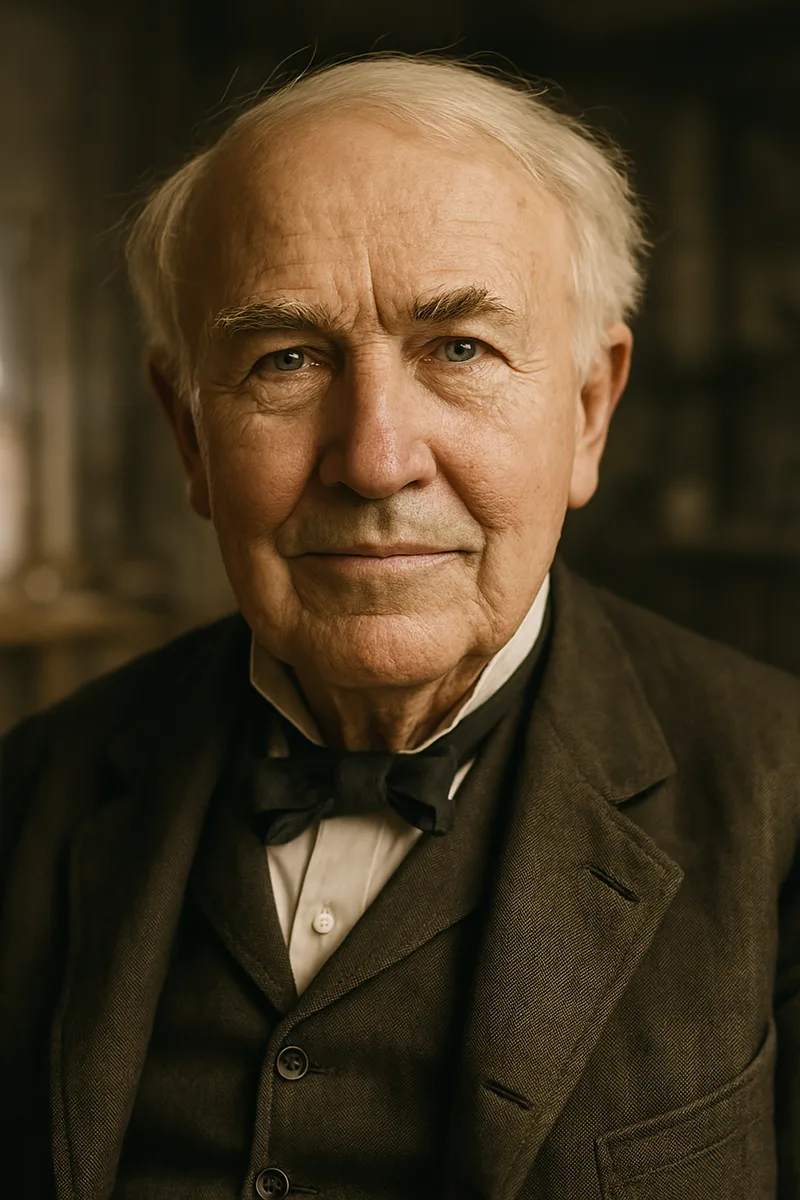
Thomas Edison: The Wizard of Menlo Park
Thomas Alva Edison was the most prolific inventor in American history and one of the most influential figures of the modern age. Holding 1,093 U.S. patents - a record that stood for decades - Edison developed the phonograph, the practical incandescent light bulb, the motion picture camera, and the first commercially viable electrical power distribution system. Born in Milan, Ohio, in 1847, largely self-educated, and nearly deaf from childhood, Edison built the world's first industrial research laboratory at Menlo Park, New Jersey, and pioneered the modern model of systematic, team-based invention. His rivalry with Nikola Tesla over alternating versus direct current became one of the great technological battles of the industrial age. More than any single person, Edison shaped the material world of the twentieth century.
Context & Background
Thomas Alva Edison was born on February 11, 1847, in Milan, Ohio, the youngest of seven children of Samuel and Nancy Edison. His father was a political activist and shingle maker; his mother, a former schoolteacher, became his primary educator after he was pulled from school at age seven - reportedly because a teacher called him "addled." Nancy Edison taught her son to read and fostered his voracious curiosity, and Edison later credited her as the making of him: "My mother was the making of me. She was so true, so sure of me; and I felt I had something to live for, someone I must not disappoint."
The America of Edison's youth was being transformed by the Industrial Revolution. Railroads, telegraph lines, and factories were reshaping the landscape and creating enormous demand for practical innovation. Edison began his career as a telegraph operator, a job that combined technical skill with the excitement of working at the cutting edge of communications technology. He was largely self-taught - reading voraciously, experimenting constantly, and developing the hands-on, trial-and-error approach to invention that would define his career.
Edison suffered from progressive hearing loss beginning in childhood - probably caused by scarlet fever or a genetic condition - and by adulthood was nearly deaf. He treated this not as a disability but as an advantage, claiming it helped him concentrate and freed him from the distraction of unnecessary conversation.
Edison's greatest innovation may not have been any single device but the concept of the industrial research laboratory itself. In 1876, he established a laboratory at Menlo Park, New Jersey, staffed with a team of machinists, scientists, and technicians whose sole purpose was to produce inventions on a systematic basis. This was revolutionary: before Edison, invention was largely an individual, ad hoc activity. Edison industrialized it, promising "a minor invention every ten days and a big thing every six months or so."
The promise was not idle. In 1877, Edison invented the phonograph - the first device capable of recording and reproducing sound. The achievement astonished the public and earned him the nickname "The Wizard of Menlo Park." The following year, he turned his attention to electric lighting, and after thousands of experiments with different filament materials, produced a practical incandescent light bulb in October 1879. But Edison understood that a light bulb without a power system was useless, so he also designed and built the entire infrastructure of electrical power generation and distribution - generators, wiring, switches, meters, and the Pearl Street power station in lower Manhattan, which began operation in 1882.
Edison's electrical system used direct current (DC), which could only be transmitted short distances without significant power loss. Nikola Tesla and George Westinghouse championed alternating current (AC), which could be transmitted efficiently over long distances using transformers. The resulting "War of Currents" in the late 1880s and early 1890s was one of the most dramatic technological battles in history.
Edison fought fiercely for DC, engaging in a public relations campaign that included the electrocution of animals to demonstrate the supposed dangers of AC. He supported the development of the electric chair - using AC - as a way to associate his rival's technology with death. Despite these efforts, AC's technical superiority was undeniable, and the Westinghouse-Tesla system eventually prevailed. Edison's loss in the War of Currents was one of the few major defeats in his career, and it demonstrated both the limits of his empirical approach and his unwillingness to abandon a position once committed.
Edison moved to a larger laboratory complex in West Orange, New Jersey, in 1887, and continued inventing at a prodigious pace. He developed the kinetoscope (an early motion picture viewer), improved the phonograph, worked on storage batteries, and experimented with everything from cement houses to an electric car. During World War I, he chaired the Naval Consulting Board and worked on military applications of technology.
His method was famously empirical: try everything, fail often, learn from each failure, and keep going. "I have not failed," he reportedly said. "I've just found 10,000 ways that won't work." This approach was enormously productive but also limited: Edison lacked the mathematical and theoretical training that might have led him to solutions more efficiently, and his stubbornness sometimes kept him pursuing dead ends long after others had moved on.
Edison was a workaholic who regularly slept only four hours a night, taking brief naps on a cot in his laboratory. He expected the same dedication from his employees and was not always a generous employer - he was notoriously reluctant to share credit or profits with his team members.
He was also a shrewd businessman who understood that invention without commercialization was mere tinkering. He founded over a dozen companies, including what would eventually become General Electric, and he was among the first to grasp that intellectual property - patents - was the real currency of the innovation economy.
Edison died on October 18, 1931, in West Orange, New Jersey, at the age of eighty-four. President Herbert Hoover asked Americans to turn off their lights for one minute in tribute - a fitting gesture for the man who had given them the means to turn them on.