
Mark Twain
Quotes & Wisdom
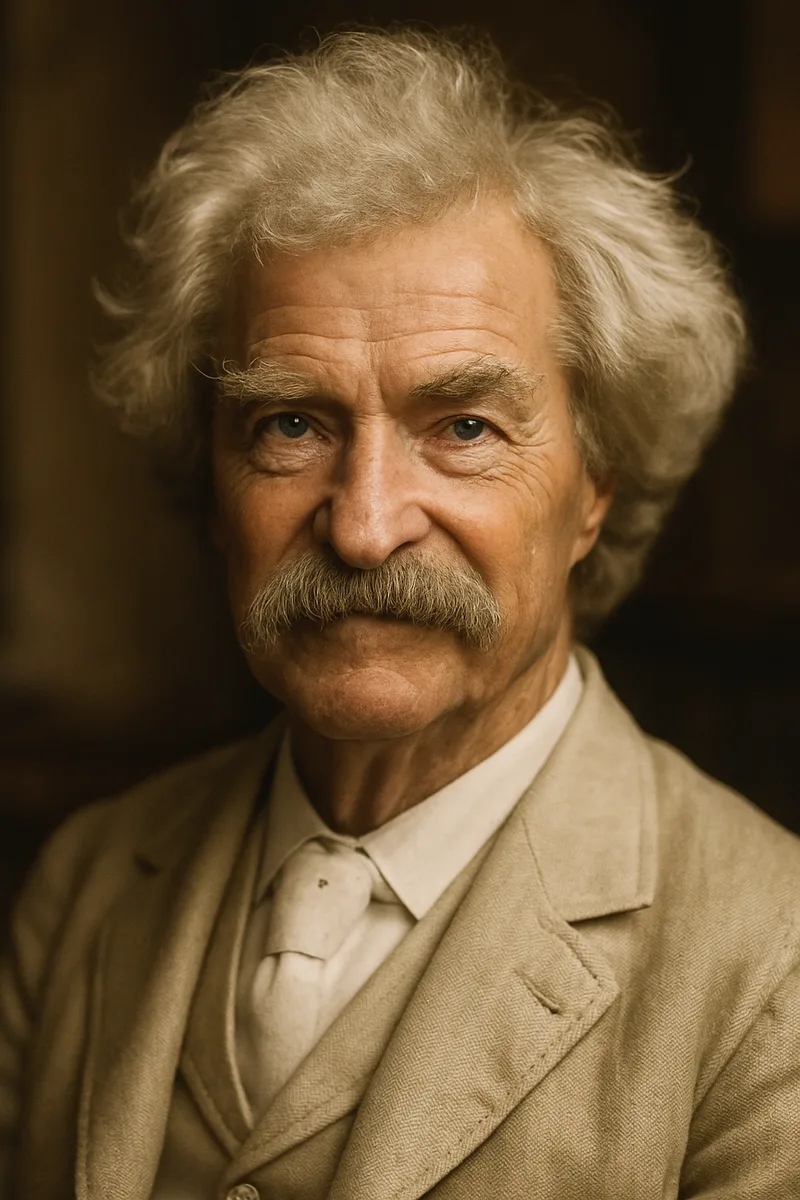
Mark Twain: America's Greatest Literary Voice
Mark Twain was the pen name of Samuel Langhorne Clemens, the writer who invented modern American literature and wielded humor as a weapon against hypocrisy, injustice, and pomposity with a precision that has never been surpassed. Born in 1835 in a small Missouri town, he worked as a riverboat pilot, silver miner, and journalist before publishing The Adventures of Tom Sawyer and Adventures of Huckleberry Finn - the latter called by Ernest Hemingway the book from which "all modern American literature comes." His wit was legendary, his observations on human nature devastatingly accurate, and his influence on the English language so pervasive that dozens of sayings attributed to him have become part of everyday speech.
Context & Background
Samuel Langhorne Clemens was born on November 30, 1835, in Florida, Missouri, a village of roughly one hundred people. The family moved to Hannibal, Missouri, when Sam was four, and it was this Mississippi River town - with its steamboats, caves, islands, and social hierarchies - that would provide the raw material for his greatest fiction. Hannibal was a slaveholding community, and young Sam grew up among enslaved people, absorbing both the casual cruelty of the institution and the humanity of the individuals caught within it. These childhood observations would fuel the moral core of his writing decades later.
His father, John Marshall Clemens, was a lawyer and small-time businessman who died when Sam was eleven, leaving the family in financial difficulty. Sam left school to work as a printer's apprentice, and by his early twenties he had fulfilled his childhood dream of becoming a Mississippi River steamboat pilot - a prestigious, well-paid profession that required memorizing every sandbar, snag, and current along twelve hundred miles of river. He later said these years on the river gave him his pen name (a riverboat term meaning two fathoms deep - safe water) and, more importantly, his education in human nature.
The Civil War shut down river traffic, and Clemens drifted west. He tried silver mining in Nevada, failed spectacularly, and turned to journalism. His humorous dispatches from the Nevada Territory and later from San Francisco made him a regional celebrity, and his 1865 short story "The Celebrated Jumping Frog of Calaveras County" made him a national one. By the 1870s, he was the most famous writer in America, married to Olivia Langdon - the daughter of a wealthy New York coal magnate - and living in a lavish Hartford, Connecticut, mansion that reflected his ambitions.
Mark Twain's literary achievement was fundamentally about voice. Before Twain, American literature was largely written in the formal, Latinate style imported from England. Twain wrote the way Americans actually talked - in dialect, in slang, in the rhythms of everyday speech. This was not a stylistic quirk but a philosophical statement: that the language of ordinary people was worthy of literature, and that truth was more likely to be found in a riverboat pilot's yarn than in a Harvard professor's essay.
Adventures of Huckleberry Finn (1884) is the masterwork. On the surface, it is an adventure story about a boy and an escaped slave floating down the Mississippi on a raft. Beneath the surface, it is the most devastating critique of American racism written in the nineteenth century. The climactic moment comes when Huck, having been taught that helping a runaway slave will send him to hell, decides to help his friend Jim anyway: "All right, then, I'll go to hell." In that single sentence, Twain captured the moral revolution that occurs when an individual conscience overrides the corrupted values of an entire society.
His other major works - The Adventures of Tom Sawyer, A Connecticut Yankee in King Arthur's Court, The Prince and the Pauper, Pudd'nhead Wilson - continued his exploration of American identity, class, and the gap between what people profess and what they do. He was also a masterful travel writer whose The Innocents Abroad and Roughing It demolished the reverence with which Americans treated European culture.
Twain's humor was not mere entertainment - it was a method of truth-telling. He understood that laughter disarms the defenses that protect comfortable illusions, and he used it ruthlessly. His targets included organized religion, political corruption, imperialism, and above all the human capacity for self-deception. "It is easier to fool people than to convince them that they have been fooled," he reportedly observed, and this insight animated his entire body of work.
As he aged, his humor darkened. The deaths of his wife and two of his three daughters, combined with financial ruin from bad investments, pushed him toward a bleak philosophical pessimism. Late works like The War Prayer and The Mysterious Stranger are savage indictments of human cruelty and divine indifference. Yet even in his darkest moments, Twain's prose retained its crackling energy and comic timing, suggesting that humor and despair are not opposites but companions.
He was also among the first American celebrities to use his fame for political purposes. He opposed American imperialism in the Philippines, championed anti-lynching legislation, and used his platform to advocate for causes he believed in - always with the understanding that satire could accomplish what sermons could not.
Twain was obsessed with technology and invested enormous sums in inventions, most disastrously in an automatic typesetting machine called the Paige Compositor. The machine was a mechanical marvel that never worked reliably, and it cost Twain his entire fortune - roughly the equivalent of eight million dollars today. He was forced to declare bankruptcy in 1894 and spent years on grueling worldwide lecture tours to pay back his creditors, which he did in full - an act of financial honor that further cemented his public reputation.
He wore his famous white suits only in the last years of his life, adopting them as a deliberate performance of his public persona. He smoked an estimated forty cigars a day, went to bed at any hour he pleased, and was born in 1835, the year Halley's Comet appeared - and died on April 21, 1910, the day after the comet returned. He had predicted this himself: "I came in with Halley's Comet in 1835. It is coming again next year, and I expect to go out with it." It remains one of the most remarkable coincidences in literary history.