
Niels Bohr
Quotes & Wisdom
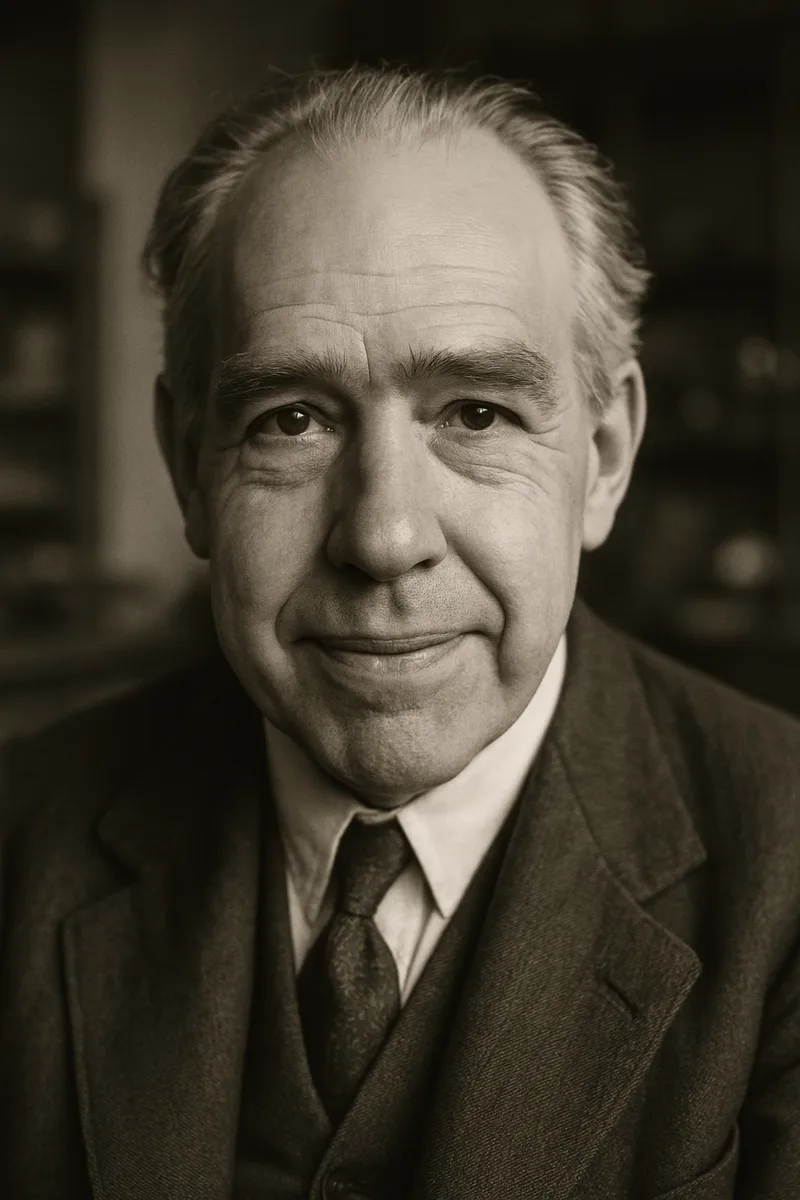
Niels Bohr: Architect of the Quantum World
Niels Bohr transformed our understanding of the atom and laid the foundations of quantum mechanics, earning the Nobel Prize in Physics in 1922. Born in Copenhagen to a family steeped in academic excellence, Bohr became one of the twentieth century's most influential scientists - not only for his revolutionary atomic model but for his philosophical reflections on the nature of knowledge itself. His principle of complementarity challenged classical logic, arguing that contradictory descriptions could both be necessary to capture reality. As the founder of the Copenhagen Institute, Bohr mentored a generation of physicists who would reshape science. His wit and paradoxical style of thinking made him as quotable as he was brilliant, and his dialogues with Albert Einstein remain among the most celebrated intellectual exchanges in history.
Context & Background
Niels Henrik David Bohr was born on October 7, 1885, in Copenhagen, Denmark, into a household where intellectual ambition was the family currency. His father, Christian Bohr, was a professor of physiology at the University of Copenhagen and a twice-nominated candidate for the Nobel Prize. His mother, Ellen Adler, came from a prominent Jewish banking family. Young Niels and his brother Harald - who would become a distinguished mathematician and Olympic footballer - grew up in an environment where dinner-table conversations ranged from philosophy to physics.
Denmark at the turn of the century was a small but culturally confident nation, and Copenhagen's academic circles were cosmopolitan and well connected to the broader European intellectual world. Bohr studied physics at the University of Copenhagen and completed his doctoral thesis on the electron theory of metals in 1911. He then traveled to England, first to Cambridge to work under J.J. Thomson, and then to Manchester, where Ernest Rutherford's laboratory was producing groundbreaking work on atomic structure. It was Rutherford's discovery of the atomic nucleus that gave Bohr the springboard for his own revolutionary contribution.
The early twentieth century was a period of extraordinary upheaval in physics. Max Planck had introduced the quantum hypothesis in 1900, and Albert Einstein had published his papers on the photoelectric effect and special relativity. Classical physics - the framework of Isaac Newton - was proving inadequate at the atomic scale. Bohr stepped into this ferment with his 1913 model of the hydrogen atom, which applied quantum ideas to atomic structure for the first time. The Bohr model was not a final answer, but it was a decisive break with the past, and it earned him the Nobel Prize in Physics in 1922 at the age of thirty-seven.
What set Bohr apart from many of his contemporaries was his insistence that quantum mechanics was not merely a mathematical tool but a fundamental shift in how humans could know the world. His principle of complementarity, articulated in the late 1920s, held that certain pairs of properties - like the wave and particle nature of light - were mutually exclusive yet equally necessary for a complete description. You could measure one or the other, but never both simultaneously.
This was not simply a technical observation; it was a philosophical position with far-reaching implications. Bohr argued that the act of measurement itself shaped what could be known, and that the classical ideal of an objective, observer-independent reality had to be abandoned at the quantum level. These ideas became the core of what is known as the Copenhagen interpretation of quantum mechanics, which remains the most widely taught framework in physics today.
Bohr's dialogues with Albert Einstein on these questions are legendary. Einstein, who famously declared that "God does not play dice," resisted the implications of quantum indeterminacy. At the Solvay Conferences of 1927 and 1930, the two men engaged in elaborate thought experiments - Einstein proposing scenarios designed to expose contradictions in quantum mechanics, Bohr painstakingly refuting each one. The debates were conducted with mutual respect and deep affection, and they sharpened the conceptual foundations of modern physics in ways that continue to reverberate.
In 1921, Bohr founded the Institute of Theoretical Physics at the University of Copenhagen, which quickly became the world's leading center for quantum research. The "Copenhagen spirit" was collaborative, egalitarian, and intensely creative. Young physicists from across Europe - Werner Heisenberg, Wolfgang Pauli, Paul Dirac, and many others - came to work with Bohr, and the institute became a crucible where the new quantum theory was forged through constant debate and revision.
Bohr's leadership style was unique. He was notoriously difficult to follow in conversation, often mumbling and circling back on his own ideas, but his ability to identify the essential difficulty in any problem was unmatched. He would engage colleagues in exhaustive discussions, sometimes lasting hours, wearing down their resistance not through authority but through relentless Socratic questioning.
The rise of Nazism disrupted this scientific paradise. After Germany occupied Denmark in 1940, Bohr remained in Copenhagen, using his influence to protect Jewish scientists and maintain the institute. In 1943, warned of an imminent arrest, he escaped to Sweden by fishing boat and was then flown to England in the bomb bay of a Mosquito aircraft - nearly losing consciousness when his oxygen mask failed. He subsequently traveled to the United States, where he joined the Manhattan Project at Los Alamos under the code name "Nicholas Baker."
Bohr's role at Los Alamos was more philosophical than technical. He grasped early that the atomic bomb would transform international relations and advocated passionately for open sharing of nuclear information between the Allies and the Soviet Union to prevent a catastrophic arms race. He brought this message directly to both Winston Churchill and Franklin D. Roosevelt, but was rebuffed by both leaders. Churchill, in particular, found Bohr's proposal dangerously naive.
Bohr was an avid footballer in his youth, playing goalkeeper for the Copenhagen club Akademisk Boldklub - though his brother Harald was the better player and represented Denmark in the 1908 Olympics. He had a lifelong love of westerns and once explained to a colleague his theory of why the hero always outdraws the villain: the hero, reacting instinctively, is faster than the villain, who must decide to act.
His writing process was legendary for its difficulty. Bohr would dictate drafts to assistants, then revise obsessively, sometimes going through dozens of versions of a single paper. He believed that clarity of expression was inseparable from clarity of thought, and he treated every sentence as a philosophical commitment.
Bohr was awarded the inaugural Atoms for Peace Award in 1957 and spent his later years advocating for the peaceful use of nuclear energy. He died on November 18, 1962, at his home in Copenhagen. His son, Aage Bohr, would follow in his footsteps, winning the Nobel Prize in Physics in 1975. Few families have left a deeper mark on the history of science.