
Winston Churchill
Quotes & Wisdom
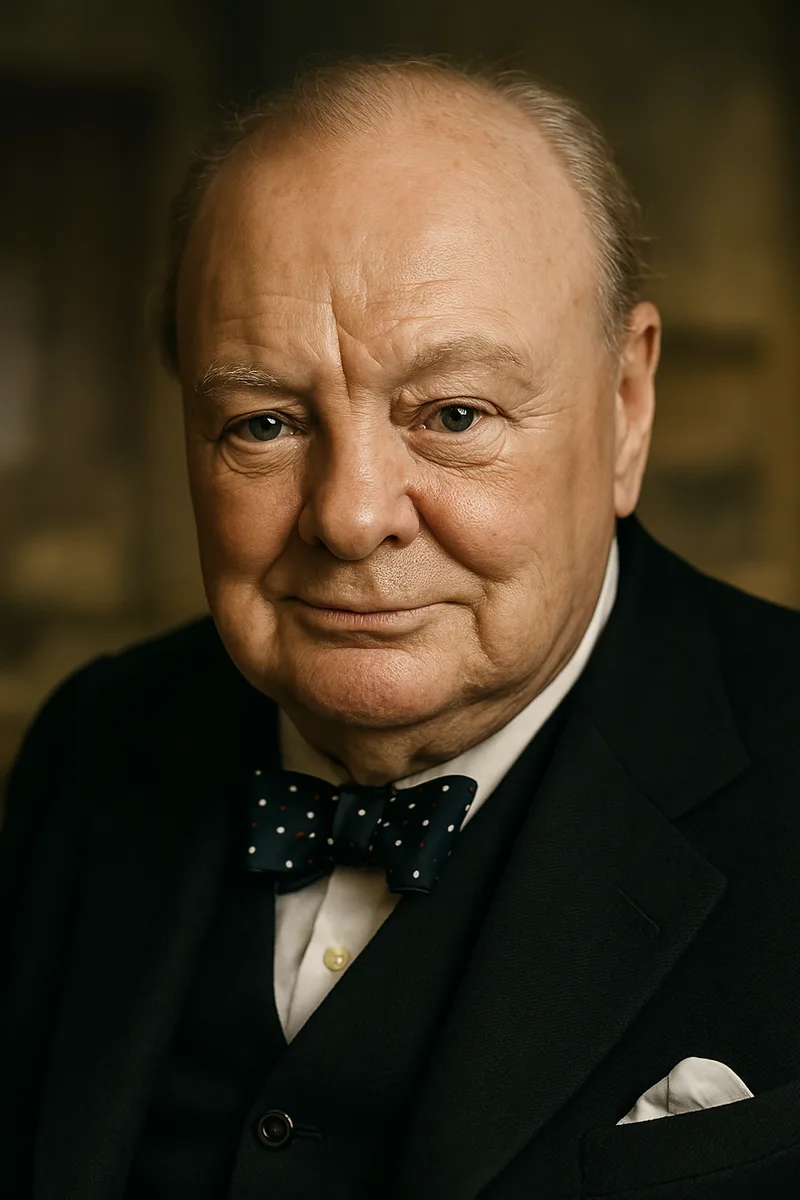
Winston Churchill: The Voice of Defiance
Winston Churchill was the British Prime Minister who rallied a nation and helped save Western civilization during its darkest hour. Born into the English aristocracy in 1874, Churchill lived one of the most extraordinary lives of the twentieth century - soldier, war correspondent, cabinet minister, painter, historian, Nobel Prize-winning author, and twice Prime Minister. But it is his leadership during World War II that defines his legacy. When Britain stood alone against Nazi Germany in 1940, Churchill's speeches - delivered with a combination of rhetorical grandeur, bulldog defiance, and bone-dry wit - transformed the English language into a weapon of war. His words stiffened the spine of a nation and gave voice to the democratic world's refusal to surrender. He remains the gold standard against which all wartime leaders are measured.
Context & Background
Winston Leonard Spencer Churchill was born on November 30, 1874, at Blenheim Palace, the ancestral home of the Dukes of Marlborough. His father, Lord Randolph Churchill, was a brilliant but erratic Conservative politician; his mother, Jennie Jerome, was an American socialite of great beauty and energy. Winston's childhood was emotionally austere - he adored his parents but saw them rarely, spending most of his youth at boarding schools where he was an indifferent student who excelled only in English and history.
The British Empire into which Churchill was born was at the zenith of its power, governing a quarter of the world's land surface and a quarter of its population. Churchill absorbed the imperial worldview with his mother's milk and never entirely abandoned it - his attitudes toward India, race, and empire remained Victorian throughout his life, and they constitute the most problematic aspect of his legacy.
After Sandhurst, Churchill served as a cavalry officer and war correspondent in Cuba, India, Sudan, and South Africa, combining military service with journalism in a way that made him famous by his mid-twenties. He was elected to Parliament in 1900 and held virtually every major cabinet position over the next four decades - Home Secretary, First Lord of the Admiralty, Chancellor of the Exchequer, Secretary of State for War - gaining a reputation for brilliance, energy, and unreliability. His sponsorship of the disastrous Gallipoli campaign in 1915 nearly destroyed his career, and his years "in the wilderness" during the 1930s, warning about the rise of Hitler while being ignored by the establishment, seemed to confirm that he was a man whose time had passed.
Everything changed on May 10, 1940, when Churchill became Prime Minister as German forces swept through the Low Countries and France. Within weeks, the British army was trapped at Dunkirk, France had fallen, and Britain stood alone against the most powerful military machine in history. It was the moment for which Churchill's entire life had been preparation.
His speeches during the summer of 1940 are among the greatest in the English language. "I have nothing to offer but blood, toil, tears and sweat." "We shall fight on the beaches, we shall fight on the landing grounds, we shall fight in the fields and in the streets, we shall fight in the hills; we shall never surrender." "This was their finest hour." "Never in the field of human conflict was so much owed by so many to so few."
These were not merely beautiful words. They were acts of war - weapons deployed to maintain British morale, rally international support, and convince Hitler that invasion would be met with implacable resistance. Churchill understood, with the instinct of a great writer, that in a democracy at war, the leader's first duty is to give the people a story they can believe in - a narrative of courage, sacrifice, and ultimate victory that makes the unbearable bearable.
Churchill's wartime leadership extended far beyond rhetoric. He was an active, interventionist war leader who involved himself in every aspect of strategy, sometimes to the frustration of his generals. His most crucial achievement was the forging of the Anglo-American alliance. His personal relationship with Franklin D. Roosevelt - cultivated through hundreds of letters, phone calls, and face-to-face meetings - was the diplomatic foundation of the Allied war effort.
Churchill was also a realist who understood that victory required compromises with unsavory partners. His alliance with Stalin's Soviet Union was purely pragmatic: "If Hitler invaded hell," Churchill quipped, "I would make at least a favourable reference to the devil in the House of Commons." He navigated the treacherous diplomacy of the Grand Alliance with a combination of charm, stubbornness, and strategic vision that held the coalition together until victory was achieved.
The war years took an enormous physical and emotional toll. Churchill suffered at least one minor heart attack during the war and worked at a pace that would have broken a younger man. He drank prodigiously - champagne, whisky, and brandy were daily staples - yet maintained a work schedule that typically ran from 8 AM to 2 or 3 AM. His physician, Lord Moran, kept detailed records of his health that reveal a man running on willpower and adrenaline.
Churchill was a serious painter who produced over 500 canvases, primarily landscapes and still lifes, in an Impressionist style. He took up painting in 1915 as therapy for depression - his "black dog" - and it remained a lifelong passion. His work was exhibited at the Royal Academy, and art historians regard his paintings as genuinely accomplished rather than merely famous.
He was also a prolific author whose literary output rivals his political career. His six-volume history of World War II and his four-volume A History of the English-Speaking Peoples are massive works of narrative history. He won the Nobel Prize in Literature in 1953 - making him one of very few political leaders to receive the prize - for "his mastery of historical and biographical description as well as for brilliant oratory."
Churchill was voted out of office in July 1945, just weeks after victory in Europe - a rejection that shocked the world but demonstrated the health of British democracy. He served as Prime Minister again from 1951 to 1955, though age and declining health limited his effectiveness. He died on January 24, 1965, at the age of ninety, and received a state funeral - the first for a non-royal since the Duke of Wellington in 1852. His coffin was carried up the Thames on a barge, and dockside cranes dipped in salute as it passed.