
William Shakespeare
Quotes & Wisdom
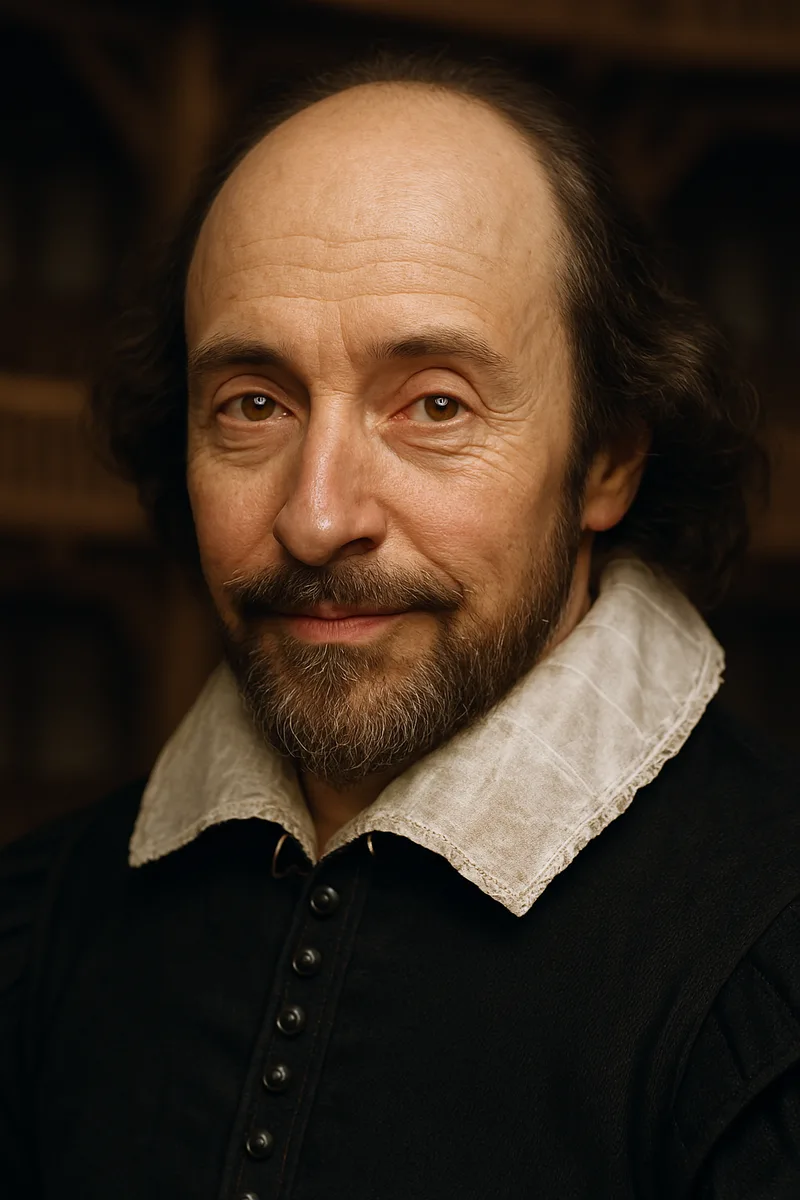
William Shakespeare: The Bard of Avon
William Shakespeare is, by near-universal consensus, the greatest writer in the English language and the world's most pre-eminent dramatist. Born in Stratford-upon-Avon in 1564, the son of a glove-maker, Shakespeare produced a body of work - thirty-seven plays, 154 sonnets, and several longer poems - that encompasses the full range of human experience with a depth, beauty, and insight that no other writer has matched. His plays have been performed more often than those of any other playwright in history, translated into every major language, and adapted into every conceivable medium. He invented over 1,700 words that remain in common use, from "eyeball" to "lonely" to "assassination." His characters - Hamlet, Othello, Lady Macbeth, Falstaff, Prospero - are as vivid and psychologically complex as any figures in literature. Four centuries after his death, Shakespeare remains not just a writer but a force of nature.
Context & Background
William Shakespeare was born on or around April 23, 1564, in Stratford-upon-Avon, a prosperous market town in Warwickshire, England. His father, John Shakespeare, was a successful glove-maker and alderman who later fell on hard times; his mother, Mary Arden, came from a minor gentry family. William likely attended the King's New School in Stratford, where he would have received a rigorous education in Latin grammar, rhetoric, and classical literature - the foundation of the learning that pervades his plays.
The England of Shakespeare's youth was a country transformed by the Reformation and energized by the Elizabethan settlement. Queen Elizabeth I's reign (1558-1603) was a period of relative political stability, growing national confidence, and extraordinary cultural creativity. The defeat of the Spanish Armada in 1588, the voyages of Drake and Raleigh, and the flowering of English literature all occurred during Shakespeare's most productive years. London, where Shakespeare spent most of his career, was a booming city of perhaps 200,000 people - crowded, dirty, plague-ridden, and magnificently alive.
The theater was at the center of London's cultural life. When Shakespeare arrived in the city in the late 1580s - the so-called "lost years" between his marriage to Anne Hathaway in 1582 and his first appearance in London's theatrical records around 1592 are undocumented - the English stage was undergoing a revolution. Christopher Marlowe, Thomas Kyd, and others were transforming drama from a crude popular entertainment into a literary art form. Shakespeare absorbed their innovations and surpassed them all.
Shakespeare's dramatic output is conventionally divided into comedies, histories, tragedies, and romances, but these categories barely contain the range of his achievement. His comedies - A Midsummer Night's Dream, Twelfth Night, Much Ado About Nothing, As You Like It - combine wit, romance, and a generous vision of human folly. His histories - the two tetralogies spanning from Richard II to Richard III, plus Henry V and King John - dramatize the English past with a political sophistication that anticipates modern historiography. His tragedies - Hamlet, Othello, King Lear, Macbeth - plumb the depths of human suffering, ambition, jealousy, and madness with a psychological penetration that remains unsurpassed.
What sets Shakespeare apart from every other dramatist is the depth and individuality of his characters. Hamlet is not "a prince who hesitates" - he is a specific, contradictory, endlessly fascinating human being whose thoughts we overhear in soliloquies that feel as immediate today as they did in 1601. Lady Macbeth is not "an ambitious wife" - she is a woman of terrifying willpower whose disintegration we watch with horror and pity. Falstaff is not "a comic fat man" - he is a genius of self-invention whose rejection by Prince Hal is one of the most heartbreaking moments in literature.
Shakespeare's influence on the English language is incalculable. He had a vocabulary of approximately 29,000 words - roughly twice that of the average educated person of his time - and he invented approximately 1,700 of them. Words like "bedroom," "lonely," "generous," "obscene," "gloomy," "assassination," "eyeball," and "birthplace" all appear for the first time in Shakespeare's works.
More importantly, Shakespeare created phrases and idioms that have become so embedded in English that most speakers do not realize they are quoting him. "Break the ice," "wild goose chase," "heart of gold," "green-eyed monster," "brave new world," "foregone conclusion," "in a pickle," "naked truth" - all Shakespeare. He did not merely use the English language; he expanded its expressive capacity in ways that continue to shape how English speakers think and communicate.
His blank verse - unrhymed iambic pentameter - achieves an extraordinary range of effects, from the stately formality of the history plays to the broken, halting speech of Lear on the heath. He could write the most beautiful love poetry ever composed and, in the next scene, produce comedy that still makes audiences laugh four centuries later.
Despite his fame, remarkably little is known about Shakespeare's private life. He married Anne Hathaway in 1582, when he was eighteen and she was twenty-six, and they had three children: Susanna, and twins Hamnet and Judith. Hamnet died at age eleven, and many scholars have seen echoes of this loss in the plays that followed, particularly King John, Hamlet, and Twelfth Night.
Shakespeare was a shrewd businessman as well as a great artist. He was a shareholder in the Lord Chamberlain's Men (later the King's Men), the most successful acting company in London, and in the Globe Theatre itself. He accumulated considerable wealth, purchasing one of the largest houses in Stratford - New Place - and investing in real estate and grain.
He retired to Stratford around 1613 and died on April 23, 1616, at the age of fifty-two. His will, a businesslike document that famously left his wife the "second-best bed," has generated centuries of speculation. His epitaph, inscribed on his grave in Holy Trinity Church, Stratford, includes the curse: "Good friend, for Jesus' sake forbear / To dig the dust enclosed here. / Blessed be the man that spares these stones, / And cursed be he that moves my bones." No one has disturbed the grave.