
Carl Jung
Quotes & Wisdom
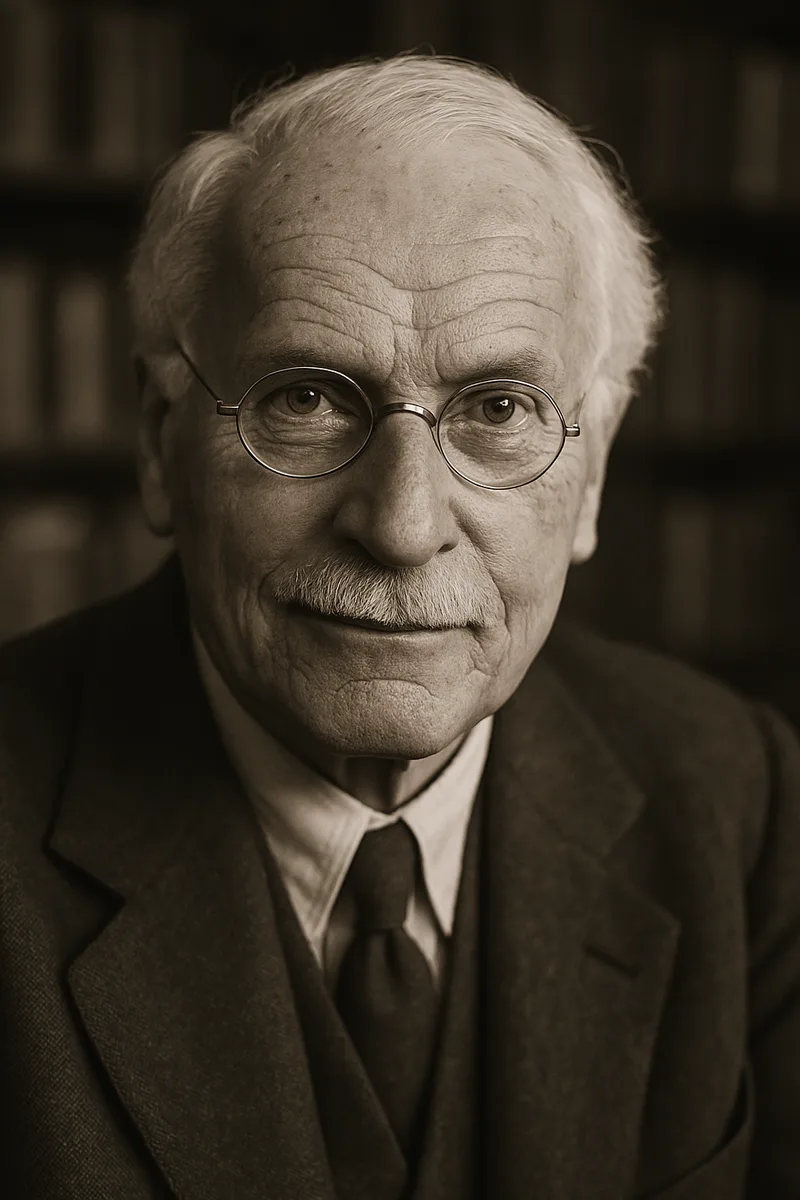
Carl Jung: Cartographer of the Unconscious Mind
Carl Gustav Jung transformed our understanding of the human mind by insisting that the psyche reaches far deeper than personal experience alone. The Swiss psychiatrist who broke with Sigmund Freud to forge his own path, Jung gave the world concepts now woven into everyday language - introvert and extrovert, the collective unconscious, archetypes, the shadow. His was a psychology that dared to take seriously what others dismissed: myth, dreams, spirituality, and the strange pull of symbols across cultures. More than six decades after his death, his ideas continue to shape therapy, literature, film, and the way millions of people think about who they really are.
Context & Background
The late nineteenth century crackled with intellectual upheaval. Charles Darwin's theory of evolution had shattered old certainties about humanity's place in nature. Friedrich Nietzsche had declared God dead and challenged Europe to face the consequences. The new science of psychology was clawing its way toward respectability, caught between the hard materialism of laboratory research and the murky depths of the human interior.
Into this ferment, Carl Gustav Jung was born in 1875 in the Swiss canton of Thurgau - the son of a struggling rural pastor and a mother who claimed to be visited by spirits. Switzerland itself provided a peculiar cradle: politically neutral, culturally multilingual, perched at the crossroads of French rationalism, German romanticism, and Italian expressiveness. The country's tradition of religious pluralism and intellectual independence would leave its mark on a thinker who refused to be boxed in by any single school of thought.
Jung grew up steeped in contradictions. His father embodied dutiful faith drained of conviction. His mother swung between warmth and dark withdrawal - she was briefly institutionalized when Jung was just three. The boy learned early that the surface of things could not be trusted, that beneath the respectable face people showed the world lay something wilder, stranger, and more powerful. This childhood intuition would become the engine of his life's work.
The story of Jung and Sigmund Freud reads like intellectual drama of the highest order. When Jung sent Freud a copy of his word-association studies in 1906, Freud recognized a brilliant ally. Their first meeting in Vienna lasted thirteen unbroken hours - two minds ablaze with the possibilities of the unconscious. Freud, twenty years older, saw in Jung the crown prince who would carry psychoanalysis into the mainstream and beyond its Jewish intellectual origins. Jung, hungry for a mentor, found in Freud a father figure whose boldness matched his own ambitions.
But the alliance carried a fatal flaw. Freud insisted that sexuality was the fundamental engine of the psyche. Jung could not accept this as the whole story. He sensed something deeper - a layer of the unconscious that belonged not to the individual but to the species, populated by ancient patterns he would come to call archetypes. The tension built for years. Their correspondence grew strained, their conversations edged with defensiveness. By 1913, the break was complete.
What followed nearly destroyed Jung. Cut off from the psychoanalytic movement, professionally isolated, he plunged into a psychological crisis that lasted years. He heard voices, experienced visions, and felt at times that he was losing his grip on reality. Rather than retreat, he made the extraordinary decision to confront the chaos head-on. He induced visions deliberately, conversed with figures that emerged from his unconscious, and recorded everything in a private journal filled with elaborate paintings and calligraphy - the legendary Red Book, so personal that his family kept it locked away for nearly half a century after his death. It was finally published in 2009, revealing a document of staggering intensity and beauty.
From this crucible emerged the core concepts of analytical psychology: the collective unconscious, archetypes, individuation, the shadow, the anima and animus. Jung had descended into his own depths and returned with a map.
Jung's great insight was that the psyche has a structure - not the mechanical structure of Freud's id, ego, and superego, but something more like an ecology. At the surface sits the persona, the mask we wear for the world. Beneath it lies the personal unconscious, filled with repressed memories and complexes. Deeper still stretches the collective unconscious, a vast shared reservoir of archetypal images and patterns inherited from the entire history of human experience.
The archetypes - the Hero, the Shadow, the Wise Old Man, the Great Mother, the Trickster - are not fixed images but dynamic patterns. They surface in dreams, myths, fairy tales, and religious symbols across every culture. Jung spent decades tracing their manifestations, from ancient Gnostic texts to the dreams of his patients in Zurich. He studied alchemy not as failed chemistry but as a symbolic language for psychological transformation. He traveled to East Africa, India, and the American Southwest, seeking confirmation that the archetypal patterns he found in European patients appeared in radically different cultures. They did.
His concept of individuation - the lifelong process of integrating the conscious and unconscious elements of the personality - gave people a framework for understanding psychological growth that went far beyond symptom relief. Therapy, for Jung, was not simply about curing neurosis. It was about becoming whole.
Perhaps his most practically influential contribution was his theory of psychological types. By distinguishing between introversion and extroversion, and identifying four fundamental functions of consciousness - thinking, feeling, sensation, and intuition - Jung created a framework that would eventually inspire the Myers-Briggs Type Indicator, used by millions worldwide. He himself cautioned against rigid categorization, noting dryly that a pure introvert or extrovert would belong "in the lunatic asylum."
The man behind the theories was as complex as his ideas suggested he should be. As a boy, Jung carved a tiny mannequin from the end of a wooden ruler, hid it in a pencil case in the attic with a painted stone, and periodically visited it with scrolls written in a secret language - a private ritual that he later recognized as his first encounter with the numinous. At twelve, he discovered he could avoid school by fainting on command, a six-month experiment in self-induced hysteria that ended abruptly when he overheard his father confessing terror about the boy's future.
Jung's intellectual appetites knew no conventional boundaries. His doctoral dissertation analyzed the seances of his own cousin. He maintained a decades-long friendship with the Nobel physicist Wolfgang Pauli, exploring the strange territory where psychology and quantum mechanics seemed to rhyme - work that produced his concept of synchronicity, or meaningful coincidence. In 1958, he published a book about flying saucers - not to validate UFO sightings, but to ask what psychological need they fulfilled.
After his mother's death in 1923, Jung began building a stone tower at Bollingen on the shore of Lake Zurich. He returned to it throughout his life, often living without electricity, chopping his own wood, cooking over a fire. It was his sanctuary, his monument to the inner life. He died in Kusnacht on June 6, 1961, having spent his final decades as one of the most influential and controversial thinkers of the twentieth century - a man who insisted, against the grain of his materialist age, that the soul was real and worth taking seriously.