
Sigmund Freud
Quotes & Wisdom
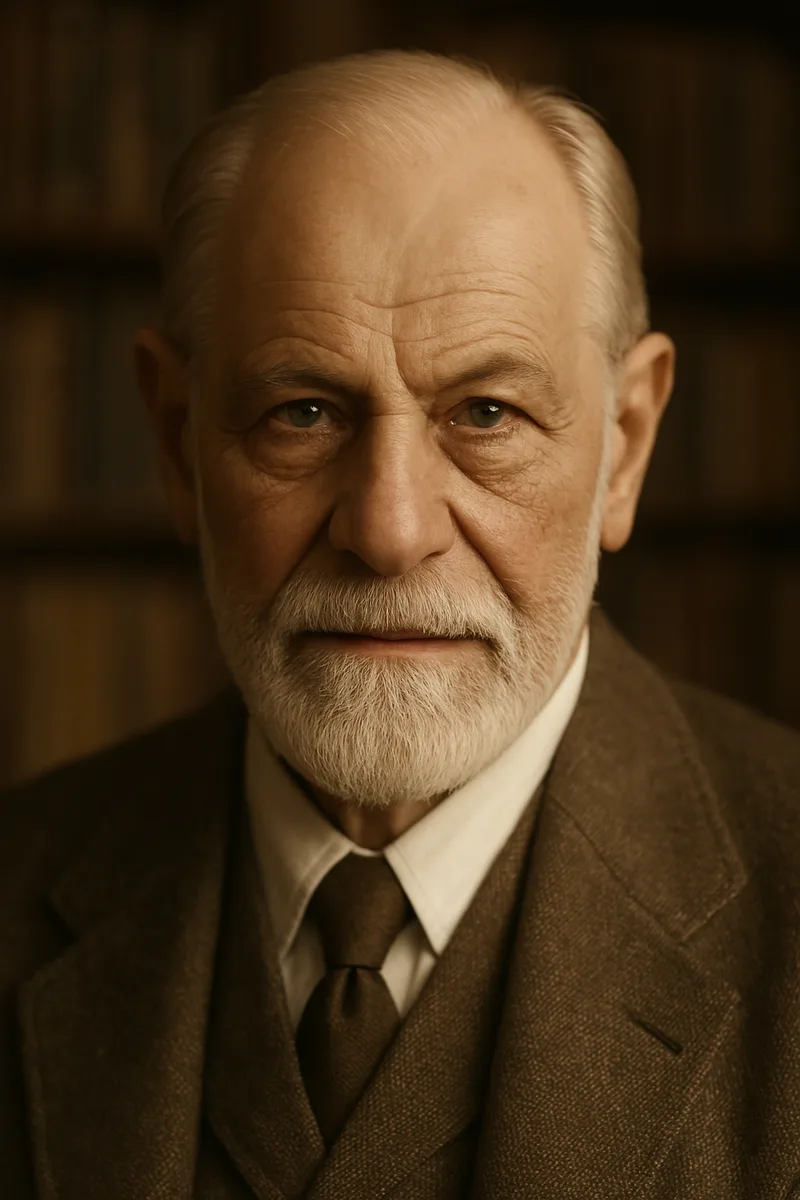
Sigmund Freud: Explorer of the Unconscious Mind
Sigmund Freud fundamentally altered how human beings understand themselves. The founder of psychoanalysis, Freud argued that our conscious thoughts and actions are driven by unconscious desires, repressed memories, and conflicts we can barely perceive - an idea that shook the foundations of Western thought. Born in the Moravian town of Freiberg in 1856, Freud spent most of his life in Vienna, where he developed his theories of the unconscious, dream interpretation, the Oedipus complex, and the structural model of the psyche. Though many of his specific theories have been challenged or revised, his fundamental insight - that much of mental life operates below the threshold of awareness - has become so thoroughly absorbed into modern culture that it is difficult to imagine thinking without it. He remains one of the most cited, debated, and influential thinkers of the twentieth century.
Context & Background
Sigismund Schlomo Freud was born on May 6, 1856, in Freiberg, Moravia (now Pribor, Czech Republic), the eldest child of Jacob Freud, a wool merchant, and his third wife, Amalia Nathansohn. The family was Jewish, and the antisemitism Freud encountered throughout his life shaped both his outsider's perspective and his fierce intellectual independence. When Freud was four, the family moved to Vienna, where he would live and work for nearly eight decades.
The Vienna of Freud's maturity was one of the great cultural capitals of Europe - a city of music, art, philosophy, and science, but also of rigid social conventions and simmering ethnic tensions. The late nineteenth century saw the triumph of scientific materialism: Darwin had shown that humans were animals shaped by evolution, and the new discipline of neurology was mapping the physical basis of the mind. Freud trained as a neurologist at the University of Vienna, studying under some of the leading medical scientists of the era, and initially planned a conventional academic career in neuroscience.
The pivot toward psychology came gradually. In 1885-1886, Freud studied in Paris under Jean-Martin Charcot, the great neurologist who used hypnosis to treat hysteria. Charcot's demonstrations convinced Freud that psychological symptoms could have psychological rather than purely physical causes - a radical idea at the time. Back in Vienna, Freud collaborated with Josef Breuer on the treatment of "Anna O." (Bertha Pappenheim), a patient whose symptoms seemed to improve when she talked about her experiences. This "talking cure" became the seed of psychoanalysis.
Freud's masterwork, The Interpretation of Dreams (Die Traumdeutung), was published in November 1899 (though dated 1900 by the publisher). In it, Freud argued that dreams were not random neural noise but the "royal road to the unconscious" - disguised fulfillments of repressed wishes. Through the analysis of dreams, including his own, Freud developed his theory of the unconscious mind as a vast reservoir of desires, fears, and memories that shape behavior without our knowledge.
The book was initially a commercial failure - it sold only 351 copies in its first six years - but it gradually became one of the most influential works of the twentieth century. Freud followed it with a series of groundbreaking works: The Psychopathology of Everyday Life (1901), which argued that slips of the tongue ("Freudian slips") revealed unconscious thoughts; Three Essays on the Theory of Sexuality (1905), which scandalized Vienna with its claims about infantile sexuality; and Beyond the Pleasure Principle (1920), which introduced the death drive (Thanatos) as a counterpart to the life drive (Eros).
His structural model of the psyche - dividing the mind into the id (primitive desires), the ego (the rational self), and the superego (the moral conscience) - became one of the most widely known frameworks in the history of psychology, even among those who have never read a word of Freud.
Freud was not merely a theorist; he was the leader of a movement. He gathered a circle of disciples in Vienna - including Carl Jung, Alfred Adler, Sandor Ferenczi, and Otto Rank - who met weekly at his apartment to discuss cases and develop psychoanalytic theory. The International Psychoanalytic Association, founded in 1910, spread Freud's ideas across Europe and America.
But the movement was riven by schisms. Jung, Freud's designated "crown prince," broke with him over the nature of the unconscious and the centrality of sexuality, going on to develop his own analytical psychology. Adler departed over similar disagreements. Freud responded to dissent with a tendency toward dogmatism that alienated some of his most gifted followers.
Despite these conflicts, psychoanalysis transformed Western culture in ways that extended far beyond medicine. Freud's ideas influenced literature (James Joyce, Thomas Mann, Virginia Woolf), art (Surrealism), film (Alfred Hitchcock), social theory (the Frankfurt School), and everyday language. Terms like "ego," "repression," "neurosis," "projection," and "the unconscious" entered common usage and reshaped how people understood themselves and each other.
Freud was a gifted prose stylist who won the Goethe Prize for Literature in 1930 - one of the few scientists so honored. His case studies - "Dora," "Little Hans," "The Rat Man," "The Wolf Man" - read like novellas and are literary achievements in their own right.
He smoked twenty cigars a day for most of his life, a habit that contributed to the oral cancer diagnosed in 1923. He endured thirty-three surgeries over sixteen years and wore a painful prosthesis in his jaw, yet continued to write and see patients almost to the end.
When the Nazis annexed Austria in 1938, Freud - elderly, ill, and Jewish - was persuaded to flee to London. The Gestapo required him to sign a statement that he had been treated well; he reportedly added: "I can heartily recommend the Gestapo to anyone." He died in London on September 23, 1939, at the age of eighty-three, after requesting a lethal dose of morphine from his physician. His house at 20 Maresfield Gardens is now the Freud Museum.