
Abraham Lincoln
Quotes & Wisdom
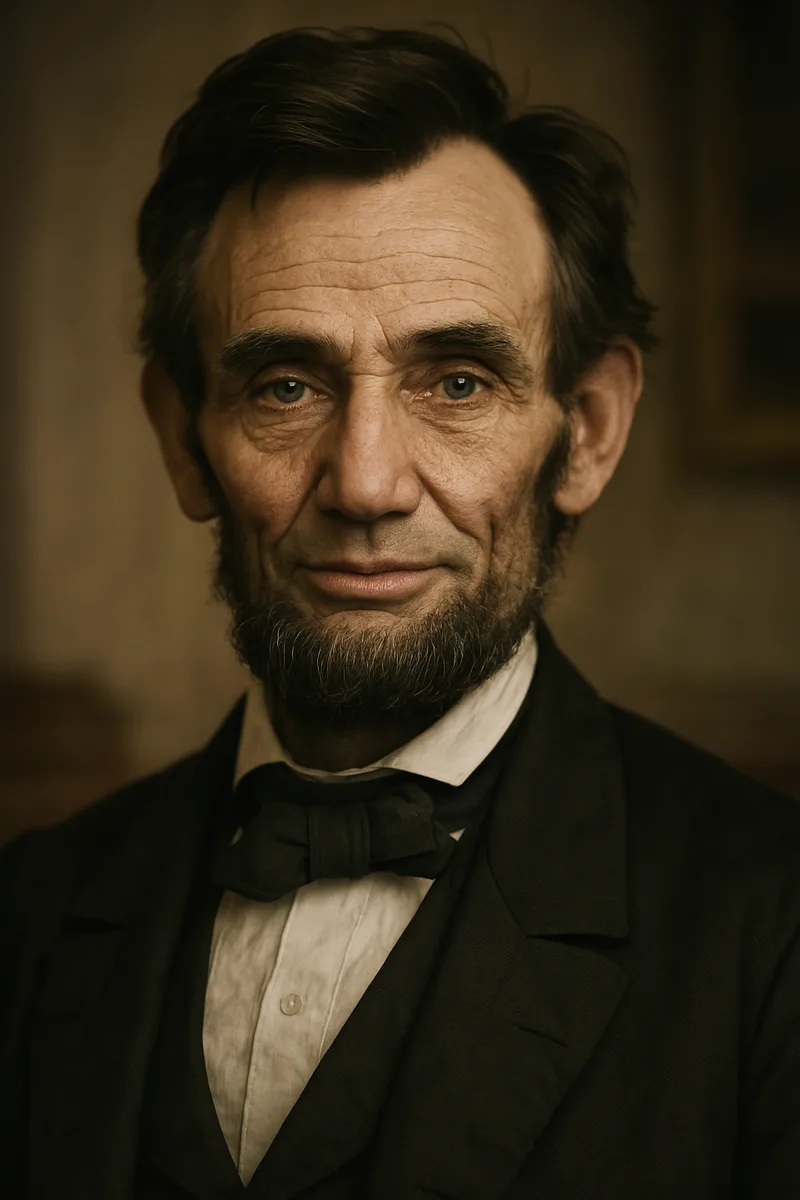
Abraham Lincoln: The Great Emancipator Who Preserved a Nation
Abraham Lincoln rose from a one-room Kentucky cabin to the presidency of a fracturing republic, steering the United States through its deadliest trial - the Civil War. Self-educated by firelight, he practiced law on the Illinois frontier before entering politics with an unshakable conviction that slavery was a moral wrong. His gift for language - spare, rhythmic, and devastating in argument - made him one of the greatest orators in the English-speaking world. The Emancipation Proclamation and the Gettysburg Address remain cornerstones of democratic thought. Assassinated in 1865 at the moment of Union victory, Lincoln became a martyr to the cause of human equality and national unity. His life embodies the idea that character, not circumstance, determines greatness.
Context & Background
Abraham Lincoln was born on February 12, 1809, in a log cabin in Hardin County, Kentucky, into a world where the young American republic was still finding its footing. The nation had existed for barely a generation, and the tensions between slave states and free states were already pulling at the seams of the constitutional compact. Lincoln's family moved to Indiana when he was seven, partly to escape a legal system that tolerated slavery. His mother, Nancy Hanks Lincoln, died when he was nine, and his father, Thomas, soon remarried - a union that gave young Abraham a stepmother, Sarah Bush Johnston, who recognized and nurtured his hunger for learning.
The frontier demanded physical labor, but Lincoln's mind craved books. With fewer than twelve months of formal schooling across his entire childhood, he educated himself by reading Benjamin Franklin's autobiography, the King James Bible, Shakespeare, and Blackstone's legal commentaries. He moved to New Salem, Illinois, as a young man, working as a store clerk, postmaster, and surveyor before teaching himself law. His early political career in the Illinois state legislature and later in the U.S. Congress coincided with a period of explosive westward expansion that made the slavery question unavoidable.
The Kansas-Nebraska Act of 1854, which allowed new territories to decide the slavery question for themselves, pulled Lincoln back into active politics. His debates with Stephen Douglas in 1858 - seven public confrontations across Illinois - made him a national figure. Though he lost that Senate race, the debates positioned him for the 1860 presidential nomination. He won the presidency without carrying a single Southern state, and before he took office, seven states had already seceded. The America that shaped Lincoln was one of possibility and peril, where democratic self-government was an experiment many expected to fail.
Lincoln assumed the presidency on March 4, 1861, facing a crisis no American leader had confronted before - the dissolution of the Union itself. He had no military experience, a fractious cabinet of rivals, and a Northern public deeply divided over whether the war was worth fighting. His genius lay not in battlefield strategy but in his understanding of the war's moral and political dimensions. He recognized early that the conflict could not remain solely about preserving the Union - it had to become a war for human freedom.
The Emancipation Proclamation, issued on January 1, 1863, was both a moral declaration and a masterstroke of wartime strategy. By freeing enslaved people in Confederate territory, Lincoln transformed the war's purpose, discouraged European powers from recognizing the Confederacy, and opened the door for Black soldiers to serve in the Union Army. Nearly 180,000 African Americans would fight for the Union by war's end. Lincoln's management of his generals - cycling through commanders until he found Ulysses S. Grant - showed patience, pragmatism, and an ability to learn from failure.
Lincoln's literary achievement is inseparable from his political legacy. The Gettysburg Address, delivered on November 19, 1863, at the dedication of a military cemetery, lasted barely two minutes and contained fewer than 275 words, yet it redefined the meaning of the American experiment. Where the Founders had built a nation on the legal framework of the Constitution, Lincoln reached back to the Declaration of Independence and its assertion that "all men are created equal," making equality the nation's founding principle rather than an aspiration.
His Second Inaugural Address, delivered on March 4, 1865, as the war ground toward its end, is perhaps the most profound meditation on justice and suffering ever delivered by a head of state. Rather than claiming victory or assigning blame, Lincoln acknowledged that both North and South had benefited from slavery and that the war's carnage might be divine punishment for that shared sin. "With malice toward none, with charity for all" - these words established the framework for Reconstruction and revealed a leader whose moral imagination grew as the stakes increased.
Lincoln's private letters and conversations reveal the same precision and wit. He used humor as both a weapon and a coping mechanism, defusing political tension with frontier anecdotes and pointed stories that made his arguments unforgettable.
Lincoln stood six feet four inches tall, making him the tallest president in American history. He was a gifted wrestler in his youth, reportedly losing only one match out of roughly 300. He held a patent - the only U.S. president to do so - for a device to lift boats over shoals, which he never commercialized. His law practice was one of the most successful in Illinois, and he represented railroads as often as he represented individuals. He suffered from deep bouts of melancholy throughout his life, what modern clinicians might diagnose as clinical depression, yet he channeled that darkness into empathy and moral clarity. He was an avid reader of Shakespeare and could recite long passages from memory, with a particular fondness for the tragedies. His relationship with his wife, Mary Todd Lincoln, was tumultuous, marked by the death of two sons and the immense pressures of the war. He was the first president to be assassinated, shot by John Wilkes Booth at Ford's Theatre on April 14, 1865, and he died the following morning.