Antifragile
Nassim Nicholas Taleb · 2012
Economics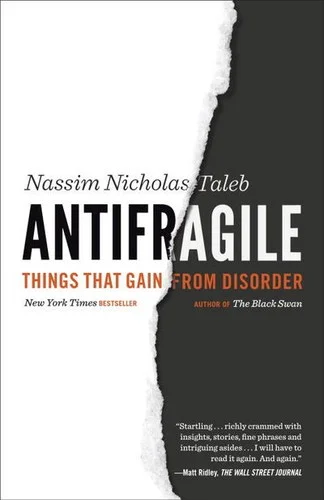
Things That Gain from Disorder
Nassim Taleb goes beyond resilience to identify a property he calls antifragility — systems that actually benefit from shocks, volatility, and disorder. The opposite of fragile isn't robust; it's antifragile. Understanding this concept changes how we think about risk, innovation, health, politics, and the design of institutions.
Context & Background
Following The Black Swan, Taleb asked a deeper question: how can we not only survive uncertainty but actually gain from it? He coined the term "antifragile" because no word existed for things that get stronger under stress — the opposite of fragile. Wind extinguishes a candle but energizes a fire; Taleb shows how to be the fire.
The triad of fragile, robust, and antifragile applies everywhere: your body gains from exercise stress (antifragile), a coffee cup doesn't care about small shocks (robust), and a crystal glass breaks under stress (fragile). Taleb's barbell strategy — combining extreme safety with small, speculative bets — applies to investing, career design, and life decisions. Via negativa — improvement by subtraction rather than addition — challenges our bias toward doing more.
The concept of antifragility has been adopted in fields from software engineering to urban planning. Companies use it to design systems that improve under stress. It completed Taleb's philosophical project (the Incerto) and provided the constructive counterpart to The Black Swan's warnings.
Quotes from Antifragile
Related Books

The Wealth of Nations
Adam Smith
Same genre — complementary perspectives on Economics
Capitalism and Freedom
Milton Friedman
Essential reading in Economics
The Intelligent Investor
Benjamin Graham
Complementary insights from Finance & Investing
Good to Great
Jim Collins
Related perspective from Strategy