
Ralph Waldo Emerson
Quotes & Wisdom
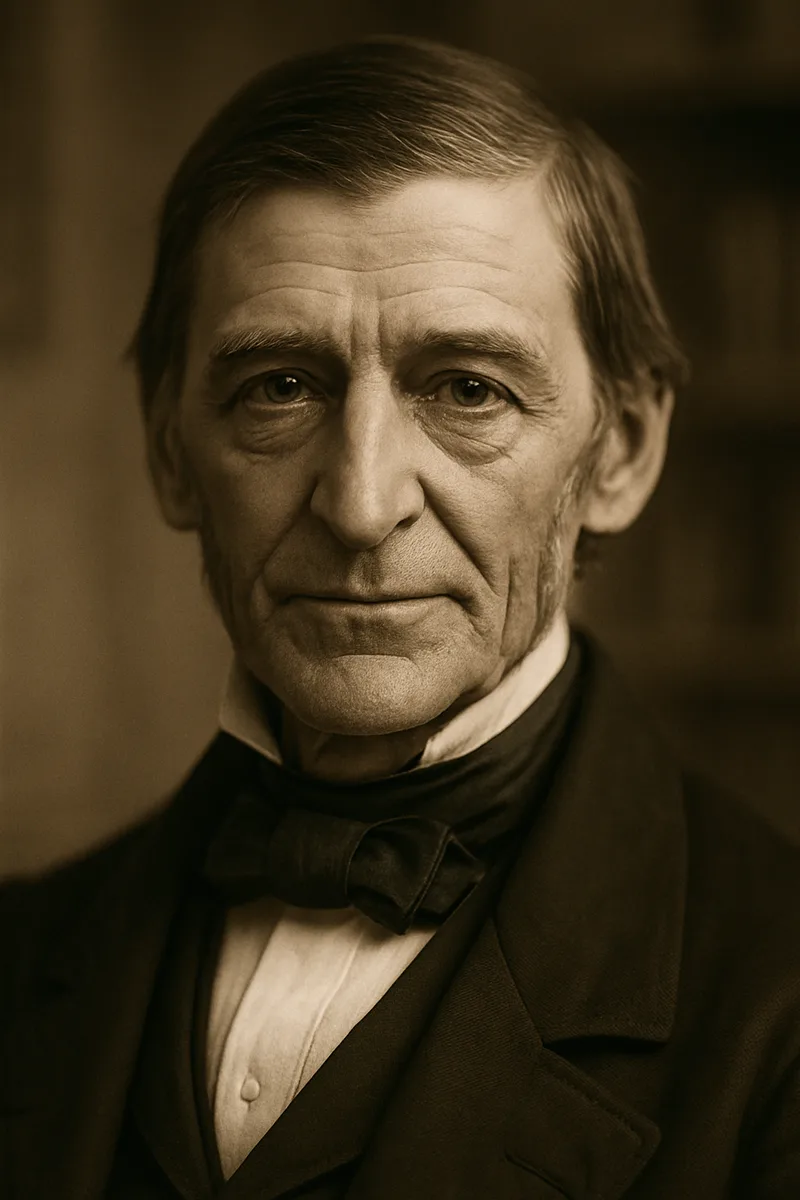
Ralph Waldo Emerson: The Sage of Concord
Ralph Waldo Emerson was the intellectual father of American individualism - an essayist, poet, and philosopher whose call to self-reliance, original thinking, and communion with nature shaped the American character in ways that persist to this day. Born in Boston to a long line of ministers, Emerson broke with organized religion to forge a new philosophy that blended Eastern mysticism, European Romanticism, and a distinctly American optimism. As the leading voice of the Transcendentalist movement, he argued that every individual contained the spark of divinity and that conformity was the enemy of greatness. His essays, particularly "Self-Reliance" and "Nature," became foundational texts of American thought, influencing Henry David Thoreau, Walt Whitman, Friedrich Nietzsche, and generations of writers, activists, and entrepreneurs.
Context & Background
Ralph Waldo Emerson was born on May 25, 1803, in Boston, Massachusetts, into a family of Unitarian ministers that stretched back five generations. His father, William Emerson, was the minister of Boston's First Church, and the young Emerson was raised in an atmosphere of intellectual seriousness and modest means - the family was never wealthy, and Emerson's father died when he was eight, leaving the household in genteel poverty.
The America of Emerson's youth was a young republic still defining itself intellectually and culturally. The nation had won its political independence from Britain, but its cultural independence was another matter. American literature, philosophy, and art were widely regarded - by Americans and Europeans alike - as derivative and second-rate. The great challenge for Emerson's generation was to create an authentically American intellectual tradition, and no one answered that challenge more decisively than Emerson.
He attended Harvard College at fourteen and Harvard Divinity School at twenty-two, following the family path into the Unitarian ministry. He was ordained as junior pastor of Boston's Second Church in 1829 and married Ellen Louisa Tucker, a young woman of radiant beauty who suffered from tuberculosis. Her death in 1831, at the age of nineteen, devastated Emerson and precipitated a spiritual crisis that led him to resign his pastorate in 1832. He could no longer administer communion, he told his congregation, because he did not believe in its validity as a sacrament.
Emerson traveled to Europe, where he met Thomas Carlyle, Samuel Taylor Coleridge, and William Wordsworth - encounters that deepened his conviction that the soul's direct experience of the divine was more important than any inherited theology. He returned to America determined to become a new kind of thinker - not a minister, not an academic, but a public intellectual who would speak directly to the American people.
Emerson settled in Concord, Massachusetts, in 1834, and it became his home for the rest of his life. In 1836, he published his first major work, Nature, a lyrical essay arguing that the natural world was a direct manifestation of the divine spirit and that human beings could access transcendent truths through intuition and direct experience rather than through tradition or authority. The book became the founding document of American Transcendentalism.
In 1837, Emerson delivered "The American Scholar" address at Harvard, which Oliver Wendell Holmes Sr. called America's "intellectual Declaration of Independence." Emerson argued that American scholars had been too deferential to European models and must develop their own original relationship to truth. The following year, his "Divinity School Address" scandalized Harvard's establishment by arguing that organized religion had become a dead form that stifled genuine spiritual experience. He was not invited back to Harvard for nearly thirty years.
His essay "Self-Reliance" (1841) is perhaps the single most influential piece of American nonfiction ever written. Its central argument - "Trust thyself: every heart vibrates to that iron string" - is a call to intellectual and moral independence that resonates far beyond its original context. Emerson argued that conformity was a form of spiritual death, that society everywhere conspires against the individuality of its members, and that greatness consists in being misunderstood by the crowd.
Emerson was not merely a solitary thinker; he was the gravitational center of a remarkable circle of writers, reformers, and intellectuals. The Transcendentalist Club, which met informally from 1836 onward, included Margaret Fuller, Bronson Alcott, Theodore Parker, and - most importantly - Henry David Thoreau, whom Emerson mentored, housed, and championed.
The relationship between Emerson and Thoreau was one of the most productive in American literary history. Emerson provided Thoreau with the land on which he built his cabin at Walden Pond, and Thoreau's great experiment in simple living was, in many ways, an attempt to put Emerson's philosophy into practice. Their friendship was not without tension - Emerson sometimes found Thoreau stubborn and contrarian, while Thoreau felt Emerson had become too comfortable and conventional - but their mutual influence was enormous.
Emerson was also a committed abolitionist, though he came to the cause more slowly than some of his contemporaries. He was deeply influenced by Frederick Douglass, whom he admired as a living embodiment of self-reliance, and he was radicalized by the Fugitive Slave Act of 1850, which required Northern citizens to assist in the capture of escaped slaves. By the 1850s, Emerson was speaking publicly against slavery with a passion that surprised those who had known him as a detached philosopher.
Emerson's journals, which he kept from his college years until late in life, run to over two hundred volumes and constitute one of the great diaries in the English language. They reveal a more complex, more doubting, and more human figure than the serene sage of the published essays. He struggled with grief throughout his life - losing his first wife, his beloved brother Charles, and his five-year-old son Waldo, whose death in 1842 from scarlet fever was a blow from which Emerson never fully recovered.
He was one of the most popular lecturers in America, delivering some 1,500 lectures across the country over his career. He traveled by train, coach, and steamboat to frontier towns and major cities alike, and his lectures were major cultural events. He earned a comfortable living from this work and used it to support causes and people he believed in.
In his later years, Emerson's memory began to fail - he could not remember the names of everyday objects, and he once referred to an umbrella as "the thing that strangers take away." He died on April 27, 1882, in Concord, at the age of seventy-eight. His funeral was attended by thousands, and Henry Wadsworth Longfellow, Louisa May Alcott, and other luminaries paid their respects to the man who had done more than anyone to define what it meant to think as an American.