
Frederick Douglass
Quotes & Wisdom
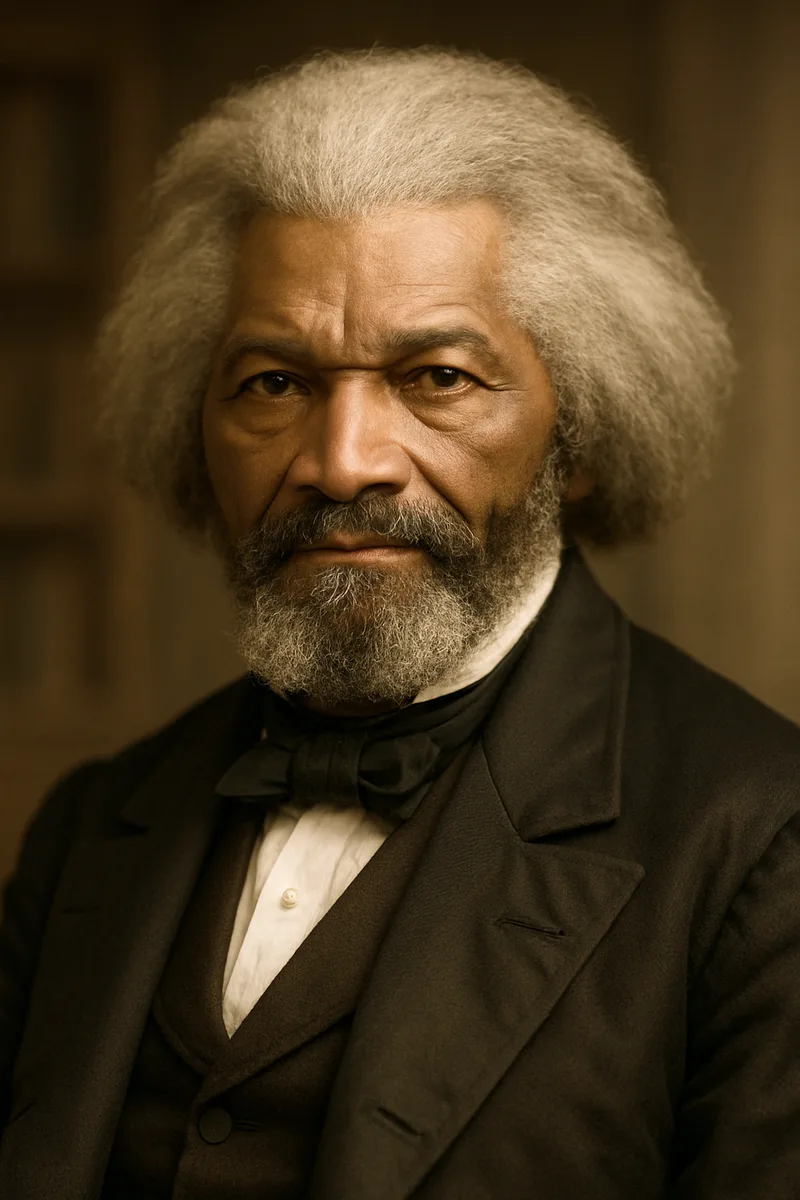
Frederick Douglass: The Voice That Broke the Chains
Frederick Douglass was the most influential African American of the nineteenth century - an escaped slave who became the nation's most powerful orator, writer, and abolitionist. Born into bondage on the Eastern Shore of Maryland around 1818, he taught himself to read in defiance of law and custom, escaped to freedom at twenty, and became a thundering voice against slavery whose eloquence shattered the racist assumption that Black people were intellectually inferior. His autobiographies, particularly Narrative of the Life of Frederick Douglass (1845), are masterpieces of American literature. He advised Abraham Lincoln, recruited Black soldiers for the Union Army, and fought for the rights of women alongside those of his own people.
Context & Background
Frederick Douglass was born Frederick Augustus Washington Bailey in February 1818 on a plantation in Talbot County, Maryland. He never knew the exact date of his birth - slaveholders routinely denied this basic knowledge to enslaved people - and he later chose February 14 as his birthday. His mother, Harriet Bailey, was an enslaved woman he rarely saw; his father was almost certainly a white man, possibly his master. This was the world of American chattel slavery, where human beings were property, families were broken apart at will, and literacy among the enslaved was a criminal offense.
As a child, Douglass was sent to Baltimore to serve the Auld family, and it was there that Sophia Auld began teaching him to read - until her husband forbade it, declaring that education would make a slave unfit for bondage. This prohibition electrified Douglass: if literacy was the path from slavery to freedom, he would pursue it at any cost. He secretly taught himself to read using newspapers, books, and the help of white children in the neighborhood.
The America of Douglass's youth was a nation built on the contradiction between its founding ideals - "all men are created equal" - and the reality of four million enslaved people. The abolitionist movement was growing but still marginal, and most white Americans, including many who opposed slavery, considered Black people racially inferior. It was into this hostile landscape that Douglass escaped in 1838, disguised as a sailor, traveling by train and ferry from Baltimore to New York City, and then to New Bedford, Massachusetts, where he adopted the surname Douglass.
Douglass's career as a public speaker began in 1841, when he addressed an antislavery convention in Nantucket, Massachusetts. William Lloyd Garrison, the leading white abolitionist, heard him speak and immediately recognized his extraordinary power. Douglass became a lecturer for the Massachusetts Anti-Slavery Society, traveling across the Northern states and enduring physical threats, verbal abuse, and at least one brutal beating.
His first autobiography, Narrative of the Life of Frederick Douglass, an American Slave (1845), was a sensation - selling 30,000 copies in five years and establishing Douglass as both a literary and political force. But publishing the details of his enslavement put him at risk of recapture, and he spent two years lecturing in Britain and Ireland, where admirers raised the money to purchase his legal freedom.
Returning to America, Douglass founded The North Star, an abolitionist newspaper, and gradually moved away from Garrison's moral-suasion approach toward a more politically engaged abolitionism that worked within the constitutional system. His 1852 speech "What to the Slave Is the Fourth of July?" remains one of the most devastating critiques of American hypocrisy ever delivered.
During the Civil War, Douglass was among the first to argue that the conflict must become a war for emancipation and that Black men must be allowed to fight for their own freedom. He met with Abraham Lincoln three times and pushed the president toward the Emancipation Proclamation. He recruited Black soldiers for the 54th Massachusetts Infantry and other regiments, and his sons Charles and Lewis served in the Union Army.
After the war, Douglass fought for the passage of the Thirteenth, Fourteenth, and Fifteenth Amendments and served in several government positions, including U.S. Marshal for the District of Columbia and Minister to Haiti. He continued to speak and write against racial injustice until his death in 1895.
Douglass was the most photographed American of the nineteenth century, deliberately using photography to present dignified, powerful images of Black manhood that countered racist caricatures. He was a supporter of women's suffrage and attended the Seneca Falls Convention in 1848, seconding Elizabeth Cady Stanton's resolution for the right to vote. He played the violin and was a music lover throughout his life. His second marriage, to Helen Pitts, a white woman, caused controversy among both Black and white communities; Douglass responded that his first wife "was the color of my mother, and the second, the color of my father." He owned a home in the Anacostia neighborhood of Washington, D.C., which is now a National Historic Site. He died of a heart attack on February 20, 1895, after attending a women's rights meeting.