
Oscar Wilde
Quotes & Wisdom
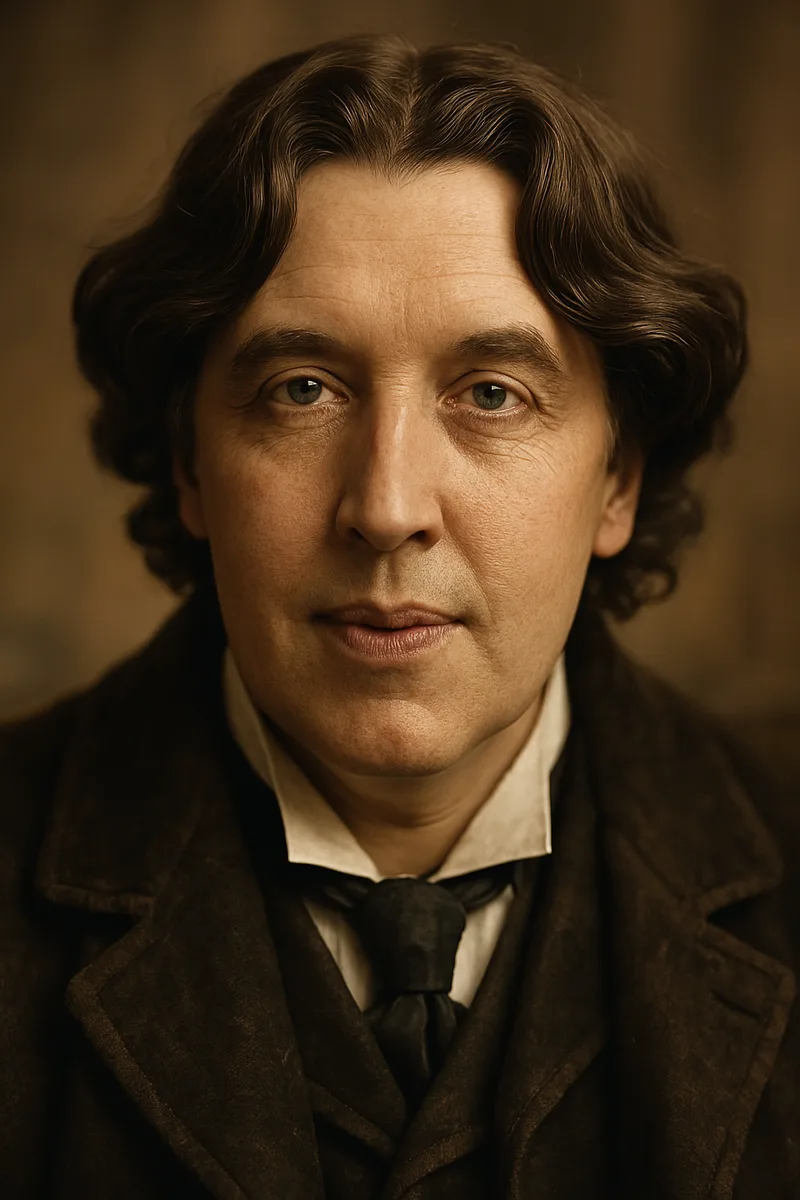
Oscar Wilde: The Supreme Artist of Wit
Oscar Wilde was the most dazzling conversationalist of the Victorian age, a playwright, novelist, poet, and essayist whose epigrams have become part of the English language itself. Born in Dublin to intellectually formidable parents, Wilde conquered London's literary scene with his flamboyant personality and razor-sharp prose. His comedies - including The Importance of Being Earnest and An Ideal Husband - remain among the most performed plays in the English language. His novel The Picture of Dorian Gray explored vanity, corruption, and the cost of aestheticism with unsettling brilliance. At the height of his fame, Wilde was destroyed by a criminal prosecution for gross indecency, serving two years of hard labor. He emerged broken in health but unbroken in spirit, producing De Profundis and The Ballad of Reading Gaol before dying in exile in Paris at forty-six.
Context & Background
Oscar Fingal O'Flahertie Wills Wilde was born on October 16, 1854, in Dublin, Ireland, to parents who were themselves figures of considerable distinction. His father, Sir William Wilde, was Ireland's leading eye and ear surgeon, a census commissioner, and an antiquarian of national reputation. His mother, Jane Francesca Wilde, wrote revolutionary poetry under the pen name "Speranza" for the Young Ireland movement and held a famous literary salon. The Wilde household was steeped in language, learning, and a theatrical sense of self that Oscar would perfect into an art form.
Victorian Ireland was a complex place - politically restive, culturally vibrant, and economically scarred by the recent memory of the Great Famine. Wilde absorbed both the Irish gift for storytelling and a deep awareness of the gap between surface respectability and hidden truths, a tension that would animate his greatest works. He was educated at the Portora Royal School, then Trinity College Dublin, where he distinguished himself in classics, before winning a scholarship to Magdalen College, Oxford.
At Oxford, Wilde fell under the influence of John Ruskin and Walter Pater, the leading figures of the Aesthetic Movement, which held that art existed for its own sake - "art for art's sake" - and that the pursuit of beauty was the highest human calling. Wilde took this philosophy and lived it, becoming famous for his velvet suits, sunflowers, and extravagant pronouncements before he had published anything of note. A lecture tour of America in 1882 made him a transatlantic celebrity; when asked by customs officials if he had anything to declare, he allegedly replied, "Nothing but my genius."
Wilde's literary output spans poetry, criticism, fiction, and drama, but his most enduring legacy may be the epigram itself. No writer in English has produced so many quotable lines per page. His wit operated through inversion - taking a received truth and flipping it on its head to reveal a deeper, more uncomfortable truth underneath. "I can resist everything except temptation." "To live is the rarest thing in the world. Most people exist, that is all." "The truth is rarely pure and never simple."
These are not merely clever; they are surgical. Wilde used humor to expose the hypocrisy of Victorian morality, the emptiness of social convention, and the painful gap between what people profess and what they practice. His comedies - Lady Windermere's Fan (1892), A Woman of No Importance (1893), An Ideal Husband (1895), and The Importance of Being Earnest (1895) - are structured as elaborate mechanisms for delivering these insights, wrapped in the most elegant drawing-room dialogue ever written for the English stage.
The Picture of Dorian Gray (1890), his only novel, goes darker. The story of a beautiful young man who remains youthful while his portrait ages and corrupts is a meditation on vanity, influence, and the price of living without conscience. Critics attacked it as immoral; Wilde responded with a preface that became a manifesto for aestheticism: "There is no such thing as a moral or an immoral book. Books are well written, or badly written. That is all."
At the peak of his fame in 1895, with two plays running simultaneously in the West End, Wilde made the catastrophic decision to sue the Marquess of Queensberry for libel after Queensberry accused him of "posing as a sodomite." The trial collapsed when evidence of Wilde's relationships with younger men was introduced, and the government then prosecuted Wilde himself. He was convicted of gross indecency and sentenced to two years of hard labor at Reading Gaol.
The imprisonment destroyed Wilde physically and financially. He lost his home, his possessions, custody of his two sons, and his place in society. But it also produced two of his most powerful works. De Profundis, a long letter written to his former lover Lord Alfred Douglas from prison, is a remarkable document of self-examination - by turns bitter, tender, philosophical, and spiritually searching. The Ballad of Reading Gaol (1898), published after his release, is his most directly emotional poem, a meditation on guilt, punishment, and the cruelty of the justice system.
Released in 1897, Wilde went into exile in France under the assumed name Sebastian Melmoth. He never wrote another major work. His health, broken by prison, continued to decline. He converted to Catholicism on his deathbed and died of meningitis on November 30, 1900, in a small hotel room in Paris. His reported last words - "My wallpaper and I are fighting a duel to the death. One of us has got to go" - may be apocryphal, but they are perfectly Wildean.
Wilde was a devoted father to his two sons, Cyril and Vyvyan, and the children's stories he wrote - The Happy Prince, The Selfish Giant - are among the most moving fairy tales in the English language. He was also an accomplished editor, running The Woman's World magazine from 1887 to 1889 and transforming it from a fashion periodical into a serious journal of women's writing and thought.
Wilde stood six feet three inches tall and was by all accounts a physically imposing presence. His conversational powers were legendary - even his enemies conceded that no one in London could match him in person. George Bernard Shaw, Mark Twain, and André Gide all testified to the extraordinary spell he cast in a room.
His grave at Père Lachaise Cemetery in Paris, designed by Jacob Epstein, has become one of the most visited graves in the world. For decades, visitors covered it in lipstick kisses until a glass barrier was erected in 2011. Wilde would probably have approved - he always understood that beauty, however messy, was the point.