
Muhammad Ali
Quotes & Wisdom
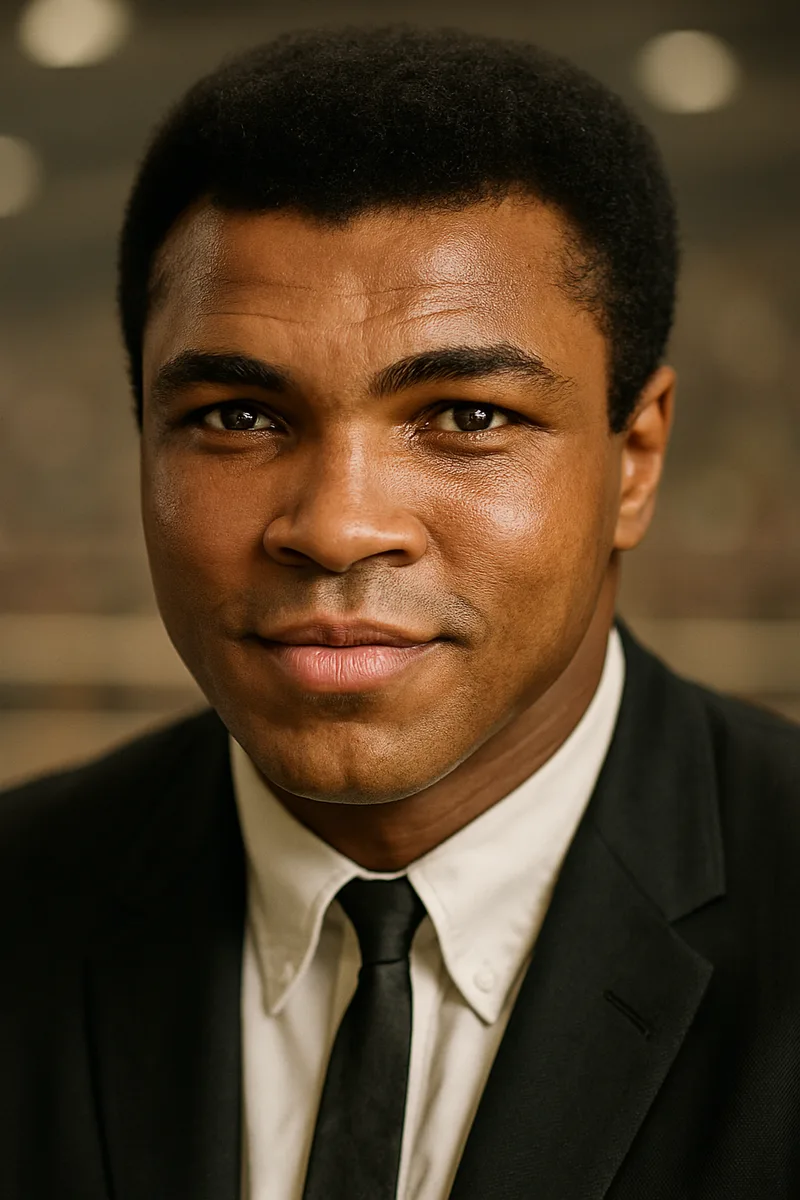
Muhammad Ali: The Greatest Who Proved It
Muhammad Ali was the most famous athlete of the twentieth century - a heavyweight boxing champion who transcended his sport to become a global symbol of courage, conviction, and charisma. Born Cassius Marcellus Clay Jr. in Louisville, Kentucky, in 1942, he won an Olympic gold medal at eighteen, claimed the world heavyweight title at twenty-two by defeating the "invincible" Sonny Liston, and then shocked America by converting to Islam, changing his name, and refusing induction into the Army during the Vietnam War. Stripped of his title and banned from boxing for three years during the prime of his career, he returned to fight some of the most legendary bouts in sports history and reclaimed his championship twice more.
Context & Background
Cassius Marcellus Clay Jr. was born on January 17, 1942, in Louisville, Kentucky, a city that straddled the line between the South and the Midwest, with all the racial tensions that implied. His father, Cassius Clay Sr., was a sign painter who dreamed of being an artist; his mother, Odessa Grady Clay, was a household domestic. The family was middle class by Black Louisville standards, but the indignities of segregation were everywhere. Young Cassius could not eat at the same lunch counters, swim in the same pools, or attend the same schools as white children - an injustice that burned in him from an early age.
He came to boxing at twelve, after his bicycle was stolen and a policeman named Joe Martin, who also ran a boxing gym, encouraged the furious boy to learn how to fight before confronting the thief. Cassius proved to be a prodigy - fast, fearless, and possessed of a work ethic that stunned his trainers. By eighteen, he had compiled a 100-5 amateur record and won the light heavyweight gold medal at the 1960 Rome Olympics. The legend, which Ali himself later embellished, holds that he threw the medal into the Ohio River after being refused service at a Louisville restaurant - a story that perfectly captured the contradiction of representing a country that treated him as a second-class citizen.
He turned professional in 1960 and began the verbal theatrics that would make him as famous for his mouth as for his fists. Drawing on the showmanship of professional wrestler Gorgeous George, he predicted the round in which he would knock out his opponents, composed doggerel poems about their destruction, and proclaimed himself "the greatest" at every opportunity. The boxing establishment dismissed him as a loudmouth. They were wrong.
Ali's boxing style was as revolutionary as his personality. In an era when heavyweights were expected to be plodding sluggers, Ali danced. He held his hands low, leaned away from punches instead of blocking them, and threw combinations with a speed that seemed impossible for a man of his size. His footwork was balletic, his jab was a piston, and his ability to read an opponent's intentions was almost telepathic. He did not merely win fights - he reinvented the way heavyweight boxing could be fought.
His upset victory over Sonny Liston in February 1964 announced a new era. Liston was considered the most terrifying heavyweight since Joe Louis - a former convict with fists like sledgehammers whom no one wanted to fight. The twenty-two-year-old Clay, a seven-to-one underdog, dominated him with speed and intelligence and celebrated by screaming at the press, "I shook up the world!" The next day, he announced his conversion to the Nation of Islam and his new name: Muhammad Ali. Much of white America, and much of the sports press, refused to use it.
The fights of the 1970s elevated Ali from athlete to legend. The "Rumble in the Jungle" against George Foreman in Kinshasa, Zaire, in 1974 - where Ali deployed the "rope-a-dope" strategy, leaning against the ropes and letting the younger, stronger Foreman exhaust himself before knocking him out in the eighth round - is considered one of the greatest sporting events of the century. The "Thrilla in Manila" against Joe Frazier in 1975 was so brutal that Ali himself called it "the closest thing to dying that I know of."
In April 1966, Ali was reclassified as eligible for the draft. On April 28, 1967, he refused induction, stating, "I ain't got no quarrel with them Viet Cong. No Viet Cong ever called me nigger." The statement was a thunderbolt. He was convicted of draft evasion, sentenced to five years in prison (which he remained free on appeal), stripped of his boxing license in every state, and had his passport confiscated. He was twenty-five years old and at the peak of his physical abilities. He would not fight again for three and a half years.
The sacrifice was staggering. Ali gave up millions of dollars, the prime years of his athletic career, and his standing with a significant portion of the American public - all for a principle. As the Vietnam War grew increasingly unpopular, public opinion shifted in his favor. The Supreme Court unanimously overturned his conviction in 1971. But the years he lost could never be recovered, and many historians believe the punishment his body absorbed in later fights - when his legs had slowed and he relied on absorbing punishment rather than avoiding it - contributed to the Parkinson's disease that plagued his final decades.
Ali was genuinely funny - not in the rehearsed way of athletes reading cue cards, but spontaneously, brilliantly funny. His press conferences were performances that combined braggadocio, poetry, social commentary, and improvisational comedy in a way no athlete before or since has matched. He was also deeply generous, giving away money to strangers, visiting sick children in hospitals without notifying the press, and spending hours signing autographs for fans when his handlers urged him to leave.
He was diagnosed with Parkinson's disease in 1984, and his long decline was painfully public. The man who had been the fastest, most verbal athlete alive gradually lost his ability to speak and move. Yet he remained a public figure, lighting the Olympic cauldron at the 1996 Atlanta Games in a moment that brought the world to tears. He died on June 3, 2016, at the age of seventy-four. His funeral in Louisville drew thousands of mourners and tributes from every corner of the globe - confirmation that he had been, as he always claimed, the greatest.