
Mother Teresa
Quotes & Wisdom
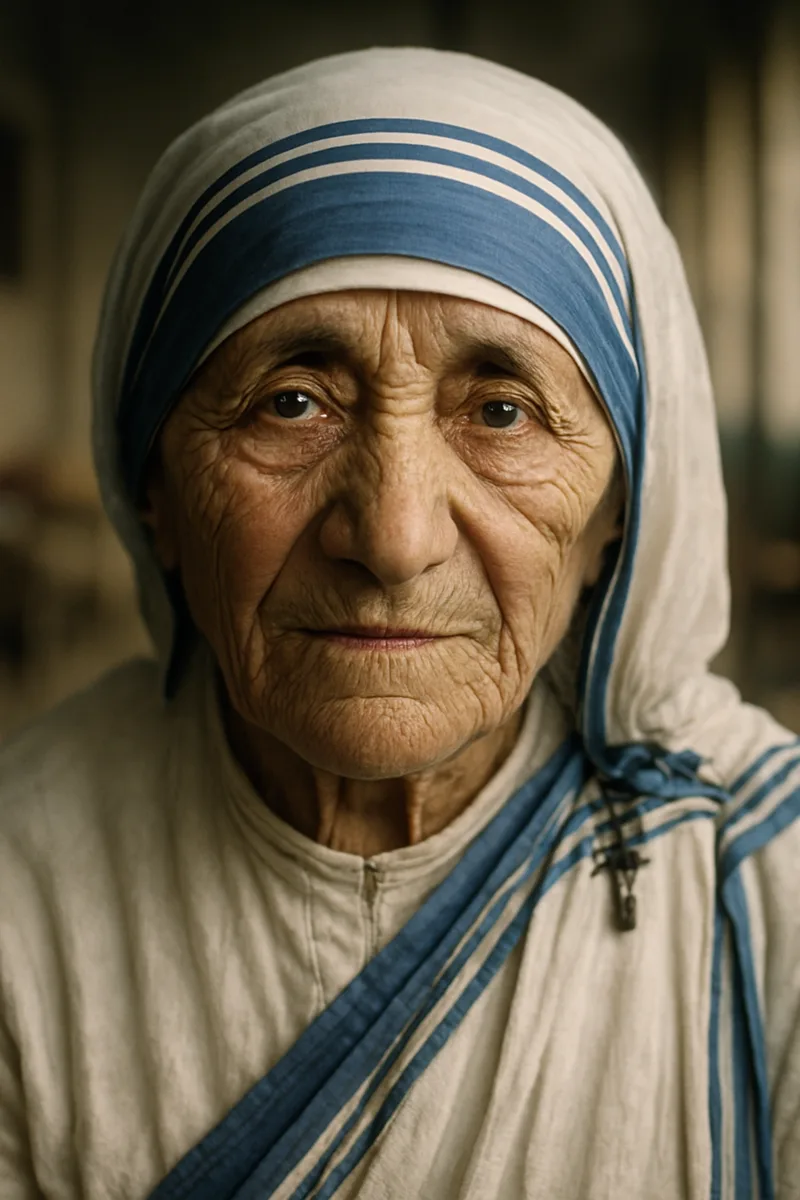
Mother Teresa: The Saint of the Gutters
Mother Teresa was an Albanian-born Catholic nun who devoted her life to serving the poorest of the poor in the slums of Calcutta, founding the Missionaries of Charity and building a worldwide network of hospices, orphanages, and care centers that served millions. Born Anjeze Gonxhe Bojaxhiu in Skopje in 1910, she left home at eighteen to join the Sisters of Loreto and never saw her family again. Her work among the dying and destitute of Calcutta made her one of the most recognized and revered figures of the twentieth century, winning the Nobel Peace Prize in 1979. Yet her private letters, published after her death, revealed decades of spiritual darkness - a crisis of faith that made her public devotion all the more remarkable.
Context & Background
Anjeze Gonxhe Bojaxhiu was born on August 26, 1910, in Skopje, in what was then the Ottoman Empire and is now North Macedonia. Her parents, Nikola and Dranafile Bojaxhiu, were ethnic Albanians and devout Catholics in a predominantly Muslim region. Her father was a successful merchant and local politician who died under suspicious circumstances when Anjeze was eight - possibly poisoned for his support of Albanian nationalism. The loss devastated the family financially and emotionally, and her mother, Dranafile, supported three children by sewing and selling cloth while deepening her commitment to faith and charity.
Dranafile's example was formative. She regularly brought food to the sick and destitute, and she told her children, "When you do good, do it as if you were casting a stone into the deep sea." Anjeze was a serious, studious girl who was deeply involved in her parish and its Sodality of the Blessed Virgin Mary. By the age of twelve, she felt a calling to religious life, and at eighteen she left Skopje to join the Sisters of Loreto in Ireland, then traveled to India to begin her novitiate in Darjeeling. She would never return to her homeland or see her mother and sister again.
She took her religious vows in 1931, choosing the name Teresa after Therese of Lisieux, the patron saint of missionaries. For nearly twenty years, she taught geography and catechism at St. Mary's High School in Calcutta, eventually becoming the school's principal. She was, by all accounts, a devoted and effective teacher. But the comfortable life within the convent walls sat uneasily against the suffering she witnessed outside them.
On September 10, 1946, during a train ride to Darjeeling for a spiritual retreat, Teresa experienced what she later called "the call within the call" - an overwhelming inner directive to leave the convent and serve the poorest of the poor, living among them. She petitioned the Vatican for permission to leave the Loreto order, which was granted in 1948.
She began her work alone, dressed in a simple white sari with a blue border, walking into the slums of Calcutta with no money, no organization, and no plan beyond responding to the need in front of her. She started an open-air school for street children, writing the alphabet in the dirt with a stick. Former students and young women inspired by her example soon joined her, and in 1950 the Vatican granted her permission to found a new religious order: the Missionaries of Charity.
The Missionaries' most distinctive work was the Home for the Dying, which Teresa established in 1952 in a building donated by the city of Calcutta. People who had been left to die on the streets - rejected by hospitals because they were beyond treatment - were brought in, bathed, fed, and given the dignity of human attention in their final hours. Critics accused Teresa of providing insufficient medical care; her defenders argued that the point was not medical treatment but human dignity for people whom the world had abandoned entirely.
The most startling revelation about Mother Teresa came after her death, when her private letters and spiritual diaries were published. They revealed that for nearly fifty years - from shortly after founding the Missionaries of Charity until her death - she experienced a profound spiritual darkness, an absence of God's presence that tormented her. "Where is my faith? Even deep down, there is nothing but emptiness and darkness," she wrote to her confessors. "If there be God - please forgive me."
This was not a temporary crisis but a permanent condition that she bore silently while projecting an image of serene faith to the world. The revelation humanized her in ways that the official hagiography never could. Here was a woman who dedicated her life to God while feeling abandoned by God - who served the poorest of the poor not because faith made it easy but because she chose to do it despite the absence of the consolation she craved.
Mother Teresa received the Nobel Peace Prize in 1979, and the Missionaries of Charity grew to over 4,500 sisters operating 610 missions in 123 countries. She became one of the most famous people in the world, meeting presidents and popes while continuing to live in radical simplicity - she owned only three saris and a bucket for washing.
Mother Teresa was canonized as a saint by the Catholic Church in 2016, but her legacy remains contested. Critics point to her opposition to contraception and abortion even in cases of extreme poverty, her acceptance of donations from questionable sources, and the quality of medical care in her facilities. Supporters counter that she gave dignity and love to millions of people whom no one else would touch, and that judging her by Western medical standards misses the radical nature of her commitment.
What is beyond dispute is the scale of her personal sacrifice. She left her family at eighteen and never saw them again. She lived in voluntary poverty for nearly seventy years. She spent decades in spiritual anguish while publicly embodying faith. Whatever one thinks of her theology or her methods, the intensity of her commitment to others is extraordinary. She died on September 5, 1997, in Calcutta, the city she had made her own.