Milton Friedman
Quotes & Wisdom
Milton Friedman: The Champion of Free Markets
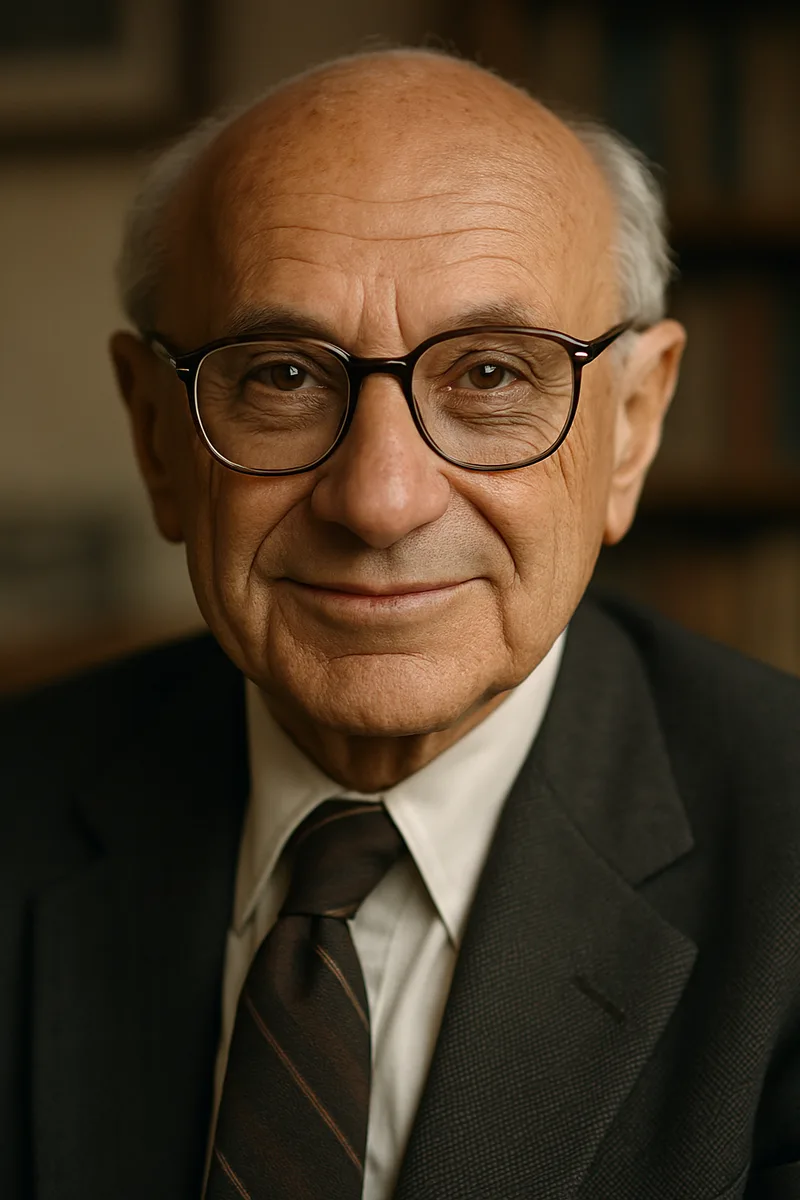
Milton Friedman was the most influential economist of the second half of the twentieth century, a diminutive, fast-talking intellectual whose ideas about monetary policy, free markets, and limited government reshaped economic thinking worldwide. Winner of the 1976 Nobel Prize in Economics, he spent three decades at the University of Chicago building the intellectual framework that challenged Keynesian orthodoxy and provided the theoretical foundation for the economic policies of Ronald Reagan and Margaret Thatcher. His gift was not just academic brilliance but an extraordinary ability to explain complex economic concepts to general audiences, making him one of the rare economists who genuinely changed public opinion.
Context & Background
Milton Friedman was born on July 31, 1912, in Brooklyn, New York, to Jewish immigrants from Beregszasz in what was then Austria-Hungary. His parents, Jeno and Sarah, ran a small dry-goods store and lived modestly. The family moved to Rahway, New Jersey, when Milton was young, and his father died during his senior year of high school, leaving the family in financial difficulty. Friedman earned a scholarship to Rutgers University, where he initially planned to become an actuary but was drawn to economics by two remarkable teachers, Arthur Burns and Homer Jones, who showed him that economics was not merely an academic discipline but a way of understanding how societies succeed or fail.
He earned his master's degree at the University of Chicago in 1933, during the depths of the Great Depression - an event that shaped every economist of his generation. While many of his contemporaries concluded that the Depression proved the failure of capitalism and the necessity of government intervention, Friedman would eventually reach the opposite conclusion: that the Depression was caused not by market failure but by government failure - specifically, the Federal Reserve's catastrophic contraction of the money supply. This contrarian interpretation, developed over decades, would become his most important scholarly contribution.
After working at the National Bureau of Economic Research and the U.S. Treasury during World War II, Friedman joined the University of Chicago's economics department in 1946. Chicago would become his intellectual home for the next thirty years, and the "Chicago School" of economics - with its emphasis on free markets, monetary policy, and skepticism of government intervention - would become the most influential school of economic thought in the postwar period.
Friedman's most significant academic contribution was his revival and modernization of the quantity theory of money, which he developed into what became known as monetarism. His landmark work, A Monetary History of the United States, 1867-1960, written with Anna Schwartz, demonstrated that changes in the money supply were the primary driver of economic fluctuations - and that the Great Depression had been deepened and prolonged by the Federal Reserve's failure to prevent a collapse in the money supply.
This was a direct challenge to the Keynesian consensus that dominated postwar economics, which held that government fiscal policy - taxing and spending - was the primary tool for managing the economy. Friedman argued that monetary policy was far more powerful and that government spending programs often did more harm than good. His "permanent income hypothesis" explained why consumers' spending depended on their long-term expected income rather than their current income, undermining the theoretical basis for short-term fiscal stimulus.
By the 1970s, when Keynesian economics struggled to explain "stagflation" - the simultaneous occurrence of high inflation and high unemployment that Keynesian theory said should be impossible - Friedman's ideas gained enormous influence. Central banks around the world began targeting money supply growth, and his framework became the foundation for modern monetary policy.
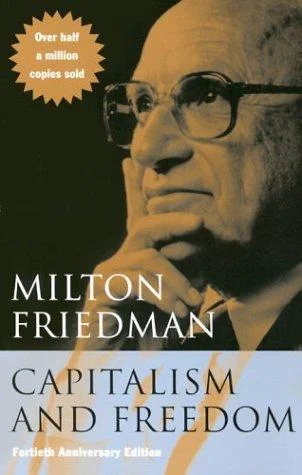
Friedman was unusual among academics in his eagerness to engage with the general public. His 1962 book Capitalism and Freedom argued that economic and political freedom were inseparable, and that well-intentioned government programs often produced the opposite of their intended effects. He advocated school vouchers, a volunteer military (replacing the draft), floating exchange rates, and a negative income tax to replace the welfare system. Many of these ideas, considered radical at the time, have since been adopted in various forms.
His 1980 television series Free to Choose, and the accompanying book written with his wife Rose, brought his ideas to millions of viewers and became one of the most successful public-television programs in history. Friedman's television persona was disarming: a small, bespectacled man with a quick smile and an even quicker mind who could demolish an opponent's argument in thirty seconds flat while remaining entirely cheerful about it.
His influence on policy was immense. He was an informal advisor to Ronald Reagan and Margaret Thatcher, and his ideas shaped the deregulation and privatization movements of the 1980s. His advocacy for floating exchange rates was adopted globally after the collapse of the Bretton Woods system in 1971. His work on school choice continues to drive education policy debates worldwide.
Friedman's intellectual partnership with his wife Rose Friedman was one of the great collaborations of twentieth-century intellectual life. They co-authored several books and Rose was a formidable economist in her own right who served as his closest advisor and sharpest critic for over sixty years.
He was also remarkably candid about the limits of his own prescriptions. When asked what had surprised him most about the results of free-market reforms, he answered, "How difficult it has been to maintain them." He understood that the case for freedom had to be made anew in every generation. He died on November 16, 2006, at the age of ninety-four, having lived long enough to see many of his once-radical ideas become mainstream economic thinking - and to see new challenges that even he had not anticipated.