
Henry Ford
Quotes & Wisdom
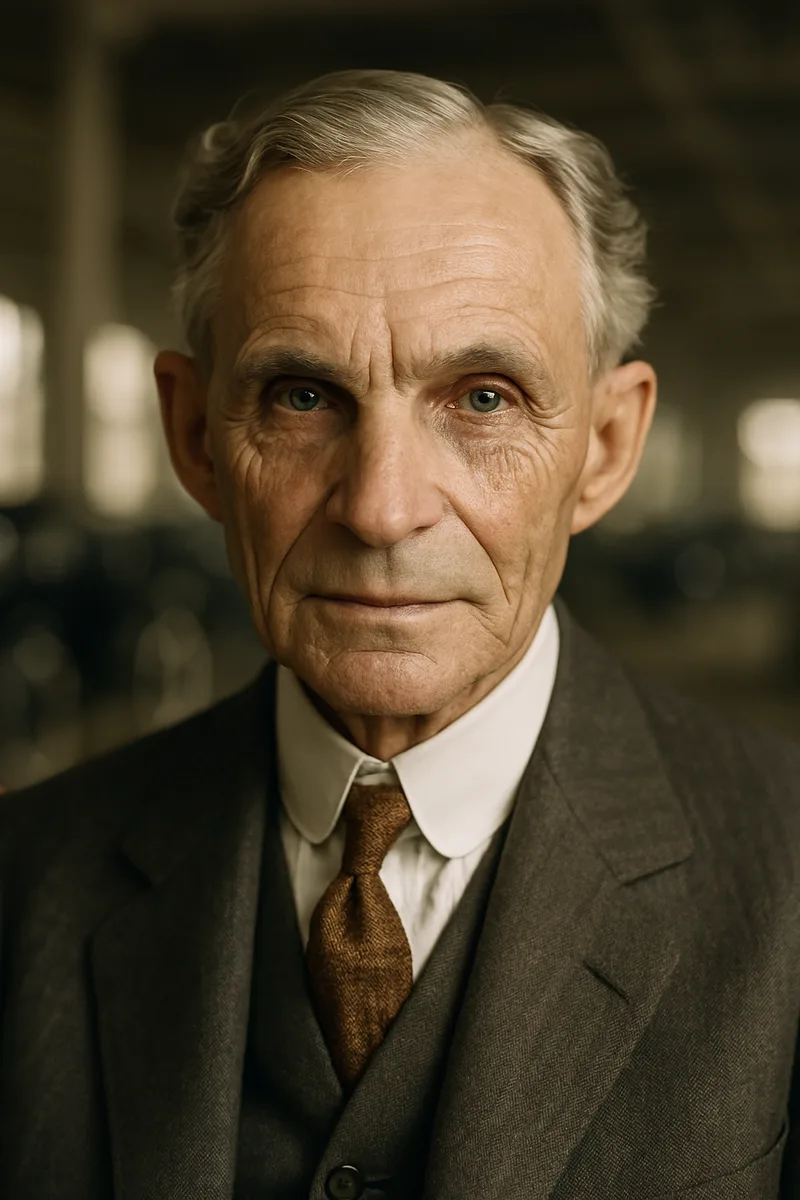
Henry Ford: The Mechanic Who Remade the Modern World
Henry Ford did not invent the automobile, but he did something arguably more transformative - he made it affordable. Through the assembly line, the five-dollar workday, and relentless standardization, Ford turned the car from a luxury toy into an everyday tool, reshaping American geography, culture, and economic life in the process. A farm boy from Dearborn, Michigan, he combined mechanical genius with ruthless efficiency and a populist instinct that understood what ordinary people wanted before they knew it themselves. Ford's legacy is deeply complicated - his industrial innovations coexist with virulent antisemitism and authoritarian labor practices. His quotes reveal a mind that was simultaneously visionary and dangerously narrow, capable of brilliant insight and appalling prejudice.
Context & Background
Born on July 30, 1863, on a farm in Dearborn, Michigan, Henry Ford grew up in a world of manual labor and horse-drawn transportation. His mother Mary died when he was twelve, a loss that haunted him for life. His father William expected him to take over the farm, but young Henry despised agricultural work and was obsessed with machinery. He disassembled every watch he could find, earning a reputation as a skilled tinkerer but a hopeless farmer.
At sixteen, Ford walked to Detroit to work as an apprentice machinist. Over the next decade, he moved between machine shops, a stint at Westinghouse servicing steam engines, and his father's farm - restless, searching for the right vehicle for his ambitions. In 1891, he took a job as an engineer with the Edison Illuminating Company, where he met Thomas Edison at a convention. Edison's encouragement of Ford's gasoline engine experiments was a turning point - Ford later called it the moment he knew his path was correct.
Two failed automobile companies preceded the founding of Ford Motor Company in 1903. Those early failures taught Ford essential lessons about cost control, production efficiency, and the importance of building for the mass market rather than the elite. By the time he launched the Model T in 1908, he had spent fifteen years refining not just the automobile but his philosophy of democratic manufacturing.
The Model T, introduced in 1908, was not the best car of its era - it was the most accessible. Sturdy, simple, and repairable by anyone with basic tools, it was designed for the rutted dirt roads of rural America. Ford's insight was that the real market for automobiles was not the wealthy few but the working millions.
The moving assembly line, fully implemented at Highland Park in 1913, was the mechanism that made this vision real. By breaking production into simple, repetitive steps, Ford reduced the time to build a Model T from over twelve hours to ninety-three minutes. The price dropped from $850 to $260. By 1927, fifteen million Model Ts had been sold.
The five-dollar workday, announced in January 1914, was equally revolutionary. By doubling the prevailing wage, Ford attracted the best workers, reduced crippling turnover, and - crucially - created customers who could afford the products they built. This insight - that workers are also consumers - helped lay the foundation for the American middle class.
Ford's brilliance as an industrialist was matched by deep moral failings. Beginning in 1920, his newspaper The Dearborn Independent published a series of virulently antisemitic articles that were later compiled into a pamphlet called 'The International Jew.' The publication was widely distributed and translated, influencing antisemitic movements worldwide, including in Nazi Germany. Adolf Hitler kept a portrait of Ford in his office and cited him in Mein Kampf.
Ford's labor practices were similarly authoritarian. He resisted unionization with a private security force - the Ford Service Department under Harry Bennett - that used intimidation, surveillance, and violence against workers. The Battle of the Overpass in 1937, where Ford's men brutally beat union organizers, became a watershed moment in American labor history. Ford was the last major automaker to recognize the United Auto Workers, holding out until 1941.
Ford's impact extended well beyond automobile manufacturing. He pioneered vertical integration, controlling everything from rubber plantations in Brazil to iron mines in Michigan. He experimented with soybeans as an industrial material, built a utopian company town called Fordlandia in the Amazon, and explored early forms of what would now be called sustainable manufacturing.
His friendship with Thomas Edison, Harvey Firestone, and John Burroughs - the self-styled 'Vagabonds' who took annual camping trips together - represented the intertwining of American innovation and celebrity culture. Ford also built Greenfield Village, an open-air museum preserving the material culture of American rural life, revealing a complex nostalgia for the very world his factories were destroying.
Ford was an accomplished folk dancer who hosted weekly square dances and published a manual on American traditional dancing. He was a health food enthusiast decades before the concept became mainstream, experimenting with soybean-based foods and promoting what he considered wholesome eating. He built a personal railway and collected historical artifacts with the obsessive energy he brought to everything.
Perhaps most surprisingly, Ford was a committed pacifist who chartered a 'Peace Ship' in 1915, sailing to Europe in a quixotic attempt to end World War I through negotiation. The mission was ridiculed and failed completely, but it revealed an idealism that sat uneasily alongside his authoritarian tendencies. Ford was a man of profound contradictions - a democratic industrialist and an autocratic employer, a pacifist who admired strongmen, a nostalgist who destroyed the past he romanticized.