
Augustus
Quotes & Wisdom
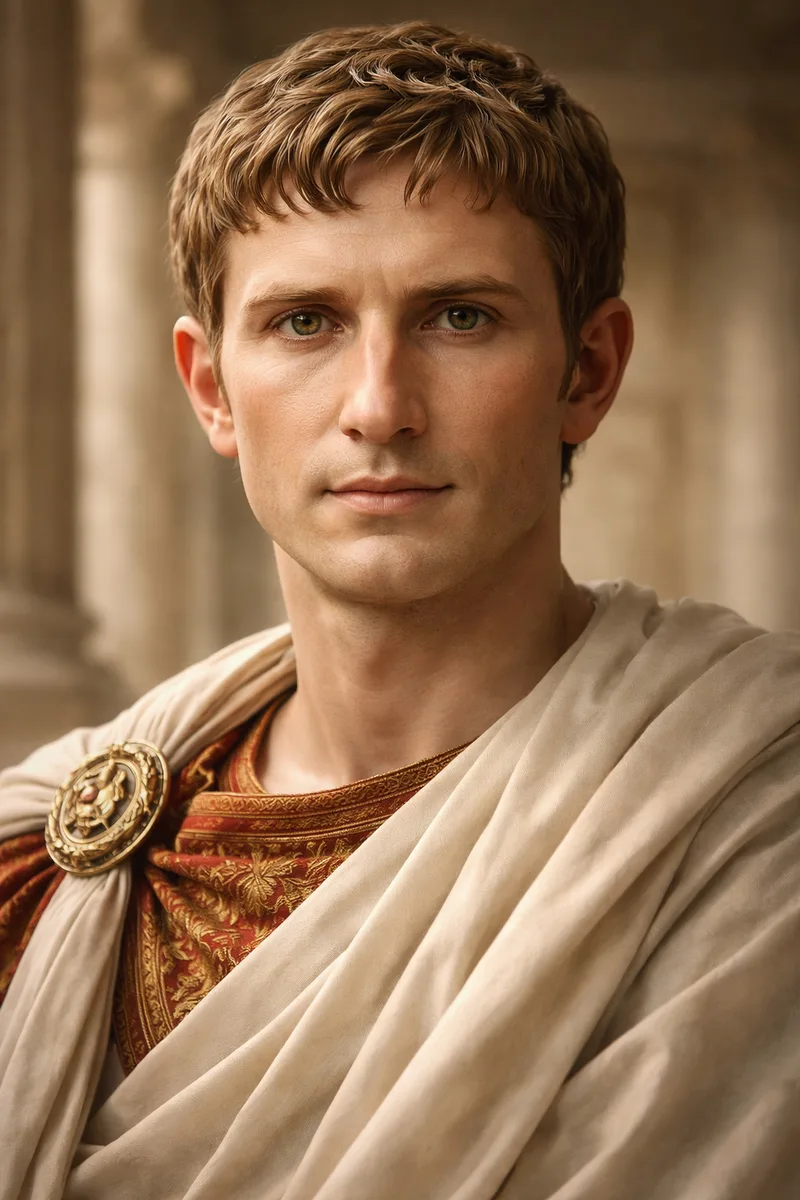
Augustus: The Architect of the Roman Empire
Augustus transformed Rome from a war-torn republic into the most powerful empire the ancient world had ever known. Born Gaius Octavius in 63 BC, he was adopted posthumously by his great-uncle Julius Caesar and thrust into a brutal power struggle at just eighteen. Through political cunning, strategic alliances, and ruthless elimination of rivals, he emerged as Rome's sole ruler by 27 BC. As the first emperor, he ushered in the Pax Romana - two centuries of relative peace and prosperity - rebuilt the city in marble, patronized poets like Virgil and Ovid, reformed the army, and created an administrative system that endured for generations. He ruled for over forty years, dying in 14 AD with a legacy that shaped Western civilization itself.
Context & Background
Augustus was born Gaius Octavius on September 23, 63 BC, in a modest house on the Palatine Hill in Rome. His father, Gaius Octavius Senior, was a wealthy Roman equestrian who had served as governor of Macedonia but died when Octavius was just four years old. His mother, Atia, was the niece of Julius Caesar, a connection that would define the boy's entire trajectory. Raised by his mother and stepfather Lucius Marcius Philippus, a consul and senator, Octavius received the classical education expected of Roman elites - rhetoric, philosophy, and Greek literature - but the political world around him was convulsing with violence and ambition.
The Roman Republic was dying. For a century, civil wars, political assassinations, and strongman politics had corroded republican institutions. Marius and Sulla had marched armies against Rome itself. The Senate's authority had been undermined by populist tribunes and ambitious generals. Pompey, Crassus, and Caesar had formed the First Triumvirate, dividing power among themselves outside constitutional channels. When Caesar crossed the Rubicon in 49 BC and defeated Pompey in a civil war that stretched from Spain to Egypt, he became dictator of Rome - an office the republic had reserved for temporary emergencies. Caesar's reforms were sweeping: land redistribution for veterans, calendar reform that gave us our modern system, citizenship expansion across the provinces, and massive public works. But on the Ides of March, 44 BC, senators who feared permanent tyranny stabbed him twenty-three times on the Senate floor.
Octavius was eighteen and studying in Apollonia (modern Albania) when he learned that Caesar's will had adopted him as son and primary heir. Against the advice of his family and every sensible friend, he traveled to Rome to claim his inheritance, adopting the name Gaius Julius Caesar Octavianus. He was stepping into a world of assassins, veteran legions hungry for land, and ruthless politicians - chief among them Mark Antony, Caesar's co-consul and military commander, who had seized Caesar's papers and treasury and had no intention of sharing power with a teenage newcomer.
The years between Caesar's assassination in 44 BC and Augustus's sole rule in 27 BC rank among the bloodiest and most politically complex in Roman history. Octavian - as historians call him during this period to distinguish him from the later Augustus - proved to be one of the most calculating political operators the ancient world ever produced. Initially dismissed by Antony as a boy who "owed everything to his name," Octavian leveraged that very name to recruit Caesar's veterans, win over the public, and maneuver the Senate into granting him military command.
He formed the Second Triumvirate with Mark Antony and Lepidus in 43 BC, a formal power-sharing arrangement ratified by law that gave the three men dictatorial authority. Their first act was the proscriptions - published lists of political enemies condemned to death and property seizure. Hundreds of senators and thousands of equestrians were killed. Among the most prominent victims was the great orator Cicero, who had championed the republic and attacked Antony in a series of blistering speeches called the Philippics. Antony's soldiers cut off Cicero's head and the hand that had written against him; both were displayed on the speaker's platform in the Forum as a warning.
After defeating Caesar's assassins Brutus and Cassius at the Battle of Philippi in 42 BC, the triumvirs divided the Roman world among themselves. Octavian took the west, Antony the east, and Lepidus Africa. Over the next decade, Octavian systematically consolidated control. He fought a brutal war against Sextus Pompey for control of Sicily and the Mediterranean grain supply. He sidelined Lepidus, stripped him of power, and placed him under permanent house arrest. He waged a propaganda war against Antony, portraying him as a debauched puppet of the Egyptian queen Cleopatra - a man who had abandoned Roman values, given away Roman provinces to foreign children, and surrendered his identity to Eastern decadence. When the final confrontation came at the naval Battle of Actium off the coast of western Greece in 31 BC, Octavian's fleet under Admiral Agrippa routed Antony and Cleopatra's combined forces. Both committed suicide in Alexandria the following year, leaving Octavian the undisputed master of the Roman world at thirty-two years old.
Augustus's greatest achievement was not military but constitutional. Having seen his adoptive father assassinated for concentrating power too openly, Augustus understood that Rome needed to feel free even while being ruled. In January 27 BC, he stood before the Senate and theatrically offered to resign all his extraordinary powers and restore the republic. The Senate, carefully managed and stacked with loyalists, refused - and instead granted him the honorific "Augustus" (the revered one) along with a vast portfolio of provinces and military commands that gave him control of most of Rome's legions. This choreographed performance was the foundation of the Principate, the system of government that would rule Rome for three centuries.
The genius lay in the disguise. Augustus held no title of king or dictator - words that Romans associated with tyranny. He called himself princeps - "first citizen" - and maintained the outward forms of republican government. The Senate still met and debated, elections still happened on the Field of Mars, magistrates still served annual terms. But real power flowed from Augustus through his control of the military, the treasury, and the frontier provinces. He appointed governors, directed foreign policy, legislated through senatorial decrees he had drafted, and controlled the grain supply that fed Rome's one million residents. Later Roman writers, including Seneca, would grapple with the tension between republican ideals and imperial reality that Augustus had embedded at the heart of the system.
He reformed every dimension of Roman life. He reorganized the army into a permanent professional force of twenty-eight legions, stationed along the frontiers from Britain to Syria, with fixed twenty-year terms of service and retirement grants of land or cash. He created the Praetorian Guard as his personal security force in Rome. He rebuilt the capital's infrastructure - aqueducts, roads, forums, temples - famously boasting that he had found Rome a city of brick and left it a city of marble. He established Rome's first professional police force (the vigiles) and fire brigade, reformed provincial taxation, conducted a census of the entire empire, created a courier-based postal system connecting the provinces, and enacted social legislation promoting marriage and childbearing among Roman citizens.
Augustus understood that lasting power required not just force but narrative. He patronized a circle of poets and writers - Virgil, Horace, Ovid, Livy, Propertius - whose works celebrated Roman destiny and Augustan peace. His friend and advisor Maecenas served as an informal minister of culture, funding artists whose work aligned with the regime's values. Virgil's Aeneid traced Rome's origins to the Trojan hero Aeneas, presenting Augustus as the fulfillment of cosmic prophecy and Jupiter's plan for universal peace. Horace's Carmen Saeculare, commissioned for the Secular Games of 17 BC, praised the return of morality and agricultural abundance. Livy's monumental history of Rome from its founding glorified the virtues of early Romans that Augustus claimed to restore.
These were not simply artistic achievements; they were instruments of ideological consolidation that shaped how Romans understood their own history, identity, and future. Augustus also commissioned the Ara Pacis (Altar of Peace), one of the finest surviving works of Roman art, and his own mausoleum and forum, creating a landscape of power in marble that still echoes through Rome today.
The Pax Romana that Augustus inaugurated brought unprecedented stability to the Mediterranean world. Trade flourished along networks that connected Britain to India by land and sea. Cities grew, agriculture expanded across newly irrigated lands, and provincial elites adopted Roman customs, language, and law in a process that bound the empire together. The system Augustus built would endure in the west for nearly five centuries and in the east - as the Byzantine Empire - for nearly fifteen hundred years. Marcus Aurelius, the philosopher-emperor who ruled a century and a half after Augustus, inherited a framework of governance that was still fundamentally Augustan in its architecture.
Ancient sources describe Augustus as short - perhaps five foot seven by modern estimates - with fair hair that curled slightly, calm bright eyes, and teeth that were widely spaced and decayed. He was a lifelong hypochondriac who suffered from a weak constitution, seasonal illnesses, kidney stones, and a painful bladder condition, yet he outlived nearly all his contemporaries through careful management of his health: cold baths, simple food, moderate exercise, and avoidance of extremes. He was famously frugal in personal habits - sleeping on a low bed with thin covers, eating bread, cheese, small fish, and pressed dates - even as he spent staggering sums on public works and spectacles.
His private life was marked by tragedy and ruthlessness in equal measure. He exiled his own daughter Julia for sexual scandals that may have masked political conspiracies against his rule, and later banished her daughter (also named Julia) for the same offenses. He outlived nearly every heir he carefully designated: his beloved nephew Marcellus died at nineteen, his trusted general and son-in-law Agrippa died at fifty, and his grandsons Gaius and Lucius both died young under circumstances that fueled rumors of foul play by his wife Livia. His eventual successor, his stepson Tiberius - a capable but embittered military commander - was reportedly his last and most reluctant choice. On his deathbed in Nola on August 19, 14 AD, at the age of seventy-five, he reportedly asked his friends whether he had played his part well in the comedy of life, then quoted a line from Greek theater asking the audience for applause if the performance had pleased them. The month of August still bears his name - renamed from Sextilis by senatorial decree during his reign.