
Julius Caesar
Quotes & Wisdom
Julius Caesar: The General Who Conquered a Republic and Lost His Life
Gaius Julius Caesar was the most formidable figure of the ancient world - a military genius who conquered Gaul, a political strategist who outmaneuvered the Roman Senate, and a writer whose accounts of his own campaigns remain models of Latin prose. In a republic rotting from oligarchic corruption and civil violence, Caesar seized power with a combination of battlefield brilliance, popular appeal, and ruthless calculation. His assassination on the Ides of March, 44 BC, was intended to save the Republic but instead destroyed it, plunging Rome into civil wars that ended with his adopted heir Augustus establishing an empire. Caesar's words - terse, confident, stripped of ornament - reveal a man who understood power with terrifying clarity and wielded it with a boldness that still astonishes.
Context & Background
Born on July 12 or 13, 100 BC, into the patrician Julian clan, Gaius Julius Caesar grew up in the Subura, one of Rome's rougher neighborhoods - an unusual upbringing for an aristocrat that gave him a lifelong connection to the common people. His family claimed descent from Venus through the Trojan hero Aeneas, a mythological pedigree that Caesar would exploit throughout his career.
The Rome of Caesar's youth was a republic in crisis. The old system of shared aristocratic governance was breaking down under the pressures of empire, wealth inequality, and military strongmen. The civil wars between Marius (Caesar's uncle by marriage) and Sulla had demonstrated that the republic's constitution could be overridden by anyone with enough legions. Young Caesar learned two lessons from this chaos: power belonged to those bold enough to seize it, and mercy could be more effective than terror.
Sulla's dictatorship nearly ended Caesar's life before it began. The dictator ordered the teenage Caesar to divorce his wife Cornelia (whose father had been Sulla's enemy). Caesar refused - a defiant act that forced him into hiding until influential friends intervened. Sulla reportedly warned that 'in this young man there are many Mariuses.'
Caesar's campaigns in Gaul (modern France, Belgium, and parts of Germany and Britain) from 58 to 50 BC were among the most consequential military operations in history. In eight years, he conquered an area the size of France, killed or enslaved over a million people, and built a battle-hardened army personally loyal to him rather than to the Roman state.
His Commentarii de Bello Gallico - the account of these campaigns written in third-person prose of crystalline clarity - served as both military report and political propaganda, keeping Caesar's name and achievements before the Roman public while he was away from the capital. The work remains a masterpiece of Latin literature and a foundational text in military history.
The Gallic wars also revealed Caesar's tactical brilliance. The siege of Alesia in 52 BC - where Caesar built two concentric rings of fortifications to simultaneously besiege a Gallic fortress and defend against a massive relief army - is one of the greatest military engineering feats of antiquity.
On January 10, 49 BC, Caesar crossed the Rubicon River with his legions, violating Roman law and triggering civil war. 'Alea iacta est' - the die is cast - he reportedly said, though the phrase may be apocryphal. The decision was the culmination of years of escalating conflict between Caesar and the Senate, led by Pompey.
The civil war that followed was swift. Pompey and most senators fled to Greece. Caesar pursued, defeating Pompey decisively at Pharsalus in 48 BC. He then followed Pompey to Egypt, where he became entangled with Cleopatra in a relationship that produced a son and a political alliance. Campaigns in North Africa and Spain eliminated the remaining opposition by 45 BC.
As dictator, Caesar enacted sweeping reforms - the Julian calendar, debt relief, citizenship extensions, public works, and land redistribution. But his accumulation of power and his refusal to restore republican government alarmed the Senate. On March 15, 44 BC, a group of senators led by Brutus and Cassius stabbed him to death on the Senate floor. The Republic they sought to save died with him.
Caesar was renowned for his personal charisma and his ability to inspire loyalty in his soldiers. He knew thousands of legionaries by name, shared their hardships on the march, and rewarded them generously after victories. His clemency toward defeated enemies - unusual in the Roman world - was both genuine magnanimity and calculated strategy, though it ultimately contributed to his assassination, as many of his killers were men he had pardoned.
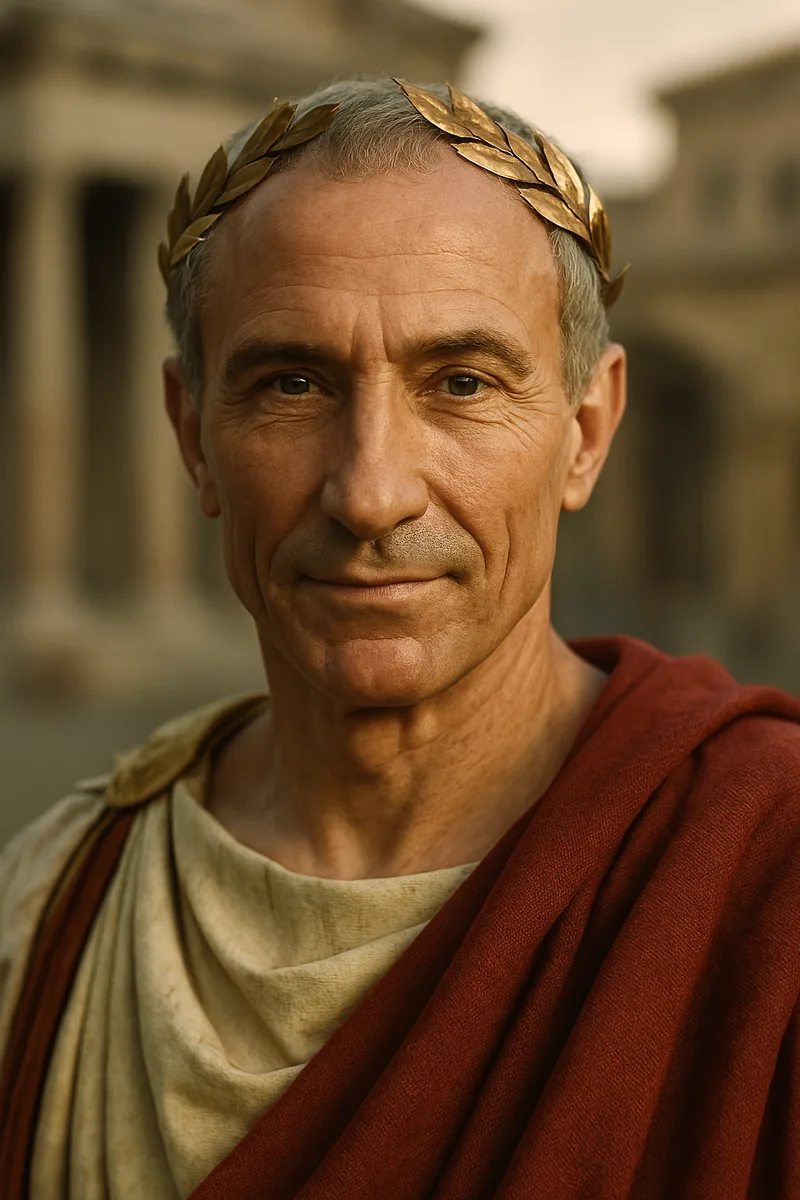
He was famously bald and reportedly sensitive about it, often wearing his laurel wreath to conceal his thinning hair. He was an accomplished swimmer, a tireless worker who dictated letters while riding horseback, and a notorious womanizer whose affairs scandalized even permissive Roman society. Marcus Aurelius would later use Caesar as an example of how earthly power fades - yet Caesar's name outlived the empire itself, becoming the root of 'Kaiser' and 'Tsar,' titles that would echo through two thousand years of European history.