
Andrew Carnegie
Quotes & Wisdom
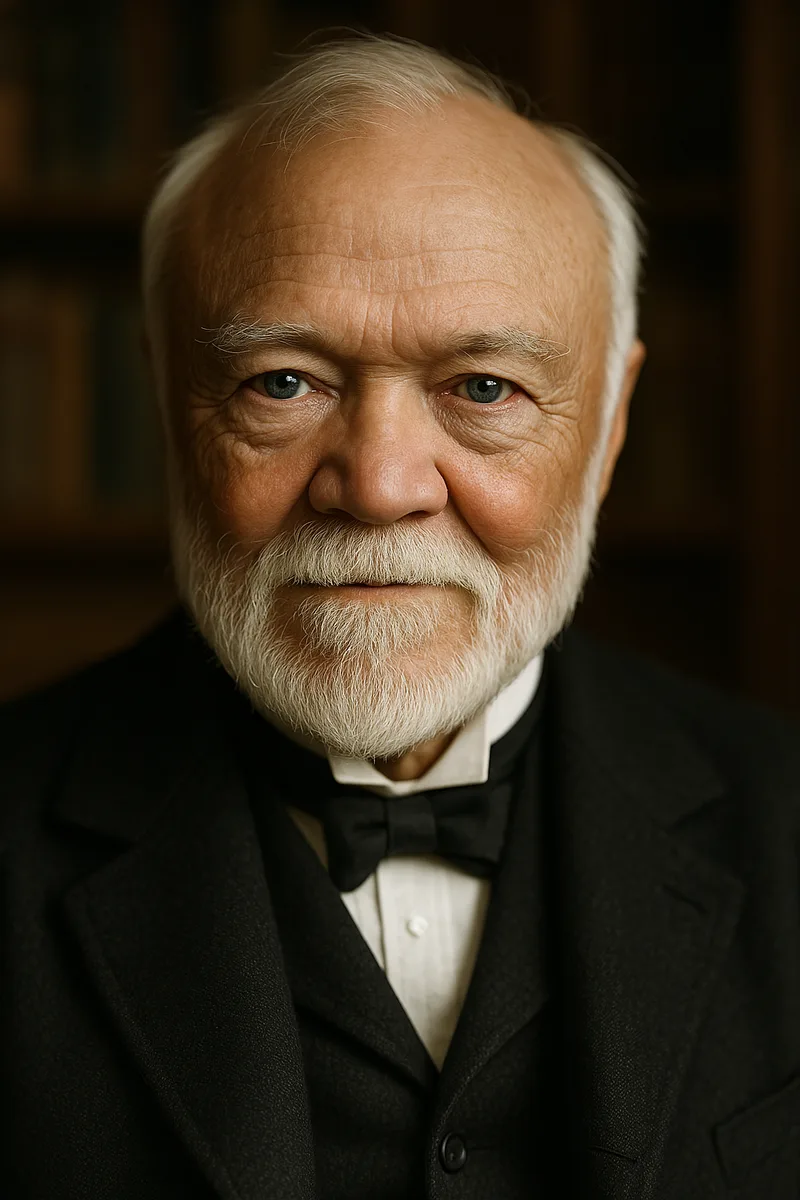
Andrew Carnegie: The Steel Titan Who Gave It All Away
Andrew Carnegie's life traces one of history's most dramatic arcs - from a penniless Scottish immigrant to the richest man in the world, and then to the most ambitious philanthropist of his age. Arriving in Pittsburgh at thirteen, he rose through the railroad industry and then built Carnegie Steel into the dominant force in American manufacturing. In 1901, he sold his company to J.P. Morgan for $480 million and dedicated his remaining years to giving away his fortune. His essay "The Gospel of Wealth" argued that the rich have a moral obligation to distribute their surplus for the common good. Carnegie funded over 2,500 public libraries, endowed universities, and established foundations that continue their work today.
Context & Background
Andrew Carnegie was born on November 25, 1835, in Dunfermline, Scotland, a town famous for its linen weaving industry. His father, William Carnegie, was a handloom weaver whose livelihood was destroyed by the mechanization of the textile industry - steam-powered looms made hand weaving obsolete almost overnight. The family's descent into poverty gave young Andrew a visceral understanding of how technological change could devastate working people, an experience that shaped both his ruthless business instincts and his later philanthropy.
In 1848, the Carnegie family emigrated to the United States, settling near Pittsburgh, Pennsylvania, where relatives had already established themselves. Thirteen-year-old Andrew went to work immediately as a bobbin boy in a cotton mill, earning $1.20 per week. He moved on to work as a telegraph messenger, then a telegraph operator - developing skills that caught the attention of Thomas Scott, superintendent of the Pennsylvania Railroad's western division. Scott became Carnegie's mentor, introducing him to the world of business, investment, and industrial capitalism.
Pittsburgh in the mid-nineteenth century was the furnace of American industry - its confluence of rivers, abundant coal, and railroad connections made it the ideal location for iron and steel production. Carnegie mastered the railroad business, then moved into iron bridges, then iron manufacturing, and finally steel, where he recognized that the Bessemer process could produce steel cheaply enough to replace iron in railroads, buildings, and bridges. By the 1890s, Carnegie Steel was producing more steel than all of Great Britain combined.
Carnegie's 1889 essay "The Gospel of Wealth" remains one of the most influential statements on the responsibilities of the rich. He argued that the concentration of wealth in the hands of the few was an inevitable result of industrial capitalism, but that wealthy individuals had a duty to use their surplus wealth for the benefit of society during their lifetimes. "The man who dies rich dies disgraced," he declared - a principle he lived by with remarkable consistency.
After selling Carnegie Steel to J.P. Morgan's U.S. Steel in 1901, Carnegie spent his remaining eighteen years distributing approximately $350 million - the equivalent of billions today. His most visible legacy is the system of 2,509 public libraries built across the English-speaking world, from small-town America to Scotland, Australia, and New Zealand. He also funded Carnegie Hall, the Carnegie Endowment for International Peace, the Carnegie Institution for Science, and Carnegie Mellon University.
Carnegie's legacy is complicated by the brutal labor practices that helped build his fortune. The Homestead Strike of 1892 - in which Carnegie's lieutenant Henry Clay Frick called in Pinkerton guards against striking steelworkers, resulting in multiple deaths - remains one of the darkest episodes in American labor history. Carnegie was in Scotland at the time and claimed to be horrified, but he had empowered Frick and benefited from the suppression of the union. His workers endured twelve-hour days, seven days a week, in dangerous conditions, while Carnegie enjoyed his Scottish castle and his philanthropic reputation.
This contradiction - genuine concern for human welfare alongside ruthless business practices - defines the Gilded Age itself. Carnegie was not unique in this regard; Cornelius Vanderbilt and John D. Rockefeller built similar empires with similar methods. But Carnegie's explicit moral philosophy made the gap between his ideals and his practices more visible and more troubling.
Carnegie stood barely five feet three inches tall, a fact that surprised people who knew him only through his outsized reputation. He was a voracious reader who credited the free library access provided by Colonel James Anderson in Allegheny City with transforming his life - inspiring his own library philanthropy. He was a committed pacifist who funded the Peace Palace in The Hague and believed that international arbitration could end war - an idealism shattered by World War I, which devastated him emotionally. He maintained a deep love for Scotland throughout his life, purchasing Skibo Castle in the Scottish Highlands and spending summers there. He wrote several books, including his autobiography and Triumphant Democracy, which celebrated American industrial progress. He died on August 11, 1919, having given away roughly 90% of his fortune.