
Cornelius Vanderbilt
Quotes & Wisdom
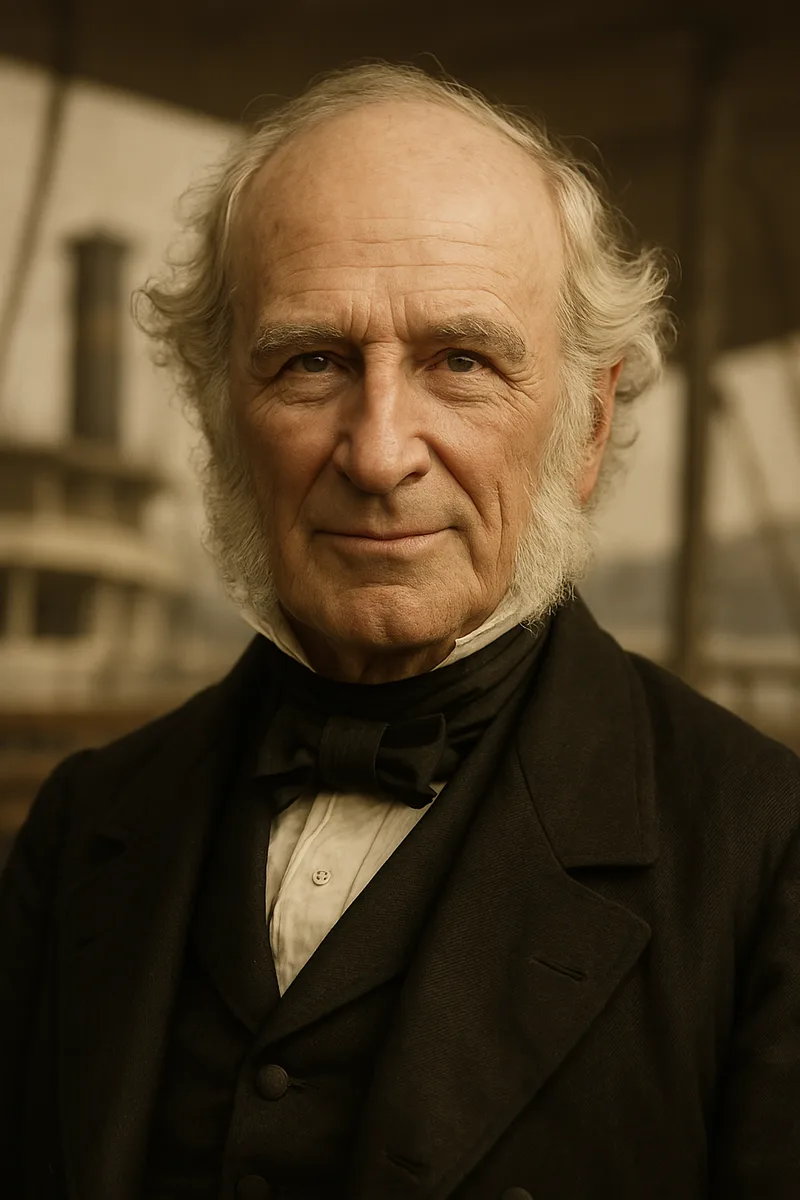
Cornelius Vanderbilt: The Commodore Who Built an Empire on Rails and Water
Cornelius Vanderbilt was the quintessential self-made American titan - a Staten Island farm boy who parlayed a single ferry boat into the largest shipping and railroad empire of the nineteenth century. Born in 1794, he dominated New York Harbor's ferry trade, then steamship routes to Central America, and finally the railroad industry, consolidating the New York Central system into the most powerful transportation network in the country. Aggressive, profane, and utterly ruthless in competition, he amassed a fortune of over $100 million at his death in 1877 - roughly equivalent to $200 billion today, making him one of the richest Americans who ever lived. His legacy includes both the infrastructure that connected a continent and the brutal competitive practices of the Gilded Age.
Context & Background
Cornelius Vanderbilt was born on May 27, 1794, on Staten Island, New York, into a family of modest Dutch-American farmers and boatmen. His father, also named Cornelius, ran a small ferry service in New York Harbor. Young Cornelius had almost no formal education - he could barely read and write throughout his life - but he understood boats, water, and commerce with an intuitive genius that no school could have provided.
The early American republic Vanderbilt inhabited was a nation of enormous opportunity and minimal regulation. New York Harbor in the early 1800s was a chaotic, competitive marketplace where dozens of ferry operators, shipping lines, and traders jostled for business. Transportation was the key to economic growth - whoever controlled the movement of goods and people controlled the economy. At sixteen, Vanderbilt borrowed $100 from his mother and bought a small sailboat, launching a ferry service between Staten Island and Manhattan. Within a few years, he was the dominant ferryman in the harbor.
The arrival of the steamboat transformed the industry. Vanderbilt worked for Thomas Gibbons, a steamboat operator who challenged Robert Fulton's monopoly on New York waterways. The resulting Supreme Court case, Gibbons v. Ogden (1824), struck down the monopoly and established the principle of federal authority over interstate commerce - a ruling that benefited Vanderbilt immensely as he expanded his operations.
Vanderbilt built his first fortune in steamships. By the 1840s, he operated a fleet on the Hudson River, Long Island Sound, and eventually transatlantic routes. During the California Gold Rush, he established a transit route through Nicaragua that competed directly with the Panama route, cutting travel time and costs. He earned the title "Commodore" - originally bestowed somewhat mockingly, but he wore it proudly for the rest of his life.
In the 1860s, now in his sixties, Vanderbilt pivoted to railroads. He acquired and consolidated several lines into the New York Central Railroad, creating a system that ran from New York City to Chicago. His methods were aggressive: he engaged in stock manipulation, rate wars, and political lobbying to crush competitors. His battle with Jay Gould and Jim Fisk for control of the Erie Railroad became one of the most notorious episodes in American financial history, involving bribery, stock watering, and legislative corruption on a spectacular scale.
Vanderbilt was not a man of refined sensibilities. He was crude, combative, and openly contemptuous of those who could not compete. When business associates who had betrayed him pleaded for mercy, he reportedly wrote: "Gentlemen: You have undertaken to cheat me. I won't sue you, for the law is too slow. I'll ruin you." Whether or not this letter is authentic, it captures Vanderbilt's approach perfectly.
Yet he was also a builder on a grand scale. The New York Central Railroad moved goods and people efficiently across a vast distance, knitting the American economy together. Grand Central Depot (predecessor to Grand Central Terminal), built in 1871, was his most visible monument. His $1 million gift to Central University in Nashville - renamed Vanderbilt University - was the largest single philanthropic donation in American history at the time.
Vanderbilt was a devoted believer in spiritualism in his later years, consulting mediums and clairvoyants about business and personal decisions. He was illiterate for much of his life and dictated his correspondence rather than writing it himself. His family life was tumultuous - he reportedly threatened to commit his son Cornelius Jeremiah to an insane asylum and left the vast majority of his fortune to his eldest son, William Henry, sparking a famous will contest. He was physically imposing, standing over six feet tall with piercing blue eyes and a commanding presence that intimidated rivals and allies alike. He never retired, working actively until his death at eighty-two on January 4, 1877. His fortune was the largest ever accumulated by an American to that point, and the Vanderbilt dynasty shaped American society, architecture, and culture for generations afterward.