The Happiness Hypothesis
Jonathan Haidt · 2006
Philosophy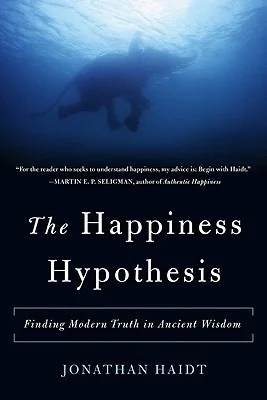
Finding Modern Truth in Ancient Wisdom
Jonathan Haidt tests ten great ideas from ancient philosophy and religion — from Buddha, Plato, Jesus, and the Stoics — against modern psychological research. His central metaphor: the mind is like a rider on an elephant, where the rider (reason) can nudge but rarely control the elephant (emotion and intuition).
Context & Background
Haidt, a social psychologist at NYU's Stern School of Business, bridges two worlds that rarely speak to each other: ancient wisdom traditions and modern empirical psychology. He shows that many insights the ancients arrived at through contemplation and observation have been confirmed by controlled experiments — and that some conventional wisdom is wrong.
The rider and elephant metaphor captures the relationship between conscious reasoning and unconscious emotional processes. The happiness formula (H = S + C + V: Happiness equals your biological Set point plus your Conditions of life plus your Voluntary activities) provides a framework for what we can and cannot change. The adaptation principle explains why we return to baseline happiness after both good and bad events. The importance of relationships — not money, status, or possessions — is confirmed as the strongest predictor of happiness.
The book helped launch the positive psychology movement into mainstream culture and established Haidt as one of psychology's most influential public intellectuals. It paved the way for his later work The Righteous Mind and The Coddling of the American Mind. Its synthesis of ancient philosophy and modern science created a template followed by many subsequent authors.