Relativity
Albert Einstein · 1916
Science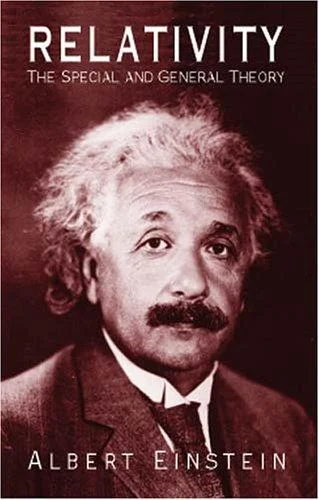
The Special and the General Theory
Albert Einstein himself wrote this short, accessible account of his two theories of relativity for the general reader. With minimal mathematics and abundant thought experiments, the greatest physicist of the twentieth century explains how space and time are interwoven, why mass and energy are equivalent, and how gravity is not a force but a curvature of spacetime itself.
Context & Background
Einstein wrote Relativity because he wanted ordinary people to understand his revolutionary ideas, not just specialists. The book demonstrates that the deepest ideas in physics can be communicated clearly by someone who truly understands them. It remains the most direct way to encounter relativity through the mind of its creator.
Special relativity (1905) shows that the speed of light is constant for all observers, that time slows down at high speeds (time dilation), that lengths contract in the direction of motion, and that mass and energy are equivalent (E=mc2). General relativity (1915) extends these ideas to gravity, showing that massive objects curve spacetime and that what we experience as gravity is the result of this curvature.
The theories of relativity revolutionized physics and our understanding of the universe. GPS satellites must account for relativistic effects to remain accurate. General relativity predicted black holes, gravitational waves (detected in 2015), and the expansion of the universe. Einstein's book remains in print over a century later, a testament to the enduring power of his ideas and his gift for explanation.