A Brief History of Time
Stephen Hawking · 1988
Science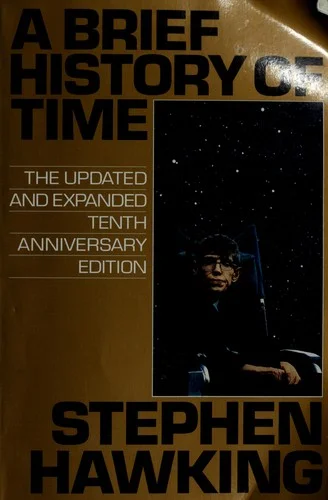
From the Big Bang to Black Holes
Stephen Hawking's landmark work made the most profound questions in physics accessible to everyone. From the nature of time and the Big Bang to black holes and the search for a unified theory, Hawking guides readers through the history of cosmology with wit, clarity, and an infectious sense of wonder that turned theoretical physics into a global conversation.
Context & Background
A Brief History of Time spent a record-breaking 237 weeks on the Sunday Times bestseller list and has sold over 25 million copies worldwide. It demonstrated that there was an enormous appetite among ordinary people for deep scientific ideas, and it transformed Hawking into the most recognizable scientist since Einstein.
Hawking explains the expanding universe and the Big Bang, black holes and their surprising thermodynamic properties (Hawking radiation), the arrow of time and why we remember the past but not the future, and the quest for a unified theory that reconciles general relativity with quantum mechanics. He poses the fundamental question: why does the universe exist at all?
The book single-handedly created the modern popular science genre. It proved that complex physics could reach a mass audience without dumbing down the ideas. Hawking's ability to communicate from a wheelchair, using a voice synthesizer, made him an icon of intellectual triumph over physical adversity.