Cosmos
Carl Sagan · 1980
Science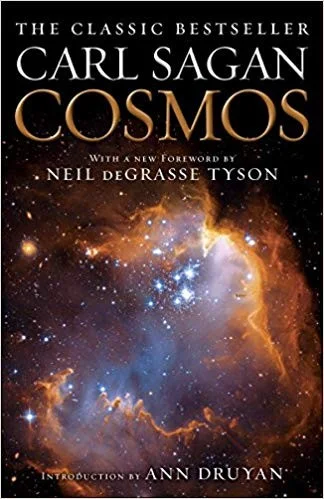
A Personal Voyage Through the Universe
Carl Sagan's magnum opus is a sweeping journey from the origins of the cosmos to the emergence of intelligence on Earth. Part science, part philosophy, part love letter to human curiosity, Cosmos weaves together astronomy, biology, history, and anthropology to show that we are all made of star-stuff and that understanding the universe is inseparable from understanding ourselves.
Context & Background
Cosmos accompanied the most-watched PBS series in American television history, reaching over 500 million viewers in 60 countries. Sagan achieved something rare: he made rigorous science feel like poetry, inspiring an entire generation to look up at the stars and ask the deepest questions about existence.
Sagan's cosmic perspective begins with the cosmic calendar — compressing the 13.8-billion-year history of the universe into a single year to reveal how recent human civilization truly is. He explores the library of Alexandria as a cautionary tale about the fragility of knowledge, the Drake equation estimating extraterrestrial civilizations, and the pale blue dot philosophy that our planet is a tiny, fragile world deserving of care.
The book and series revitalized public interest in space exploration and science education. Sagan's phrase 'billions and billions' entered the cultural lexicon, and his insistence on wonder as a scientific virtue influenced communicators from Neil deGrasse Tyson to Brian Cox. The series was rebooted in 2014 with Tyson as host, a direct tribute to Sagan's enduring impact.