A Short History of Nearly Everything
Bill Bryson · 2003
Science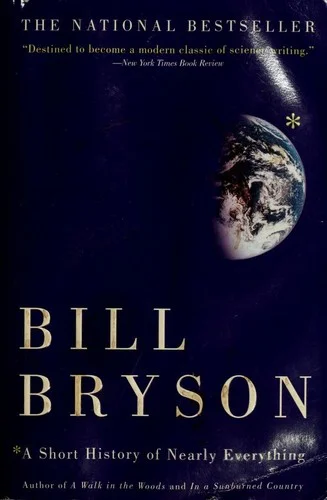
Science for the Rest of Us
Bill Bryson set out to understand everything that has happened from the Big Bang to the rise of civilization — and to find out how we know what we know. The result is a witty, accessible, and thoroughly delightful tour through the sciences, from cosmology and geology to chemistry and paleontology, told through the stories of the brilliant, eccentric, and often overlooked scientists who made the discoveries.
Context & Background
Bryson, a bestselling travel writer with no scientific background, asked the questions that ordinary readers are afraid to ask: How do we know how much the Earth weighs? What is a quark? Why did the dinosaurs disappear? His willingness to be the curious layperson in the room produced the most engaging popular science book in a generation.
The book covers the full sweep of scientific knowledge: the Big Bang and the formation of the universe, the geological history of Earth, the chemistry of life, plate tectonics, evolution and extinction, and the emergence of Homo sapiens. Bryson emphasizes how much remains unknown and how many discoveries happened by accident, luck, or the persistence of eccentric individuals.
The book has sold over 3 million copies and won the Aventis Prize for Science Books and the Descartes Prize for science communication. It became the standard recommendation for anyone who wanted to understand science but found traditional science books intimidating. Bryson proved that genuine expertise is not a prerequisite for great science writing — genuine curiosity is.