
Queen Elizabeth I
Quotes & Wisdom
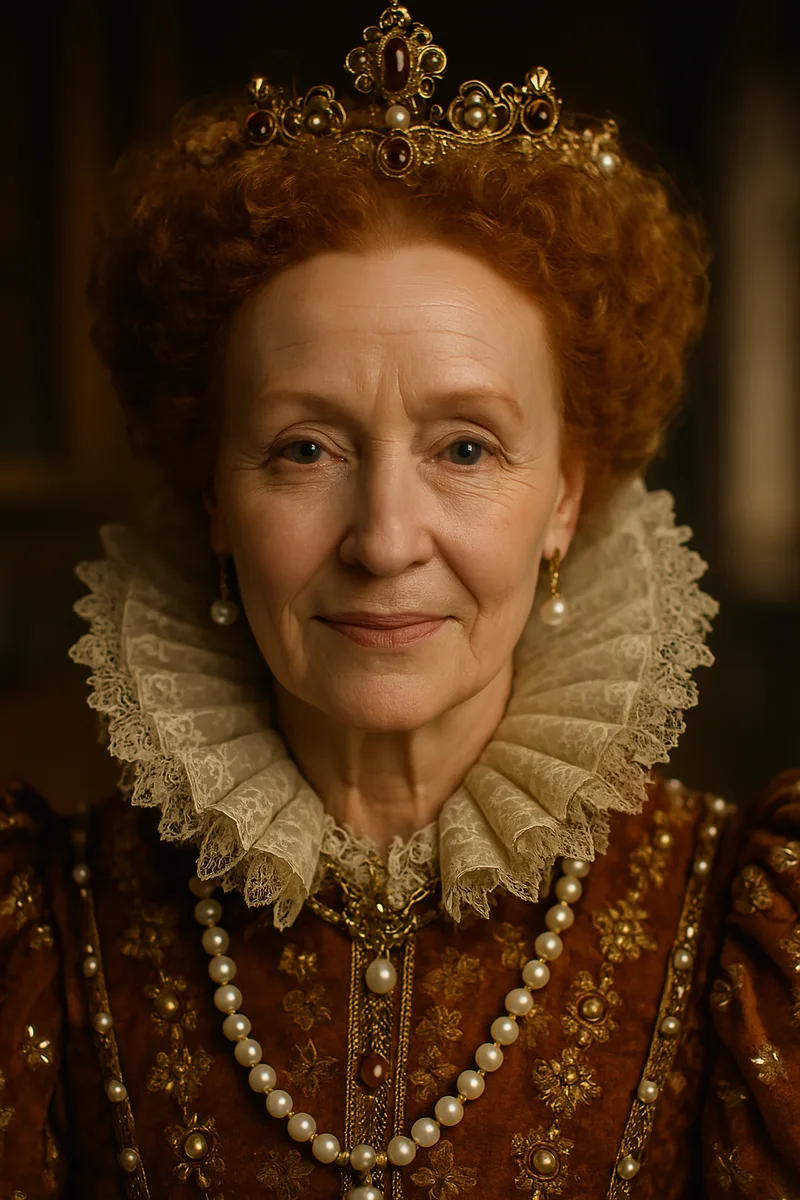
Queen Elizabeth I: The Virgin Queen Who Built an Empire
Queen Elizabeth I reigned over England for forty-five years, transforming a vulnerable island kingdom into a global power and presiding over one of the greatest cultural flowerings in human history. The daughter of Henry VIII and Anne Boleyn, Elizabeth survived a childhood of danger and uncertainty - her mother was beheaded when she was two, and she was imprisoned in the Tower of London by her own sister. She ascended the throne in 1558 at twenty-five and governed with a combination of political brilliance, personal charisma, and steely resolve that earned her a place among history's greatest monarchs. Her reign saw the defeat of the Spanish Armada, the voyages of Drake and Raleigh, and the plays of William Shakespeare. She never married, turning her single status into a tool of statecraft and mythmaking.
Context & Background
Elizabeth Tudor was born on September 7, 1533, at Greenwich Palace, the daughter of King Henry VIII and his second wife, Anne Boleyn. Her birth was a bitter disappointment to her father, who had broken with the Roman Catholic Church - splitting England from papal authority and creating the Church of England - specifically to secure a male heir. When Anne Boleyn was executed on charges of treason and adultery in May 1536, the two-year-old Elizabeth was declared illegitimate and removed from the line of succession.
The England of Elizabeth's youth was a country in religious and political turmoil. Henry VIII's break with Rome had unleashed forces that could not easily be controlled. Under Elizabeth's half-brother, Edward VI (reigned 1547-1553), England lurched toward Protestantism. Under her half-sister, Mary I (reigned 1553-1558), it lurched back toward Catholicism with a vengeance, earning Mary the nickname "Bloody Mary" for her burning of nearly three hundred Protestant heretics. Elizabeth herself was imprisoned in the Tower of London in 1554 on suspicion of involvement in a Protestant rebellion, and she came perilously close to execution.
This dangerous childhood forged the qualities that would make Elizabeth a great queen: caution, self-control, an extraordinary ability to read people, and an instinct for survival that bordered on genius. She learned early that words were weapons and that ambiguity was a form of protection. When she was questioned about her religious beliefs during Mary's reign, she gave answers of such careful vagueness that her interrogators could never pin her down. This became the template for her entire political career.
Elizabeth ascended the throne on November 17, 1558, at the age of twenty-five, inheriting a kingdom that was religiously divided, financially strained, and militarily weak. She immediately faced the question that would dominate the first decades of her reign: whom would she marry? Every court in Europe considered the English queen's hand a prize worth pursuing, and her own advisors begged her to secure the succession by producing an heir.
Elizabeth turned her single status into perhaps the most brilliant piece of political theater in English history. She entertained suitors from France, Spain, Austria, and Sweden, drawing out negotiations for years and using the possibility of marriage as a diplomatic tool without ever committing. She cultivated the image of the "Virgin Queen," married to her kingdom, and built an elaborate cult of personality around her unmarried state that gave her a freedom of action no married queen could have enjoyed.
Her governance was characterized by pragmatism, patience, and an extraordinary reluctance to make irreversible decisions. She chose her advisors well - William Cecil and Francis Walsingham were among the ablest statesmen in Europe - and she listened to them carefully, even when she overruled them. She managed her parliaments with a mix of charm, intimidation, and genuine oratorical brilliance.
The defining military crisis of Elizabeth's reign came in 1588, when Philip II of Spain launched the Armada - a fleet of 130 ships carrying 30,000 men - to invade England, depose Elizabeth, and restore Catholicism. Elizabeth's response was magnificent. She traveled to Tilbury, where her army was assembled, and delivered one of the most famous speeches in English history: "I know I have the body but of a weak and feeble woman; but I have the heart and stomach of a king, and of a king of England too."
The Armada was defeated by a combination of English seamanship, fire ships, and Atlantic storms. The victory transformed England's strategic position and made Elizabeth a Protestant heroine across Europe. It also inaugurated a period of national confidence and cultural achievement that has rarely been matched. The Elizabethan age saw William Shakespeare, Christopher Marlowe, Edmund Spenser, and Francis Bacon produce some of the greatest works in the English language. English explorers - Francis Drake, Walter Raleigh, Martin Frobisher - sailed to the New World and circumnavigated the globe. English commerce expanded, the navy grew, and London became a city of genuine international significance.
Elizabeth presided over this flowering without always controlling it. She was a patron of the arts, but her real contribution was creating the conditions of stability and confidence in which genius could flourish. Her religious settlement - the Elizabethan compromise - was deliberately ambiguous, designed to accommodate as many English Christians as possible within a single national church. It was not tolerant by modern standards, but it was remarkably so by the standards of the sixteenth century.
Elizabeth was one of the most educated women of her time. She was fluent in French, Italian, Spanish, Latin, and Greek, and she translated classical texts for pleasure throughout her life. Her letters and speeches reveal a mind of formidable power - witty, allusive, and capable of devastating precision.
She was also vain, theatrical, and sometimes cruel. In her later years, she wore increasingly elaborate wigs and makeup to maintain the illusion of youth, and she could be viciously jealous of younger women at court. Her treatment of Mary, Queen of Scots - whom she kept imprisoned for nineteen years before reluctantly signing her death warrant in 1587 - remains one of the most debated episodes in her reign.
Elizabeth died on March 24, 1603, at Richmond Palace, at the age of sixty-nine. She was the last of the Tudor monarchs, and her death marked the end of one of England's most remarkable dynasties. She was succeeded by James VI of Scotland, the son of the cousin she had executed, uniting the English and Scottish crowns for the first time.