Richard Feynman
Quotes & Wisdom
Richard Feynman: The Great Explainer
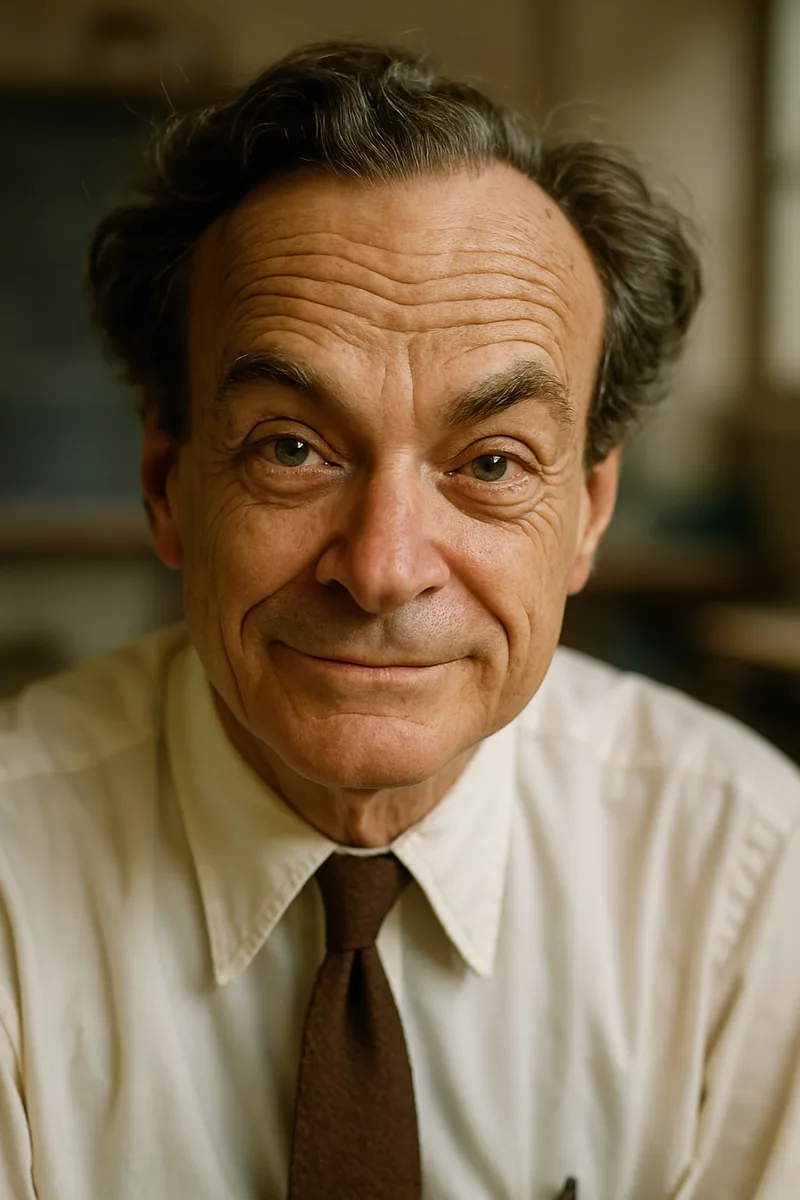
Richard Feynman was the most brilliantly original physicist of the postwar era and one of the greatest science communicators who ever lived. A Nobel laureate who made foundational contributions to quantum electrodynamics, he was equally celebrated for his infectious curiosity, his irreverent humor, and his gift for making the most complex ideas accessible to anyone willing to listen. Born in Far Rockaway, Queens, Feynman combined the rigor of a world-class theorist with the mischievous spirit of a born prankster. He cracked safes at Los Alamos, played bongo drums in a samba band, decoded Mayan hieroglyphics for fun, and exposed the cause of the Challenger disaster with a glass of ice water and a rubber O-ring on national television. His lectures and books have inspired more people to love physics than perhaps any other body of work in the history of science.
Context & Background
Richard Phillips Feynman was born on May 11, 1918, in the Far Rockaway neighborhood of Queens, New York, to Melville and Lucille Feynman. His father, a uniform salesman with a passionate amateur interest in science, ignited Richard's curiosity from an early age by teaching him to question everything and look for patterns in nature. His mother gave him his sense of humor - the ability to find absurdity everywhere and to refuse to take himself too seriously.
Far Rockaway in the 1920s and 1930s was a middle-class Jewish neighborhood at the edge of New York City, and Feynman grew up tinkering with radios, building circuits, and performing chemistry experiments in a home laboratory. He was identified as gifted early - his IQ was tested at 125, a number he later enjoyed citing to deflate claims about genius, though his mathematical abilities were clearly extraordinary.
The America of Feynman's youth was a country being transformed by science and technology. Radio, aviation, automobiles, and electrical power were reshaping daily life, and the theoretical physics coming out of Europe - relativity, quantum mechanics - was the most exciting intellectual frontier in the world. Feynman studied physics at MIT and then at Princeton, where his doctoral advisor was John Archibald Wheeler. His dissertation, completed in 1942, introduced a revolutionary reformulation of quantum mechanics using the "path integral" approach, which would become one of his greatest contributions.
In 1943, at the age of twenty-four, Feynman was recruited to join the Manhattan Project at Los Alamos, New Mexico. He worked under Hans Bethe on the theoretical physics division, contributing to calculations crucial to the development of the atomic bomb. Despite the grim purpose of the work, Feynman's time at Los Alamos became legendary for his pranks - picking locks, cracking safes containing classified documents, and driving the security officers to distraction.
During this period, Feynman's first wife, Arline Greenbaum, whom he had married despite her diagnosis with tuberculosis, was dying in a hospital in Albuquerque. He visited her regularly, and her death in June 1945 was a profound loss that haunted him for decades. A letter he wrote to her after her death - "I love you, sweetheart" - sealed and unsent, was found among his papers after his own death and has become one of the most poignant documents in the history of science.
After the war, Feynman joined Cornell and then Caltech, where he did the work that would earn him the Nobel Prize in Physics in 1965. His reformulation of quantum electrodynamics (QED) - the theory describing how light and matter interact - was a tour de force of physical intuition. He introduced Feynman diagrams, simple pictorial representations of particle interactions that transformed how physicists calculate and think about quantum processes. These diagrams were not merely a notational convenience; they embodied a new way of understanding nature.
What made Feynman unique among great physicists was his absolute commitment to understanding things from the ground up. He refused to accept any explanation he could not derive himself, and he had an uncanny ability to find the simplest, most intuitive way to see a problem. His Caltech lectures, delivered to undergraduates in 1961-1963 and published as The Feynman Lectures on Physics, are widely regarded as the finest physics textbook ever written - not because they are easy, but because they convey the genuine pleasure of understanding.
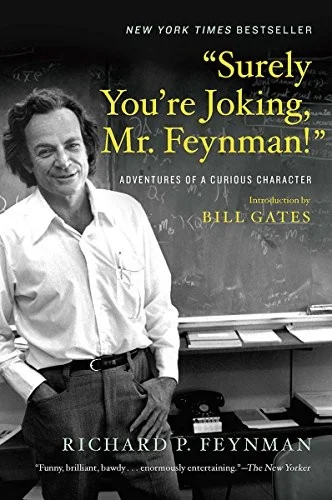
Feynman was also a gifted popular communicator. His autobiographical books - Surely You're Joking, Mr. Feynman! (1985) and What Do You Care What Other People Think? (1988) - became bestsellers and introduced millions of readers to a personality that was as compelling as his science. He wrote about picking locks, painting nudes, learning to play drums in Brazil, and investigating the Challenger disaster, all with the same infectious enthusiasm.
His role on the Rogers Commission investigating the 1986 Challenger disaster was characteristic. While other committee members engaged in bureaucratic maneuvering, Feynman conducted a simple experiment on live television: he dunked a piece of the shuttle's O-ring material in a glass of ice water and showed that it lost its resilience in the cold - the direct cause of the disaster. His appendix to the commission's report contained the now-famous observation: "For a successful technology, reality must take precedence over public relations, for Nature cannot be fooled."
Feynman was an accomplished visual artist who exhibited his drawings and paintings under the pseudonym "Ofey." He was a skilled bongo drummer who performed with samba bands and composed music. He learned to crack safes during the Manhattan Project and continued the hobby for the rest of his life, partly as an exercise in problem-solving and partly to annoy security officials.
He spoke Portuguese fluently - learned during a sabbatical year in Brazil - and had a working knowledge of Japanese. He attempted to decode Mayan hieroglyphics and made genuine progress in understanding their astronomical content. He frequented strip clubs in Pasadena, claiming they were the best places to work on physics problems undisturbed, a habit that made some colleagues uncomfortable.
Feynman was diagnosed with two rare forms of cancer in the 1980s. He died on February 15, 1988, at the age of sixty-nine. His last words were reported as: "I'd hate to die twice. It's so boring." His grave at Mountain View Cemetery in Altadena, California, is visited by physicists and admirers from around the world.