
Napoleon Bonaparte
Quotes & Wisdom
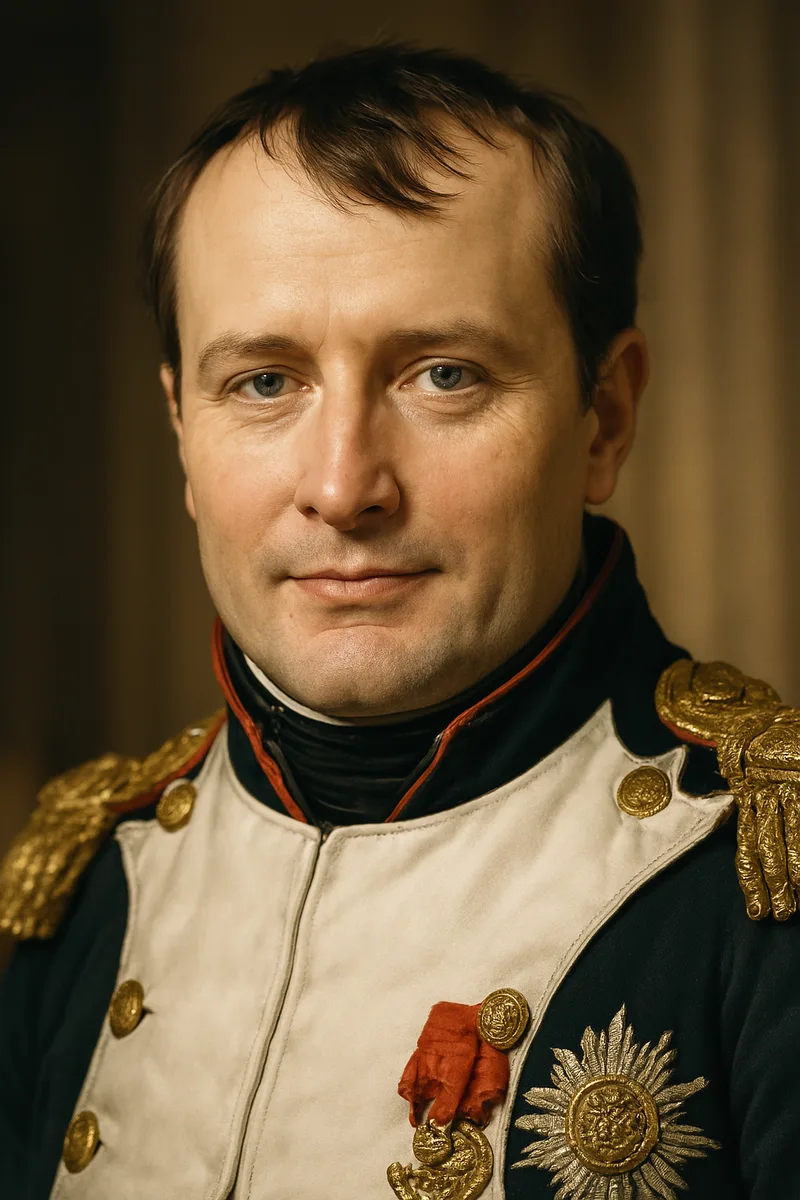
Napoleon Bonaparte: The Architect of the Modern World
Napoleon Bonaparte was the Corsican artillery officer who seized control of revolutionary France, crowned himself Emperor, conquered most of Europe, and in doing so reshaped the political, legal, and military landscape of the modern world. Born in Ajaccio in 1769, just a year after Corsica was ceded by Genoa to France, he rose through the ranks of the French army during the Revolution and by thirty was the most powerful man in Europe. His Napoleonic Code reformed civil law across the continent, his military campaigns rewrote the art of war, and his ambition - boundless, brilliant, and ultimately self-destructive - has fascinated historians for two centuries.
Context & Background
Napoleone di Buonaparte was born on August 15, 1769, in Ajaccio, Corsica, barely a year after the island was transferred from the Republic of Genoa to France. His family was minor Corsican nobility - respectable but not wealthy - and his father, Carlo, was a lawyer who had supported Corsican independence under Pasquale Paoli before pragmatically switching allegiance to France. This accommodation secured scholarships for Napoleon and his brother Joseph at French military schools, but the young Corsican never forgot his outsider status. His French schoolmates mocked his accent, his Italian-sounding name, and his provincial origins - slights that fueled a lifelong ambition to prove himself superior to those who looked down on him.
Napoleon excelled at the Ecole Militaire in Paris, particularly in mathematics and artillery, and was commissioned as a second lieutenant at sixteen. He was a voracious reader during these years - devouring histories, philosophy, and the works of Jean-Jacques Rousseau and Voltaire - and he developed a strategic mind that processed information with extraordinary speed. The French Revolution, which erupted in 1789, provided the opportunity that his talents required. The old aristocratic officer corps was swept away, and competence suddenly mattered more than birth.
His defense of the Convention government during a royalist uprising in 1795 - the famous "whiff of grapeshot" that scattered the mob - brought him to the attention of the Directory. At twenty-six, he was given command of the Army of Italy, and his campaign of 1796-1797 transformed a ragged, underfed army into a conquering force that shattered Austrian power in northern Italy. The combination of speed, deception, and concentration of force that he displayed became the template for modern military strategy.
Napoleon's military achievements are almost too vast to summarize. He fought roughly sixty major battles and lost only seven. His campaigns in Italy, Egypt, Austria, Prussia, Spain, and Russia demonstrated a range and adaptability that no commander since Alexander the Great had matched. His genius lay not in any single innovation but in the integration of all elements of warfare - logistics, intelligence, artillery, infantry, cavalry, and above all speed - into a coherent system of destruction.
The Battle of Austerlitz in December 1805 is generally considered his masterpiece. Facing a combined Austrian and Russian army that outnumbered him, Napoleon deliberately weakened his right flank to lure the enemy into attacking it, then drove a massive assault through their weakened center, splitting their army in two. The victory was so complete that it knocked Austria out of the war and established French dominance over continental Europe.
But Napoleon's genius was not limited to the battlefield. He reorganized the French state with an efficiency that the monarchy had never achieved - reforming education, infrastructure, taxation, and banking. The Napoleonic Code, promulgated in 1804, replaced the patchwork of feudal and regional laws with a unified civil code based on Enlightenment principles: equality before the law, the right to property, the separation of church and state, and the freedom of contract. The Code remains the foundation of civil law in much of continental Europe, Latin America, and parts of Africa and Asia.
Napoleon's downfall was, in many ways, the logical consequence of his greatest strength. The ambition and confidence that had carried him from Corsican obscurity to European mastery could not be switched off. He invaded Spain in 1808, installing his brother Joseph on the throne and provoking a guerrilla war that drained French resources for six years. He invaded Russia in 1812 with an army of over 600,000 - the largest military force Europe had ever seen - and lost over 400,000 men to battle, disease, starvation, and the brutal Russian winter.
The Russian disaster broke the spell of invincibility. A coalition of European powers defeated him at Leipzig in 1813, and in April 1814 he was forced to abdicate and was exiled to the island of Elba. His escape, return to France, and the "Hundred Days" that culminated in his final defeat at Waterloo in June 1815 constitute one of history's most dramatic political narratives. He spent his final six years in exile on the remote South Atlantic island of Saint Helena, dictating his memoirs and crafting the legend that would sustain his reputation for centuries.
Napoleon slept remarkably little - often four to five hours a night - and compensated with short naps during the day, a habit that allowed him to work eighteen-hour days for weeks on end. He dictated letters and orders at extraordinary speed, sometimes to multiple secretaries simultaneously, and his correspondence fills over thirty published volumes. He was a compulsive list-maker who personally reviewed the details of his armies down to the regimental level.
He was also surprisingly short-tempered about the one thing the public remembers most: his height. At roughly five feet six or seven inches, he was average for his era, and the persistent myth of his extreme shortness was largely a product of British propaganda and a confusion between French and English measurement systems. He died on May 5, 1821, on Saint Helena, probably of stomach cancer, though theories of arsenic poisoning persist. His body was returned to Paris in 1840 and lies in a massive red porphyry sarcophagus in Les Invalides - a tomb as grandiose as the ambition it commemorates.