
Marilyn Monroe
Quotes & Wisdom
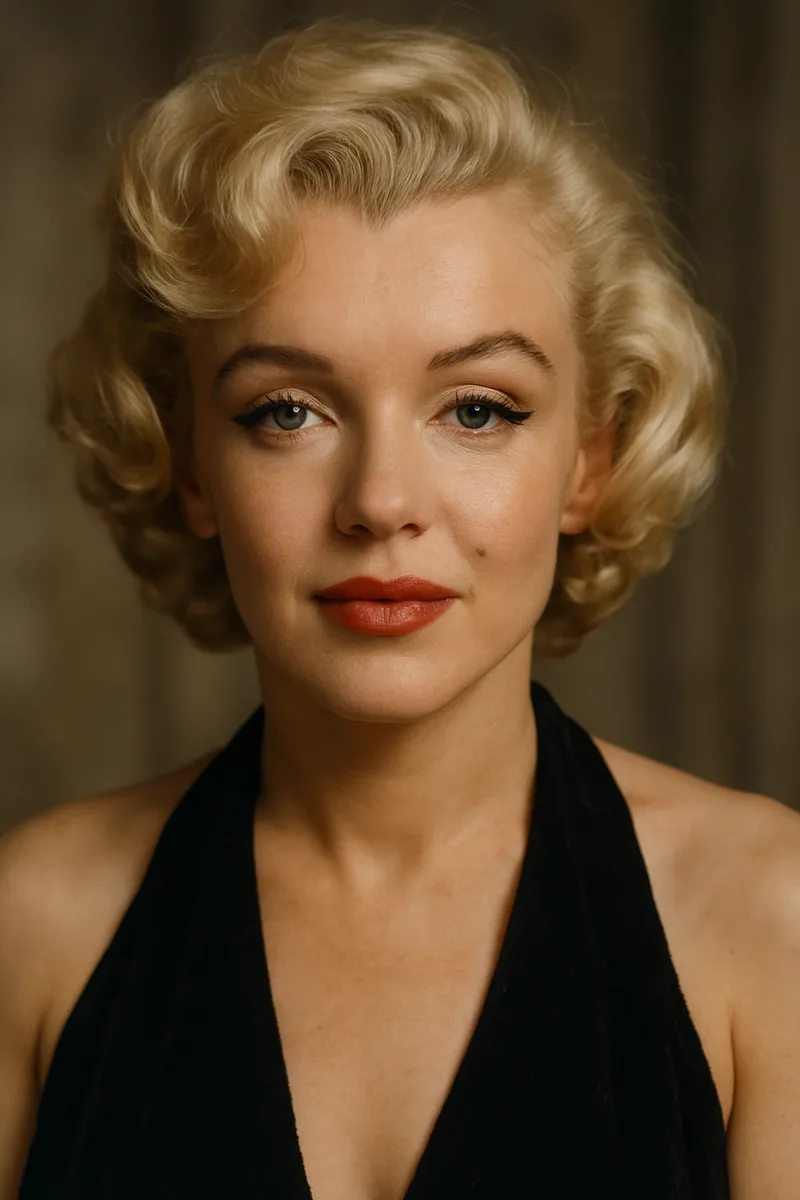
Marilyn Monroe: The Icon Who Was Never Just a Pretty Face
Marilyn Monroe remains the most famous movie star of the twentieth century, a woman whose image transcended Hollywood to become a universal symbol of glamour, vulnerability, and the impossible expectations placed on women. Born Norma Jeane Mortenson in Los Angeles in 1926, she survived a childhood of foster homes and institutional care to become the biggest box-office draw of the 1950s. Behind the breathy voice and the platinum blonde hair was an ambitious, intelligent woman who studied method acting with Lee Strasberg, read Dostoyevsky and Joyce, and fought the studio system for creative control of her career at a time when few actresses dared to try.
Context & Background
Norma Jeane Mortenson was born on June 1, 1926, in the charity ward of Los Angeles County Hospital. Her mother, Gladys Pearl Baker, was a film-negative cutter at RKO Studios who struggled with severe mental illness. The identity of her father was never confirmed. Within two weeks of her birth, Gladys placed Norma Jeane with foster parents, and the girl would spend most of her childhood shuttling between foster homes, an orphanage, and the homes of her mother's friends. Gladys was eventually committed to a psychiatric institution, and young Norma Jeane grew up knowing that the most fundamental human bond - a mother's presence - could not be relied upon.
At sixteen, she married her first husband, Jimmy Dougherty, largely to avoid returning to another foster home. When Dougherty shipped out with the Merchant Marine during World War II, an Army photographer discovered Norma Jeane working at a munitions factory in Van Nuys and photographed her for a morale-boosting magazine spread. The photos led to modeling work, which led to a screen test at Twentieth Century-Fox. The studio gave her a new name - Marilyn Monroe - and began the slow process of manufacturing a star.
Monroe's early years in Hollywood were a grinding education in the industry's treatment of young women. She endured the casting-couch culture, posed for a now-famous nude calendar to pay her rent, and accepted small roles in forgettable films while studying acting on her own time. Her breakthrough came with supporting roles in The Asphalt Jungle and All About Eve in 1950, but it was Gentlemen Prefer Blondes (1953) and How to Marry a Millionaire that made her a global phenomenon.
The public saw a dizzy blonde bombshell. The reality was far more complex. Monroe was deeply insecure about her acting abilities and desperate to be taken seriously as an artist. In 1955, she made one of the boldest moves in Hollywood history: she walked away from her Fox contract, moved to New York, and enrolled in the Actors Studio under Lee Strasberg. The studio heads were stunned. No star of her magnitude had ever defied the system so directly. She returned to Hollywood a year later with a new contract that gave her director approval and the right to make independent films - concessions that were virtually unprecedented for any actor, let alone a woman.
The films that followed included Bus Stop (1956), The Prince and the Showgirl (1957) with Laurence Olivier, and Some Like It Hot (1959) with Jack Lemmon and Tony Curtis, which many critics consider one of the greatest comedies ever made. Her performance in The Misfits (1961), written for her by her then-husband Arthur Miller, revealed a dramatic depth that surprised even her admirers.
Monroe's personal life was as turbulent as her professional life was triumphant. Her marriage to baseball legend Joe DiMaggio in 1954 lasted only nine months, destroyed by his jealousy and her ambition. Her marriage to Arthur Miller - the intellectual's intellectual - lasted longer but ended in a similar pattern of misunderstanding and disillusionment. She suffered multiple miscarriages and desperately wanted children, a longing that echoed her own motherless childhood.
She battled insomnia, anxiety, and depression throughout her adult life, self-medicating with barbiturates and alcohol in an era when mental health treatment was crude and stigmatized. Studios treated her unreliability on set as evidence of unprofessionalism rather than recognizing it as a symptom of genuine suffering. The gap between the radiant public image and the private anguish grew wider with each passing year.
Monroe died on August 4, 1962, at the age of thirty-six, from an overdose of barbiturates. Whether her death was suicide, accident, or something more sinister has been debated endlessly. What is beyond debate is that she was failed by nearly every institution and relationship in her life - the foster system, the studios, her marriages, her doctors - and yet she created performances of genuine artistry that continue to move audiences more than sixty years later.
Monroe was a serious reader who built a personal library of over four hundred books. She read James Joyce's Ulysses, Heinrich Heine's poetry, Freud, and the complete works of Dostoyevsky. She annotated her books carefully, and her marginalia reveal a thoughtful, questioning mind that was nothing like the public persona. She once told a reporter, "I am trying to find myself. Sometimes that is not easy."
She was also politically aware and quietly courageous on racial issues. In 1954, when the Mocambo nightclub in Hollywood refused to book Ella Fitzgerald because she was Black, Monroe personally called the club owner and promised to sit in the front row every night if they booked Fitzgerald. They did, and Ella Fitzgerald later said, "After that, I never had to play a small jazz club again." Monroe's gesture was characteristic - generous, impulsive, and entirely unconcerned with what powerful people might think.