
Søren Kierkegaard
Quotes & Wisdom
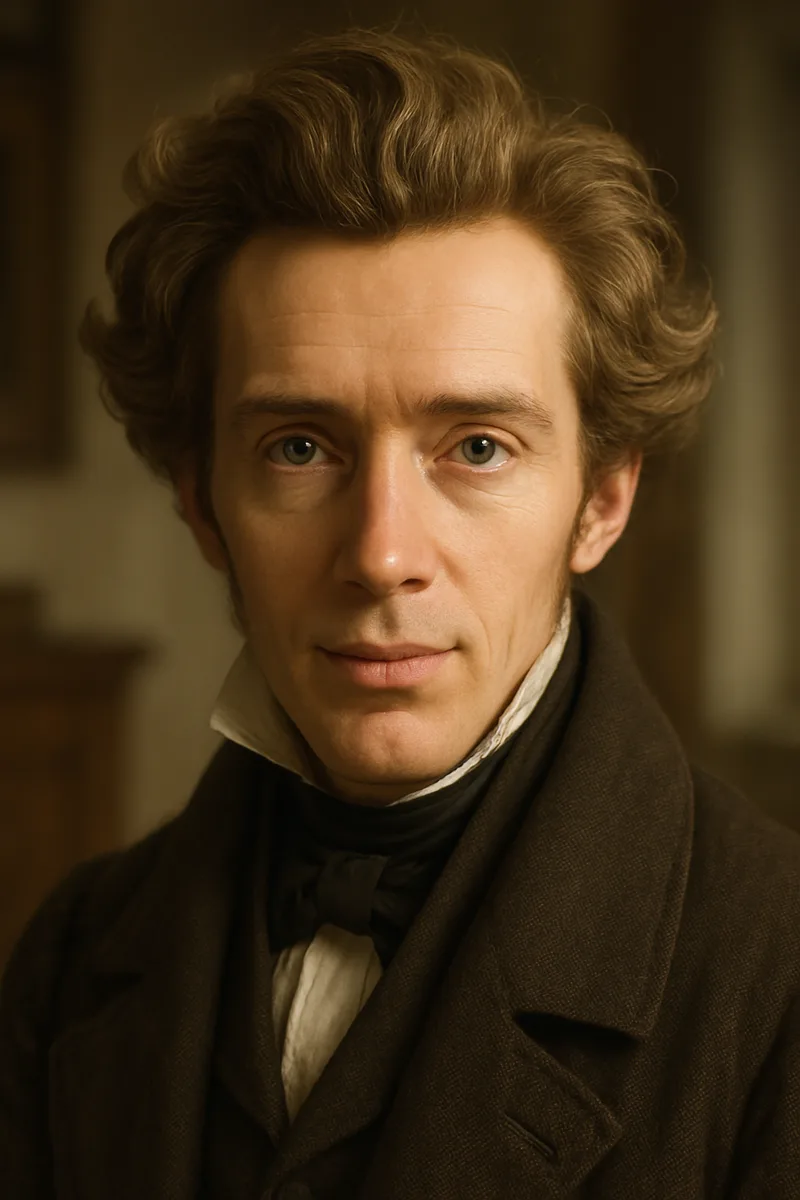
Soren Kierkegaard: The Father of Existentialism
Soren Kierkegaard was the Danish philosopher and theologian who, writing in the relative obscurity of Copenhagen in the 1840s, laid the foundations of existentialism - the philosophical movement that would dominate twentieth-century European thought. In an age when Hegel's vast system claimed to explain everything, Kierkegaard insisted on the irreducible significance of individual existence - the concrete, anxious, choosing self that no abstract system could capture. His explorations of anxiety, despair, faith, and the stages of human existence were written with a literary brilliance and psychological depth that anticipated Dostoevsky, Nietzsche, and Kafka. He published prolifically under both his own name and a dazzling array of pseudonyms, died at forty-two, and was largely forgotten until the twentieth century rediscovered him as one of the most original thinkers in Western history.
Context & Background
Soren Aabye Kierkegaard was born on May 5, 1813, in Copenhagen, Denmark, the youngest of seven children of Michael Pedersen Kierkegaard, a prosperous wool merchant, and Ane Sorensdatter Lund. His father was a formidable and tormented figure - deeply religious, haunted by guilt over a youthful curse against God and an illicit relationship with Ane (who was a servant in the household), and convinced that the family was under divine punishment. Five of the seven children died before their father, seemingly confirming his darkest fears.
Copenhagen in the 1830s and 1840s was a small, provincial capital - the entire population of Denmark was about two million - but it was intellectually lively, dominated by the University of Copenhagen and the Danish State Church. The reigning philosophical influence was Hegelianism, the system of Georg Wilhelm Friedrich Hegel, which claimed to reconcile all contradictions in a grand dialectical synthesis of Spirit. Danish theology, heavily influenced by Hegel, tended to reduce Christianity to a rational, comfortable system of ethics compatible with bourgeois life.
Kierkegaard studied theology at the University of Copenhagen, where he was a brilliant but erratic student, taking ten years to complete his degree. He wrote a massive master's thesis on irony in Socrates, defended it in 1841, and then - in one of the most consequential decisions in the history of philosophy - broke off his engagement to Regine Olsen, the young woman he loved passionately but felt unable to marry. The reasons for this break remain debated: melancholy, a sense of religious calling, the weight of his father's guilt, an inability to share his inner darkness with another person. Whatever the cause, the loss of Regine became the wound around which much of his philosophy crystallized.
Kierkegaard's philosophical project was built around what he called the "stages on life's way" - three fundamental modes of human existence: the aesthetic, the ethical, and the religious. The aesthetic life is organized around pleasure, novelty, and the avoidance of boredom. The ethical life is organized around duty, commitment, and moral responsibility. The religious life is organized around faith - the leap beyond reason into a relationship with the absolute.
These stages were not presented as a neat philosophical system but dramatized through a series of pseudonymous works, each written from the perspective of a different imaginary author. Either/Or (1843) stages a debate between an aesthete and an ethicist. Fear and Trembling (1843) examines Abraham's willingness to sacrifice Isaac as a model of the "leap of faith" that transcends ethical reasoning. The Concept of Anxiety (1844) explores the dizzying freedom that produces human anxiety. The Sickness Unto Death (1849) analyzes despair as the failure to become a self.
The use of pseudonyms was not a game; it was a philosophical strategy. Kierkegaard believed that philosophical truth could not be communicated directly - it had to be experienced, and the reader had to be brought to the point of decision through indirect means. His pseudonymous authors disagree with each other, contradict Kierkegaard's own signed works, and force the reader to choose - to take responsibility for their own interpretation.
Kierkegaard's primary philosophical target was Hegelianism - the claim that reality could be comprehended as a rational, self-developing system. Against Hegel, Kierkegaard insisted that existence could not be captured in a system because the existing individual - the person who must choose, act, suffer, and die - is always left out of any abstract account. "The system is finished," Kierkegaard wrote sardonically, "but the builder has forgotten to include a place for himself to live."
This critique of systematic philosophy made Kierkegaard the forerunner of existentialism. His insistence on the primacy of individual existence, the inescapability of choice, the reality of anxiety, and the impossibility of reducing human life to rational categories was taken up in the twentieth century by Martin Heidegger, Jean-Paul Sartre, Albert Camus, and Simone de Beauvoir - though many of them stripped away the religious dimension that was central to Kierkegaard's thought.
He was equally fierce in his attack on the Danish State Church, which he regarded as a comfortable institution that had domesticated Christianity into something unrecognizable. In the last year of his life, he launched a public campaign against the church, publishing a series of pamphlets called The Moment that accused Danish Christianity of being a fraud. "The Christianity of the New Testament simply does not exist," he declared.
Kierkegaard was a well-known figure in Copenhagen, where his eccentric appearance - thin, slightly hunchbacked, with unruly hair and trouser legs of different lengths - and his habit of walking the streets engaging strangers in conversation made him a local character. He was savagely lampooned in The Corsair, a satirical newspaper, and the experience of public ridicule deeply wounded him.
He was extraordinarily prolific, publishing more than thirty books in fourteen years, many of them running to hundreds of pages. He wrote rapidly, in intense bursts, and financed his publications from his inheritance, which he gradually spent down until he was nearly penniless at the time of his death.
Kierkegaard collapsed on the street in Copenhagen on October 2, 1855, and died on November 11, at the age of forty-two. His funeral became a public controversy when his brother Peter - a bishop in the State Church - presided, despite Kierkegaard's explicit attacks on the institution. His influence was negligible in his own lifetime but grew enormously in the twentieth century, when translations of his work into German, French, and English revealed him to be one of the most profound and psychologically penetrating thinkers in the Western tradition.