
Nelson Mandela
Quotes & Wisdom
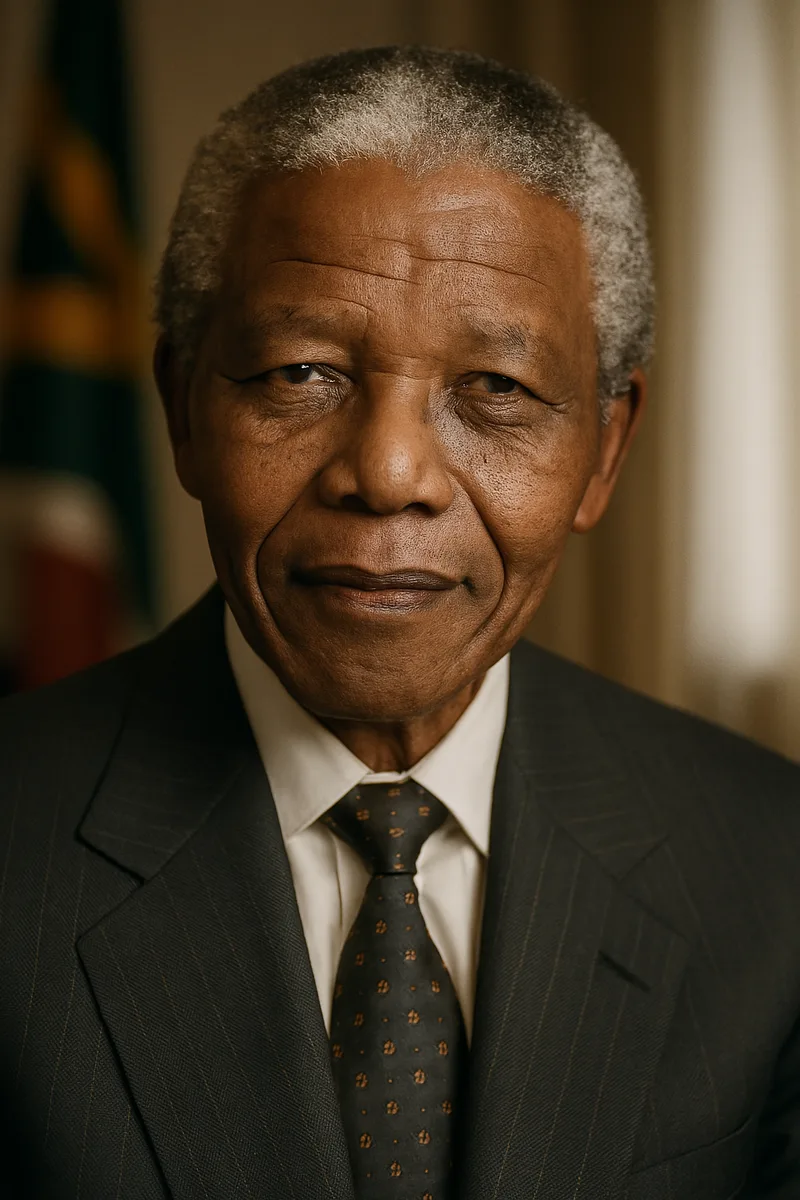
Nelson Mandela: The Prisoner Who Freed a Nation
Nelson Mandela was the anti-apartheid revolutionary who endured twenty-seven years of imprisonment and emerged to lead South Africa through its most perilous transition - from a racist police state to a multiracial democracy - without the bloodbath that the world expected and many feared. Born into the Thembu royal family in the Eastern Cape in 1918, he became a lawyer, an activist, and eventually the commander of the African National Congress's armed wing before his arrest and life sentence in 1964. His release in 1990 and his election as South Africa's first Black president in 1994 represented one of the twentieth century's most extraordinary triumphs of moral courage over institutionalized injustice.
Context & Background
Rolihlahla Mandela was born on July 18, 1918, in the village of Mvezo on the banks of the Mbashe River in the Eastern Cape of South Africa. His father, Gadla Henry Mphakanyiswa, was a chief of the Thembu people and a counselor to the Thembu king. His mother, Nosekeni Fanny, was Gadla's third wife. The name Rolihlahla means, roughly, "pulling the branch of a tree" - colloquially, "troublemaker." A teacher at his Methodist primary school gave him the English name Nelson, as was the colonial custom.
When Mandela was nine, his father died, and he was sent to live in the household of Jongintaba Dalindyebo, the regent of the Thembu people. Growing up in the regent's court, Mandela observed traditional African governance - a system in which the chief listened to all opinions before making decisions, and consensus was valued above authority. This experience profoundly shaped his leadership style: decades later, as president of South Africa, he would listen patiently to every viewpoint in a cabinet meeting before offering his own.
He attended the University of Fort Hare - the only residential higher-education institution for Black South Africans - where he studied law and encountered the ideas of African nationalism. Expelled for participating in a student protest, he fled to Johannesburg to avoid an arranged marriage, completed his degree by correspondence, and enrolled at the University of the Witwatersrand's law school. In Johannesburg, he encountered the full brutality of apartheid - the system of racial segregation that classified every South African by race and allocated rights, resources, and dignity accordingly.
Mandela joined the African National Congress in 1944 and co-founded its Youth League, which pushed the organization toward more aggressive resistance. Through the 1950s, he led defiance campaigns against apartheid laws, organized strikes and boycotts, and practiced law in a partnership with Oliver Tambo - the first Black law firm in South Africa. He initially committed to nonviolent resistance, inspired by Mahatma Gandhi's campaigns in South Africa and India.
The Sharpeville Massacre of 1960, in which police killed sixty-nine peaceful protesters, changed his calculation. The ANC was banned, and Mandela concluded that nonviolent resistance alone could not topple a regime willing to shoot unarmed people. He co-founded Umkhonto we Sizwe (Spear of the Nation), the ANC's armed wing, and traveled to Algeria and Ethiopia for military training. He was arrested in 1962 and, after the Rivonia Trial of 1963-1964, sentenced to life imprisonment.
His statement from the dock at the Rivonia Trial remains one of the most powerful speeches of the twentieth century: "I have cherished the ideal of a democratic and free society in which all persons live together in harmony and with equal opportunities. It is an ideal which I hope to live for and to achieve. But if needs be, it is an ideal for which I am prepared to die." He was sent to Robben Island, where he would spend eighteen of his twenty-seven years in prison.
Mandela's years in prison transformed him from an angry young revolutionary into the patient, strategic leader who would guide South Africa through its transition. He studied Afrikaner history and language, recognizing that any successful negotiation would require understanding the fears and motivations of the white minority. He began secret talks with the apartheid government in the late 1980s, conducted from his prison cell, laying the groundwork for his release and the negotiations that would follow.
He was released on February 11, 1990, after 27 years of imprisonment - an event watched by an estimated one billion television viewers worldwide. The negotiation process that followed was extraordinarily delicate. South Africa possessed nuclear weapons, a powerful military, and a white minority that controlled the economy. Civil war seemed not just possible but probable. Mandela's genius was in persuading both sides that a negotiated settlement was preferable to the alternatives - and his personal moral authority, built through decades of sacrifice, was the indispensable ingredient.
He was elected president in 1994 in South Africa's first fully democratic election. His presidency was defined by reconciliation rather than revenge. The Truth and Reconciliation Commission, chaired by Archbishop Desmond Tutu, offered amnesty to perpetrators of political violence who fully disclosed their actions - a mechanism that prioritized healing over punishment. Mandela's willingness to forgive his jailers, to wear a Springbok rugby jersey at the 1995 Rugby World Cup to unite a divided nation, and to serve only one term before voluntarily stepping down - all of these acts demonstrated a magnanimity that is rare in any leader and almost unheard of in one who had suffered so much.
Mandela was a man of considerable personal charm who used humor to disarm opponents and connect with ordinary people. He was also surprisingly vain about his appearance - even in his seventies, he was fastidious about his clothing and enjoyed the company of celebrities and the attention of photographers. These human qualities, far from diminishing him, made his extraordinary moral discipline all the more impressive. He was not a saint who found forgiveness easy; he was a man who chose forgiveness because he understood that it was the only path to a livable future.
He died on December 5, 2013, at the age of ninety-five. His funeral was attended by nearly one hundred heads of state and government - a testament to his global stature. His legacy is complicated, as all legacies are: South Africa still struggles with inequality, corruption, and the unfinished business of transformation. But the miracle of the peaceful transition - the fact that a country teetering on the brink of civil war chose negotiation over bloodshed - remains Mandela's enduring gift to the world.